Guest lecture by combine Consulting: “Transformative Spaces”
09/04/2019 - Reflect on your requirements and translate them into space.
Reflect on your requirements and translate them into space.
In the seminar “Culture, Work and Aesthetics in Corporate Management” with Prof. Eva-Maria Walker and Andrea Simone Barth, students from the degree programs Business Administration – Rethinking Economics and Sustainable Business explore the significance of aesthetics and aesthetic practices in the leadership and design of organizations. One opportunity for aesthetic design in companies is spatial design. On this topic, the lecturers invited the two consultants Veit Knickenberg and Björn Kitow from the consulting firm combine Consulting and combine design. Both work in the real estate sector and are responsible for the planning and implementation of office concepts and new working environments in companies.
In a keynote presentation, Björn Kitow talks about the work of combine Consulting, their approach to planning and implementing real estate projects, and addresses the changes and spatial requirements of the new world of work. The challenge for architects lies above all in connecting today’s trends with actual user needs. combine focuses on the interaction between users and their environment and asks the question: What does the individual need for work and creativity, and how is this translated into space? Björn Kitow emphasizes that, alongside spatial change, it is also important to consider changes in corporate culture. For this reason, combine supports companies from the very beginning in finding and developing the corporate vision and identity that should become visible in the spaces. They involve all employees early and actively in the transformation process. The consultants also assume that creative solutions and innovations will continue to take place in physical spaces and see their task as creating these places of encounter. It is interesting to see that the industry is increasingly relying on interdisciplinary teams made up of business economists and architects, opening up new job prospects for business students.
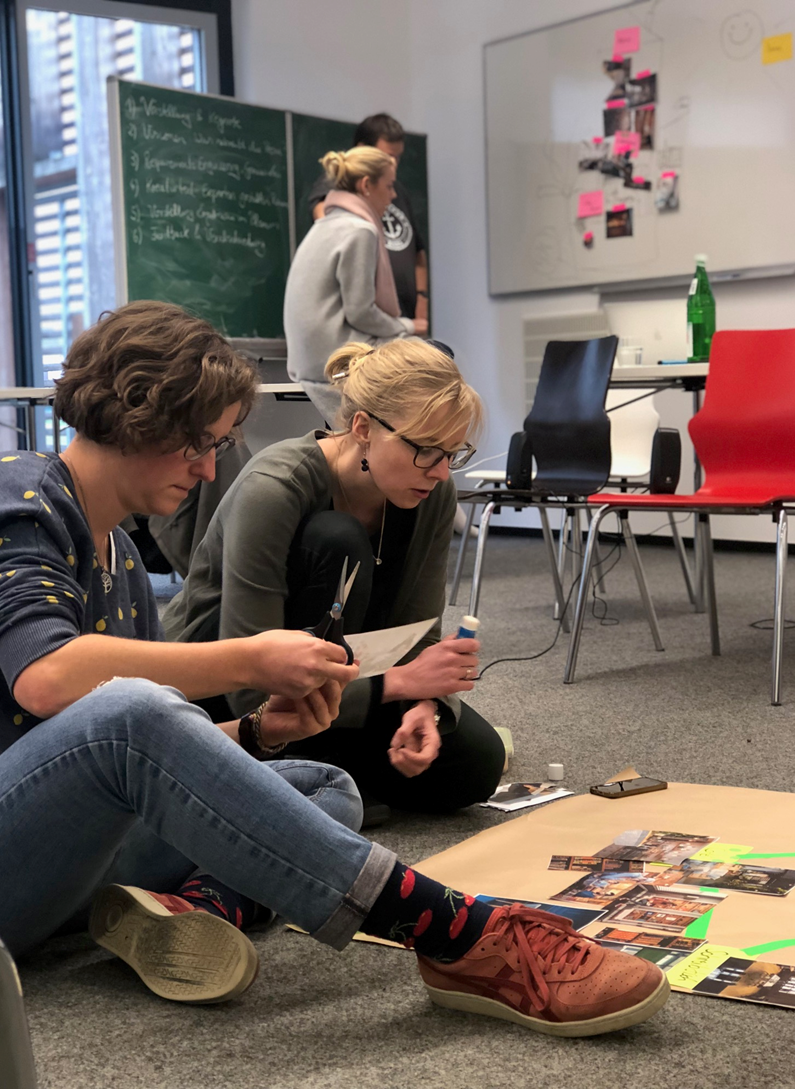
After the informative keynote, the students get to work themselves. The students engage with the question of where they like to work and which places they use for their work. Equipped with visual material, the students create initial office concepts. There is gluing, painting, and lots of laughter. Afterwards, the diverse concepts and ideas are presented and reflected on together. In this 2-hour workshop format, Veit Knickenberg makes it understandable for the students how actual user needs and requirements can be translated into concrete spatial design elements. This brief excursion into practice enabled the students to experience the theoretical content of the seminar for themselves and to better understand the importance of aesthetic and spatial design for corporate management.
At the Department of Business, Andrea Simone Barth conducts research on new workspaces in companies. In a qualitative study, she investigates the meanings associated with workspaces and the effects that new office concepts have on organizational life.