Childhood Education – a broad spectrum of career opportunities
25.11.2019 - An experience report on the event “Blickpunkt Praxis”
An experience report on the event “Blickpunkt Praxis”
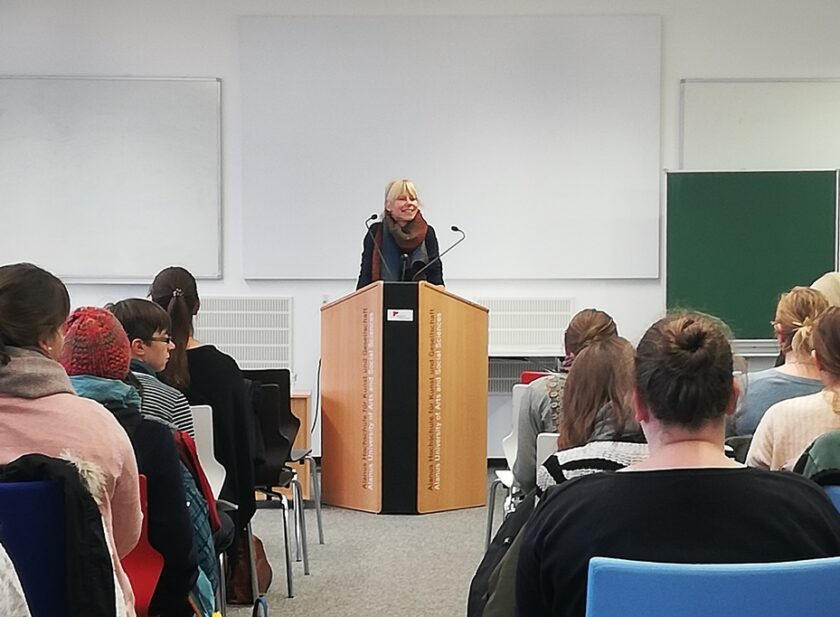
For the second time, the event “Blickpunkt Praxis” offered us students in the part-time and full-time Childhood Education degree program an insight on 12.11.2019 into the wide range of professional prospects open to us after completing our studies.
Following a welcome by institute director and professor Janne Fengler, Norbert Hocke, educator, social pedagogue and member of the Education and Science Union, spoke about the beginnings of Childhood Education degree programs in Germany. He traced developments from 2004, when the Childhood Education degree program was launched for the first time at Alice Salomon University of Applied Sciences Berlin, to the present day, where academically qualified staff have become indispensable in pedagogical fields of practice due to the increasing institutionalization of childhood. Following this highly informative lecture, Dagmar Scharfenberg and Pauline Degenhardt, representing the Association of Waldorf Kindergartens, gave a lively overview of the diverse future prospects for childhood educators in the field of Waldorf kindergarten education. In her contribution, Gitte Janosch-Schneider, head of the Protestant Family Center Porz, described the supporting pillars of a family center as well as her areas of responsibility as facility manager. This was followed by a lecture by Anita Sonntag, head and lecturer at the Waldorf Kindergarten Seminar Cologne and manager of a Waldorf kindergarten. She informed us about the opportunities for childhood educators to work as lecturers and speakers at seminars, vocational colleges, and in family education. Markus Pütz, head of department at the CJG Hermann-Josef-Haus, then provided a comprehensive insight into residential child and youth welfare services. The morning concluded with vivid accounts from Silvia Franken, who spoke in greater detail about the professional field of educational specialist consulting.
In the afternoon, there was an opportunity to move between a total of five forums led by various experts from professional practice. The career fields presented included socio-educational family support and outreach family work, inclusion and early intervention, as well as all-day open schools and integration assistance; work at the youth welfare office and the path to an academic career were also presented.
It was a day full of new and exciting impressions. What doors are open to us as childhood educators after completing our studies? How is our professional profile perceived by representatives of the various fields of work? There was an opportunity to exchange ideas with experts from professional practice, including some alumni from previous Alanus Childhood Education cohorts. Alongside the euphoric feeling that, in light of the acute shortage of skilled workers, the whole world was open to us as childhood educators, the “downsides” of our profession also became clear. For example, questions regarding the still unresolved collective wage classification and the positioning of us childhood educators as academically trained professionals were discussed. It became apparent that the profession of “childhood educator” is still a relatively young academic field. Consequently, it is not yet especially well known. Nevertheless, there are numerous opportunities to take on very different fields of work within early childhood and childhood education. It is up to us, as future childhood educators, to continue establishing the professional profile of “Childhood Education” in Germany – a challenging and exciting task at the same time.