Annual Conference of the Institute for Social Organics
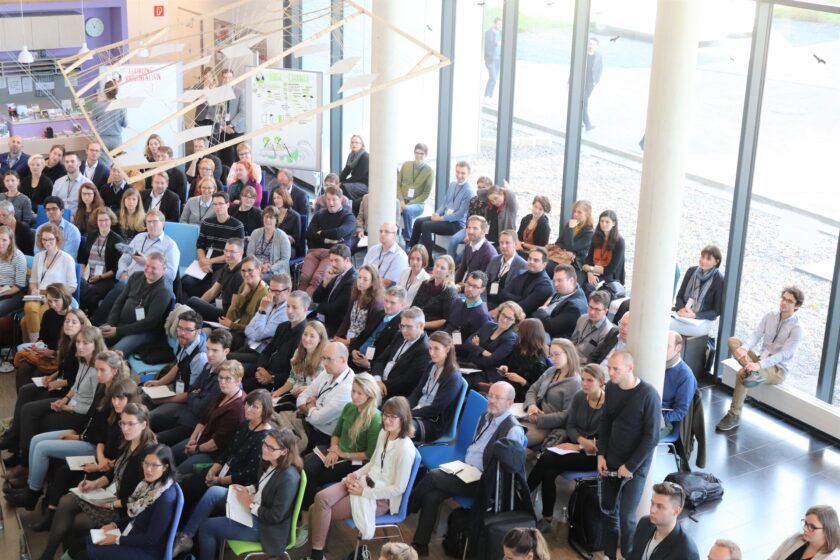
Lectures, workshops, artistic experiences: The Institute for Social Organics at Alanus University of Arts and Social Sciences in Alfter near Bonn offered a diverse program at its annual conference on November 7, 2018, under the theme “Leadership in Crisis(es) – on the Art of Recognizing Opportunities,” attended by more than 180 interested participants from business, academia, and the arts.
<iframe title="Review of the 2018 annual conference of the Institute for Social Organics at Alanus University" width="560" height="315" src="https://www.youtube.com/embed/jwASByCgAbw" frameborder="0" allow="accelerometer; autoplay; encrypted-media; gyroscope; picture-in-picture" allowfullscreen></iframe>
How can we guide companies safely through crises? What development steps are necessary in order to understand and use crises as opportunities? With these questions, Prof. Dr. Götz E. Rehn, head of the Institute for Social Organics and founder and managing director of Alnatura, opened the conference.
In his practical and inspiring lecture “Crisis as Opportunity,” Rehn addressed the challenging situation in which companies currently find themselves. A lack of trust in politics, new technologies, and the growing desire for greater flexibility require not only technical but above all social innovations. In the hope of finding ways to deal with the situation more effectively, new forms of collaboration and corporate leadership are already being tested in many places.
However, the transformation that must be managed can at times take on the character of a crisis, as Rehn knows from personal experience. He spoke about crisis situations at Alnatura and how the company was able to use the crisis as opportunities.
In her keynote “Leadership in Crisis Situations,” Daniela Lesmeister spoke about her daily leadership work as head of the North Rhine-Westphalia police. A ‘command and control’ leadership style, according to Lesmeister, is unavoidable in this job, because in emergencies and crisis situations there is simply no time for grassroots democratic consensus-building. In such situations, it is necessary for decisions to be made quickly and clearly. These are made by the highest-ranking person in the hierarchy in order to create clear accountability and avoid discussion. The challenge of ensuring that managers live up to this high level of responsibility and do not abuse their position of power is addressed in the police force through excellent training as well as ongoing professional development and reflection for managers.
In the subsequent keynote “Only the Sky Is Higher – Mastering Challenges,” extreme mountaineer Helga Hengge spoke about how she repeatedly has to overcome herself when climbing the highest mountains, and what helps her in confronting physical and emotional extremes. One’s inner attitude is especially important here: it is about not fighting against the mountain/the challenge/fate, but about trusting. She learned this from the Sherpas who accompany her on her tours. They place everything in the hands of ‘Mother Earth’ and trust that she will take care of everything. For example, she sends storms precisely when the team needs to rest in order to prepare for the ascent. When faced with the most difficult challenges, one should also not focus on what still lies ahead, such as the difficult climb to the summit, but on everything one has already accomplished and achieved. With this mindset, one can overcome upcoming difficulties and surpass oneself.
In the afternoon, Annemarie Ehrlich, founder of the Institute for Eurythmy in Working Life, made the interaction of word and movement directly and impressively tangible for the participants in a shared artistic experience. In various short reflections, the participants practiced focusing on what is essential and coordinating language and movement together.
Afterwards, participants discussed in five parallel workshops with representatives from business practice how leadership can succeed in crises.
Based on PREMIUM’s many years of experience, the workshop “Consensus-Based Corporate Leadership” by Gregor May, who has taken on various tasks for the collective since 2014 and is currently active for the collective with lectures and workshops, focused on the theory and practice of consensus-building in a business context. Consensus democracy, the conscious non-hierarchical and joint decision-making process involving all those directly affected, is an essential part of the way PREMIUM works. This results not only in smarter but generally also more socially responsible decisions, because all needs and concerns are brought into the process, according to May.
The workshop “Complex Does Not Mean Complicated,” by Pia Heinze and Backo Schönfeld, both of whom work as Scrum Masters at sipgate GmbH, offered not only insights into sipgate’s work philosophy but also a very practical experience of how systemic principles can be applied to leadership.
In their workshop “Self-Management in Crisis Situations,” Tom Andreas, coach at his own institute, and Eckhard Münch, social scientist and coach, explored the question of how we can navigate chaos and find meaning. Drawing on personal experience, participants were invited to better understand their own patterns through a practically guided self-reflection and to explore individual ways of dealing well with ongoing change.
In the workshop “Effectiveness Instead of Ego Trip – from Decision-Maker to Advisor,” Stefan Mayer, head of branch sales at Alnatura, spoke about his experience with the constant change in his leadership role within the company Alnatura.
In the workshop “Crisis as an Opportunity for a New Beginning – Elderly and Nursing Care in Teams and at Eye Level,” Andreas Klein, managing director of CareTeam, spoke about the hurdles involved in transforming organizations and the healthcare system. CareTeam’s goal is to revolutionize nursing care in Germany. While in recent decades patients as people have been neglected and turned into “customers” to whom products are sold without building a personal connection, CareTeam wants to eliminate the fragmentation of care by enabling self-managing teams to design meaningful processes that take patients seriously as human beings.
At the end of the day, participants were able to distill the essence of the conference in a dialogue with changing conversation partners. To this end, key insights were discussed on the basis of three reflection questions, and the results were recorded in writing or sketch form on paper tablecloths. In this way, the diverse experiences could be processed once again, discussed, and connected with one another.
On November 14, the Institute for Social Organics will hold this year’s annual conference at Alanus University in Alfter on the occasion of the centenary of Rudolf Steiner’s threefold social order idea.