Five Questions for Frederic Bettini
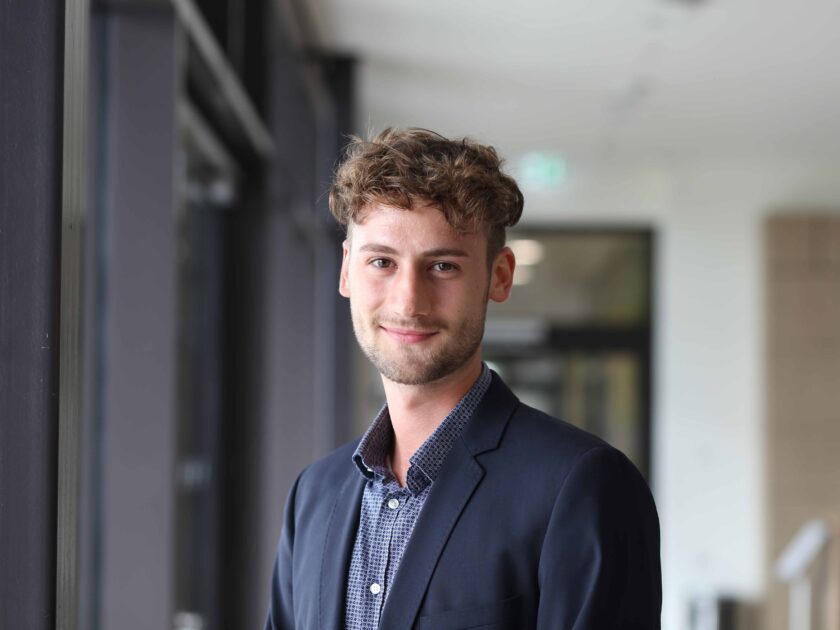
03.09.2019 - Frederic Bettini studied ‘Business Administration – Rethinking Economics’ at Alanus University until 2017. He now works at the ‘Frankfurt School-UNEP Centre for Climate & Sustainable Energy Finance’. In the autumn semester, Bettini returns to the university as a guest lecturer and provides insights into his field of work, ‘Climate Risks in the Financial Sector’.
Frederic Bettini studied ‘Business Administration – Rethinking Economics’ at Alanus University until 2017. He now works at the ‘Frankfurt School-UNEP Centre for Climate & Sustainable Energy Finance’. In the autumn semester, Bettini returns to the university as a guest lecturer and provides insights into his field of work, ‘Climate Risks in the Financial Sector’.
1. What did you study at Alanus University, and which particular impressions have stayed with you?
From 2014 to 2017, I studied ‘Business Administration – Rethinking Economics’ at Alanus University. I completed my practical phases with my practice partner dm-drogerie markt. I look back on my time studying very fondly. My fellow students and I had a lot of fun. During that time, I got to know many kind, likeable, and down-to-earth people. What was especially memorable was the intensive, profound, and witty exchange with the other students. Of course, I also remember some lectures and artistic workshops very fondly. But the most defining aspect of my time studying was the sense of community with the other students.
2. What was your favorite course/seminar?
I most enjoyed listening in the courses taught by Susanne Blazejewski, Professor of Sustainable Organization and Workplace Design, because the insights I gained there helped me move forward in many ways. Looking back, I wish I had carried my diary with me at all times and taken notes. However, I received better grades in mathematical subjects such as Investment & Finance or external accounting, which is why I also became enthusiastic about these areas. I also really enjoyed the lecture series Social Banking/Finance.
3. What new experiences did you gain over the course of your studies?
Where should I even begin? I learned a great deal during my studies. I am only 24 years old, but sometimes I feel much older. Alanus University helped me learn for life. I developed tremendously; many others never do this, or only much later. An important message for me is the favorite quote of Götz Werner: ‘Working time is lifetime.’ Work takes up so much time in life that one should by all means avoid doing a job one is not convinced of with all one’s heart. On the other hand, I also learned that a university environment can tempt you to become somewhat ‘detached from reality.’ ‘Real’ work shows that reflection and critical thinking are important, but they are not everything when it comes to advancing.
4. What are you doing now?
Since 2017, I have been working at the Frankfurt School-UNEP Collaborating Centre for Climate & Sustainable Energy Finance. The goal of the FS-UNEP Centre is to advance public- and private-sector investment in the climate field. I work in the Sustainable Finance Team: one goal is to get the financial market to correctly price and disclose climate risks. Climate change brings certain risks with it: if it does not rain for two months, crops fail. If drought causes the water level to drop, a nuclear power plant may no longer be able to draw cooling water from the river. If policymakers decide to address the issue with a certain degree of consistency, regulatory uncertainties can also arise. And finally, consumer demand behavior can change if awareness is high enough. If such risks materialize, they affect the financial markets, whose approach to risk management usually looks only a few years into the future. We help various stakeholders—banks, insurers, asset managers, regulators, and not least civil society—to better assess and manage these risks.
5. In the autumn semester of 2019, you are coming to Alanus University as a guest lecturer. What will you teach the students, and what would you like to pass on to them?
When I started my work in Frankfurt, I thought Sustainable Finance was just a small niche. Of course, the topic has still not reached the mainstream, but more and more people are engaging with it. This field needs unconventional thinkers and people who enjoy business and sustainability topics. I want to convey to the students that there is currently a great deal of momentum in this field and that it is an area that sounds much drier than it actually is. Just because finance is in the title does not mean you have to be a math genius. Apart from that, the topic of climate risks in the financial sector is very interesting. Even if you do not want to work in this area, it is still good to know what it is about.
 © Soryna Reusswig