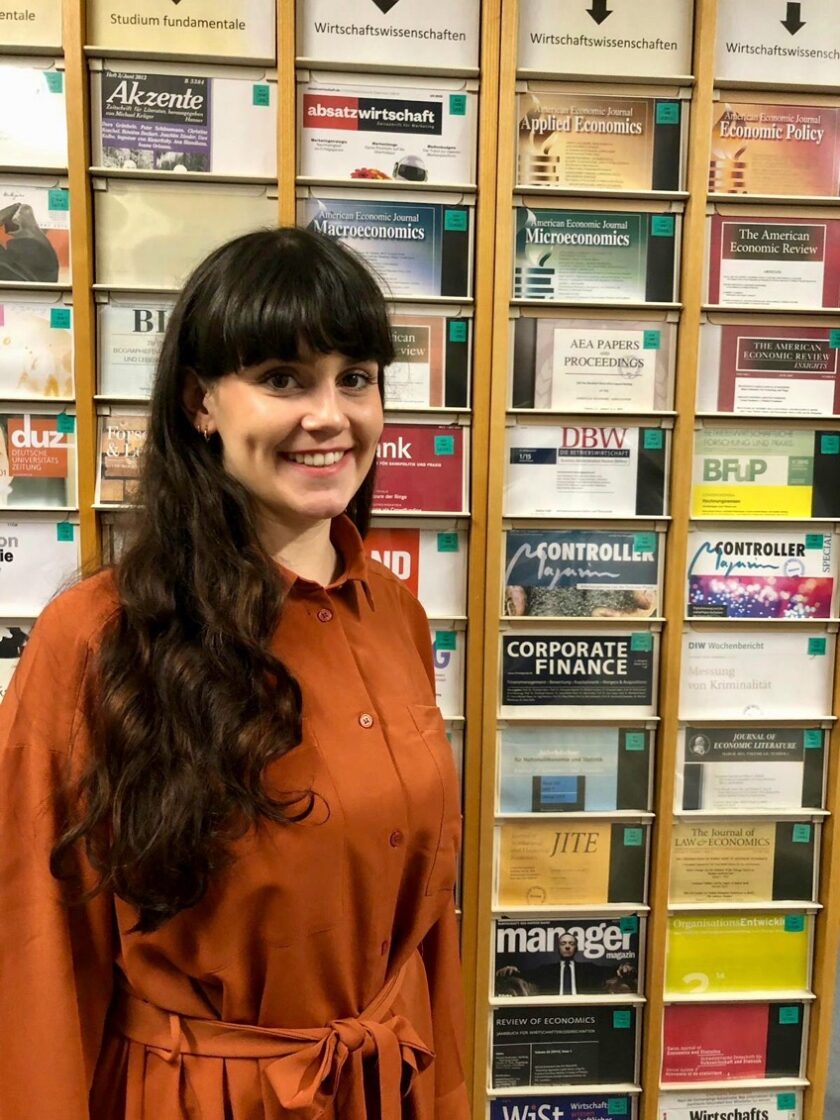
Interview with our alumna Klara Elif Jungermann
13.12.2019 - Klara works as a Senior Associate at PwC and is studying for her second master's degree alongside her job.
Klara works as a Senior Associate at PwC and is studying for her second master's degree alongside her job.
Where am I & what am I doing?
After completing my bachelor’s degree in Business Administration – Rethinking Economics at Alanus University, I decided to go into auditing and have been working for just over four years at the Cologne branch of PricewaterhouseCoopers GmbH Wirtschaftsprüfungsgesellschaft. My employer offers many different exciting fields of work. I am now a Senior Associate and, together with my colleagues, I primarily audit internal control systems as well as consolidated and annual financial statements in accordance with HGB (German Commercial Code) and IFRS (International Financial Reporting Standards).
In October 2018, I began a second master’s degree alongside my job and am studying Philosophy, Politics and Economics at Witten/Herdecke University.
I enjoy my work in auditing for various reasons. On the one hand, it requires sound specialist knowledge. Since the world, its accounting regulations, and the IT landscape are constantly evolving, I learn new things every day. Different clients and different companies continually give me new insights into operational business activity. This constantly gives me new perspectives—not only on specific technical matters, but especially on the economic system as a whole.
Apart from the wide range of subject-related aspects and the constant development of my individual professional profile, I particularly value the social aspects of my work. I was able to take on responsibility early on and can work very independently. I also travel a lot and repeatedly get to know new and exciting people as a result.
I enjoy working in and with changing teams. Because of the project-based nature of my work, organizational aspects are especially crucial within audit planning. No one here rigidly focuses only on their own tasks—quite the opposite: we work closely together as a team, communicate a great deal, and support one another. I am also able to pass on my knowledge and experience to new colleagues. I enjoy that, especially because the questions that arise repeatedly prompt me to reflect on my own work.
How did I get here?
In October 2015, I started as an Associate in auditing at PwC, immediately after completing my bachelor’s degree in business administration at Alanus University. Especially against the background of my specialization in Social Banking and Social Finance, I wanted to explore the question of how transparency and trust are created in the economy for society. In addition, I was fascinated then, as I still am today, by finance and financial instruments.
During my practical phases at Alanus University, I worked in the treasury department at Globus in St. Wendel. It was there that I first came into contact with risk management, hedging, and derivative financial instruments. I then wrote my bachelor’s thesis on hedging temperature-induced business risks through weather derivatives. Afterwards, I really wanted to know how such instruments can be audited.
Starting my career changed a great deal for me. I met many impressive personalities who supported me and taught me a great deal. In my private life, I was able to travel to many interesting countries. This repeatedly allowed me to place my professional work in a new context. In particular, I was able to relate it to the economic reality I encountered during my travels and during my voluntary work abroad. As a result of this process, in 2016 I decided to pursue questions of development policy and development economics in a master’s degree alongside my job. Looking back, this step was important for me because in this degree program I learned the necessary foundations to apply my financial knowledge to social issues in a well-grounded way. After completing this master’s degree and following my promotion at PwC, I began my current degree program at Witten/Herdecke University. There, I still focus strongly on development economics and specifically on the use of financial products to reduce social inequality in developing countries.
What makes me especially happy is the combination of professional practice and theory. At first glance, the content of auditing, development economics, and philosophy appears very different. For me, however, it is precisely at the intersections of these fields, from a more systemic perspective, that incredibly exciting synergies emerge. After all, questions relating to transparency, stability, and growth, as well as ideas for effective regulatory measures and the interplay between market, state, and civil society, are timeless and always relevant.
How did my time at Alanus University shape me?
My time at Alanus University showed me how important it is to keep looking beyond one’s own horizon and to question one’s own actions in terms of society as a whole. It also encouraged me to confidently do what makes me happy. This can be attributed to various factors. On the one hand, I experienced not only the social environment at Alanus University, but especially its intellectual orientation, as very free, diverse, and inspiring. Conformity was not required. This allowed me to experiment and develop freely during my bachelor’s studies—a privilege for which I am very grateful.
Through the unique combination of artistic, anthroposophical, humanities-based, and business-related content, new worlds and paths kept opening up during my business studies. The Studium Generale was like a lucky dip for me. I have never been to the theater as often again as I did during my bachelor’s studies. When I manage to go today, I miss the reflection on the performance afterwards, which was professionally guided by acting students and my former lecturer Bernd Dreßen.
What is unique for me is that very different personalities come together at Alanus University. As a business student, for example, I had the opportunity in the artistic tandem project to work with two eurythmists and the impressive Mary Bauermeister. I will never forget this wonderful experience for the rest of my life. Exploring the characteristics of creative processes in our art modules also taught me to remain calm and confident in my daily work, even when the goal seems unattainable or can only just be made out. Et hätt noch emmer joot jejange.
Despite all the diversity, at Alanus University I was always able to pursue my specific subject-related interests in terms of content—for example, my interest in derivatives. Here, my Professor Gregor Krämer in particular supported me and eventually supervised my bachelor’s thesis. In addition, my specialization allowed me to approach the topic of a sustainable financial sector. Personally, I consider engaging with Social Banking and Social Finance not only exciting, but also necessary and very timely. In my view, the opportunity to work precisely on these topics is definitely a distinctive feature of Alanus University. My former professor Silja Graupe sparked my enthusiasm for the history of economic ideas and political economy. In this respect, my time at Alanus University laid the foundation for my current master’s studies.
My cooperation partner Globus also gave me a great deal of freedom, allowing me to repeatedly bring theory and practice together in new ways. During my first practical phase, for example, I worked operationally in sales—where unforgettable scenes took place.
In the second semester, I then conducted a customer survey on sustainable consumer behavior, subsequently helped out at the Globus Foundation, and finally found my way into liquidity management and the treasury department. At every stage so far, I have encountered many impressive personalities, true one-offs, strong women, and role models. My bachelor’s studies in Alfter set this path in motion. That is why I would not trade the three years at Alanus University for anything.