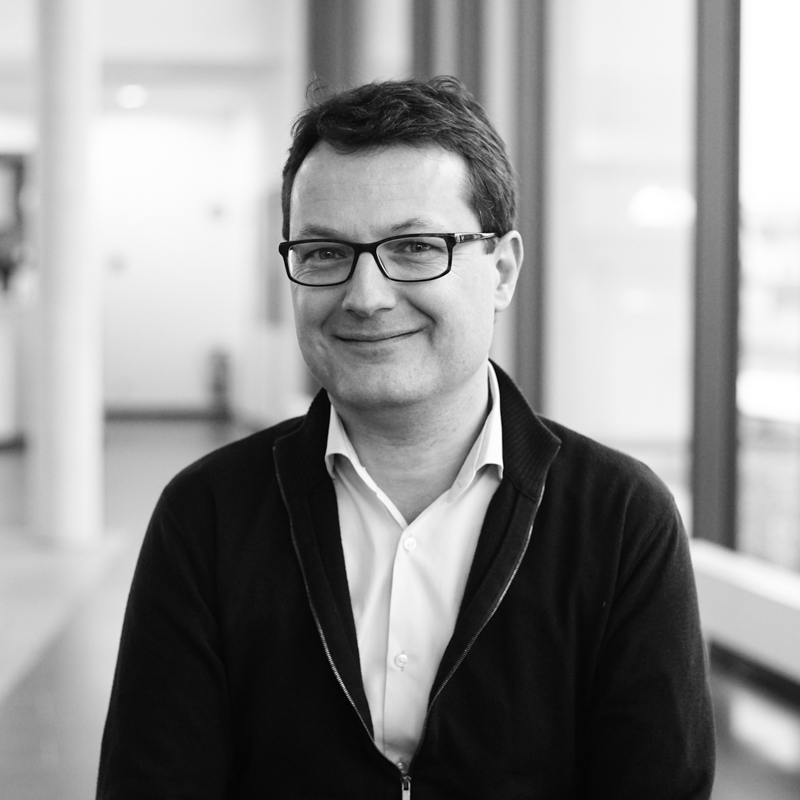
Prof. Dr. Sascha Liebermann
Professor of Sociology, Head of Department and Head of the B.A. PhASE / Chair of the Senate
Department of Philosophical and Aesthetic Education, Faculty of Educational Sciences. Research focus:
- Methodology and methods of case-reconstructive research, especially Objective Hermeneutics
- Educational processes
- Socialization
- Family sociology
- Social state
- Welfare state, with a focus on Universal Basic Income
- Theory of professionalization
- Political sociology
- Sociology of work
- Community and society
Phone: 02222 93211534
Office hours: Consultation hours by appointment
CV
Since 2021 Head of the Department of Philosophical and Aesthetic Education
2021 (May to July) Visiting Professorship at the Freiburg Institute for Basic Income Studies (FRIBIS), Albert Ludwig University of Freiburg
Since 2020 Chair of the Senate
Since 2020 Member of the Senate
Since 2016 Member of the Deutschlandstipendium Selection Committee
Since 2015 Member of the Evaluation and Research Committee, Head from 2017-21 (together with Prof. Dr. Stefanie Greubel)
2015-18 Member of the Equal Opportunities Committee
2014-18 and since 2020 Member of the Senate
Since 2014 Evaluation Officer of the Department of Philosophical and Aesthetic Education
Since 2013 Professor of Sociology, Alanus University of Arts and Social Sciences, Department of Philosophical and Aesthetic Education
2011-13 Visiting Scholar, ETH Zurich (Prof. Dr. Theo Wehner)
2010-13 Research Associate (part-time, project lead), Faculty of Social Science, Ruhr University Bochum
2009-2013 predominantly domestic work
2007-08 Research Associate, Institute for Educational Diagnostics (then in Rösrath, now in Siegburg)
2001-07 Research Assistant at the same institute
1999-2001 Research Associate, Faculty of Economics and Social Sciences, Chair of Sociology, especially Sociology of Work (Prof. Dr. Hartmut Neuendorff), TU Dortmund University
1996-99 Scholarship holder of the graduate funding program of the Konrad Adenauer Foundation
1995-2001 Dr. phil.: Doctoral candidate in the Faculty of Social Sciences at J.W. Goethe University Frankfurt am Main (Prof. Dr. Oevermann, Prof. Dr. Hansfried Kellner; doctoral procedure opened in 1999)
1989-95 – Magister Artium: Studies in Philosophy (major), Sociology and Psychoanalysis at J.W. Goethe University, Frankfurt am Main (Prof. Dr. Heinz Röttges)
Further Activities
Third-party funded projects and reports
1999 – 2001 // Collaboration in the subproject Conduct of Life under Pressure to Normalize – Discontinuities in Employment Biographies: Forms of Their Practical Coping and Patterns of Their Interpretation (Prof. Dr. Hartmut Neuendorff), DFG Research Group “Normalism” (Speaker: Prof. Dr. Jürgen Link), University of Dortmund
2001 // Co-author of the project report of the same title together with Hartmut Neuendorff, Ute Fischer, Caroline Großer and Thomas Loer
2000 – 2003 // Collaboration in the research network Desolidarization, funded by the state of North Rhine-Westphalia, – Prof. Dr. Hartmut Neuendorff (Dortmund), Prof. Dr. Wilhelm Heitmeyer (Bielefeld University) and Prof. Dr. Peter Strohmeier (Bochum University)
2010 – 2013 // Project lead (part-time) “Solidarity and political communalization. A study on habitus formations and patterns of interpretation in the public discussion on an unconditional basic income in Germany and Switzerland”, Ruhr University Bochum, project cooperation and funding by Prof. Theo Wehner, ETH Zurich
Further activities
Reviewer for Sozialer Sinn. Journal for Hermeneutic Social Research
Reviewer in educational and youth welfare services
Teaching and continuing education at universities in Germany (TU Dortmund, J.W. Goethe University Frankfurt) and Switzerland (University of Zurich, University of Applied Sciences and Arts Northwestern Switzerland). Continuing education courses in case analysis in Germany, Switzerland and Austria.
Consultant Editor of Basic Income Studies, De Gruyter
Co-founder (2001) and board member (2001-2007) of the Institute for Hermeneutic Social and Cultural Research e.V., Frankfurt am Main
Co-founder (2003) and active member of the initiative Freedom Instead of Full Employment
Supervised doctoral projects
Hendrik Muijsson: Working title: “Patterns of interpretation of family in ‘activating social policy’. Crisis management in the familial triad between structural requirements and technocratic overdetermination”
Juliane Wegner: “The unavoidable conflict of the entrepreneurial family – a structural-hermeneutic analysis of the emergence of destructive conflict dynamics in a particular type of family” (completed)
Andreas Zäh: “Generational patterns of interpretation of gainful employment – A study on the significance of gainful employment and forms of professional self-proving efforts among people born between 1985 and 1995 in Germany” (completed)
Publications (Selection)
Book
(2002): The Crisis of the Work Society in the Consciousness of German Business Leaders. An Analysis of Patterns of Interpretation, Research Contributions from Objective Hermeneutics, Volume 4. Edited by Ulrich Oevermann, Roland Burkholz, Christel Gärtner and Ferdinand Zehentreiter, Frankfurt: Humanities Online
(2015): From the Spirit of Democracy: Unconditional Basic Income, Frankfurt: Humanities Online
Articles
(with Ute Luise Fischer and Caroline Großer)(2002): “The Persistence of Patterns of Interpretation – Problems of Action and Employment-Related Patterns of Interpretation under Conditions of Transformation in Saxony”, Journal für Psychologie, vol. 10, issue 3, pp. 249-278
(with Thomas Loer) (2010): “‘Superfluous’, ‘Excess’, ‘Dispensable’ – Gaps in Constitutional Theory, Diagnostic Shortenings”, sozialersinn. Journal for Hermeneutic Social Research, issue 1 (2009), pp. 153-179
(2016): “Autonomy and Responsibility in Higher Education. On the Discussion about Mandatory Attendance“, in: sozialersinn. Journal for Hermeneutic Social Research, issue 1 (2016), pp. 143-163
(2018): “Unconditional Basic Income – Risky Experiment or Further Development of the Welfare State in the Spirit of Democracy?”, Politisches Lernen, journal of the German Association for Political Education NRW, H 1-2
(2023): “Underrated Present. Unconditional Basic Income as a Response to the Structural Contradiction Between the Civic Community and the Society of the Gainfully Employed”, in: Journal for Public Economy and the Common Good, 46 (2) 2023, pp. 211-232
Book chapters
(2009): “Political Communalization and the Autonomy of Citizens. Sociological Reflections on the Relationship Between Political and Economic Citizens”, in: Market, Human Being and Freedom. Business Ethics in Debate, ed. by Markus Breuer, Philippe Mastronardi and Bernhard Waxenberger, Bern: Haupt-Verlag, pp. 151-173
(with Thomas Loer)(2010): “Autonomy in Counseling – Promote, Inhibit or Erode?”, in: Stefan Busse, Susanne Ehmer (eds.). Do We Know What We Are Doing? Advisory Practice in Supervision and Coaching, series: Interdisciplinary Counseling Research, Göttingen: Vandenhoeck & Ruprecht, pp. 166-191
(2012): “Manifold Possibilities, Peculiar Obstacles –Basic Income in the German Debate”, in: Basic Income Worldwide. Horizons of Reform, ed. by Matthew C. Murray and Carole Pateman, forthcoming with Palgrave Macmillan – International Political Economy Series, pp. 173-199
(with Thomas Loer) (2015): “Exploring the World and Liberating the Mind. How Do We Shape the University in the 21st Century? A Sketch. In: The Task of Education. Prospects for the University, ed. by Philip Kovce and Birger Priddat, Metropolis-Verlag, pp. 175-193
(2016): “The Self-Misunderstanding of the ‘Work Society’ or on the Structural Commonality of Democracy and Unconditional Basic Income”, in: Unconditional Basic Income – Theory and Practice in Germany and Europe, Dortmund Political-Philosophical Discourses Vol. 14, ed. by Thomas Meyer and Udo Vorholt, pp. 63-85
(2018): “Challenge to the Understanding of Work Through an Unconditional Basic Income”, in: Vedder, Günther et al. (eds.): Organization of Work and Work-Integrated Continuing Education, Institute for Interdisciplinary Labour Science, Leibniz University Hannover
(2019): “‘…I would like to be independent…’. Autonomy in the Public Discussion on an Unconditional Basic Income. An Exemplary Analysis of Patterns of Interpretation”, in: Funcke, Dorett; Loer, Thomas (ed.): From Case to Theory. On the Path of Reconstructive Social Research. Wiesbaden: Springer VS, pp. 255-288
(2020): “From Marginal Idea to Contested Alternative. Recent Developments and Main Arguments in the German Debate”, in: Caputo, Richard/ Liu, Larry (Hrsg.): Political Activism and Basic Income Guarantee: International Experiences and Perspectives: Past, Present, and Near Future, Palgrave MacMillan
(with Hendrik Muijsson) (2020): “Familial Communalization or Care Arrangement? Patterns of Interpretation of Family in the Public Discussion and Among Parents of a Two-Year-Old Child”, in: Funcke, Dorett (ed.): Reconstructive Couple and Family Research, Wiesbaden: Springer VS
(with Ute Fischer) (2024): “On the Significance of Non-Standardized Methods in Research on Unconditional Basic Income”, in: Care & Gender – Potentials and Risks of Universal Basic Income (UBI), Studies of the Freiburg Institute for Basic Income Studies (FRIBIS) at Albert Ludwig University of Freiburg. Freiburg Institute for Basic Income Studies Annual Conference 2023. Zurich: LIT, pp.289-322. (open access see here)
Here you can find further publications.
Dates
Research Workshop
The event offers a forum for the analysis of data using the methods of Objective Hermeneutics and is aimed in particular at those writing theses or conducting research projects, but is also open to anyone interested. Data types that can be analyzed include interview transcripts, interaction transcripts (e.g. from classroom research, therapeutic settings, etc.), speeches, letters, text types of any kind, organizational charts, advertising media, etc.
Anyone wishing to present material should contact Sascha Liebermann well in advance of a date: sascha.liebermann@alanus.edu
Lectures on Unconditional Basic Income
Dates can be found here.