Work Placement in Japan at JFSA
06.12.2017 - Our student Anna was able to complete her third work placement at the Japanese company JFSA and reports on her experiences.
Our student Anna was able to complete her third work placement at the Japanese company JFSA and reports on her experiences.
Anna completes her work placements as part of the degree program „Business Administration – Rethinking Economics" at Service-Bund. For the third work placement, Service-Bund established contact with the Japanese company JFSA and offered Anna the opportunity to complete a work placement in Japan (Sendai). Anna shares with us the experiences she was able to gain there.
Men in gray overalls and knee-high white rubber boots darted through the corridors. From afar, I could already hear the rattling voice of the auctioneer. It was morning, shortly after five o’clock, and the large northern Japanese city of Sendai was still resting under a blanket of snow, but business was already bustling at the municipal fish market. Fish that I had otherwise only seen in small portions in sushi restaurants appeared here in their full size and in great variety, including shellfish, octopus, and tuna. The catch that had just been auctioned was packed into Styrofoam boxes, and some of it was already being cut up and cleaned at the stalls.
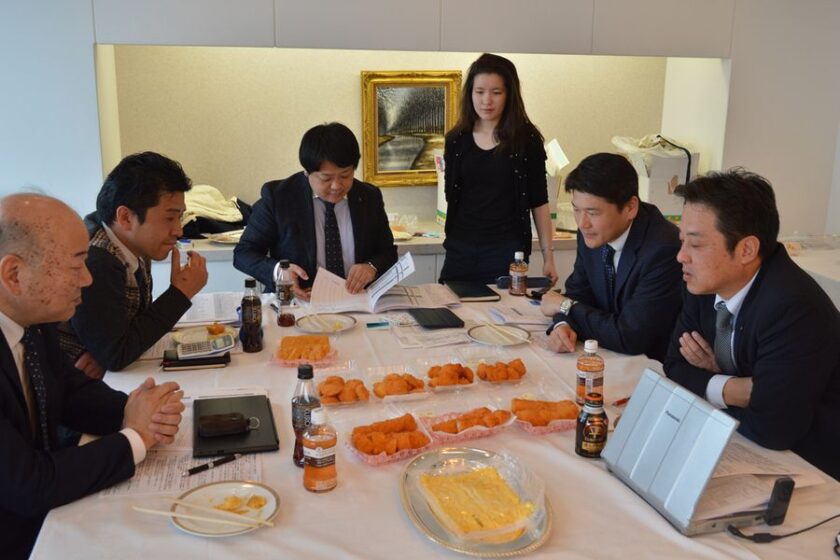
On another occasion, I accompanied employees to the monthly meeting of the “Delicacies” project group. On the 37th floor of a high-rise building, with a fantastic view over all of Tokyo, various manufacturers had been invited to present products such as fried meat or vegetables, which we then sampled afterwards. The all-day event was perfectly planned and tightly scheduled. Each manufacturer had 30 minutes to promote its product.
I was also able to experience this strictly structured way of working at the headquarters, where I spent most of my time. Every Monday at 8:30 a.m., the company’s guiding principles were recited together.
The 25 employees sit in a single open-plan office. Everyone shows great commitment to their work and identifies very strongly with “their” company. There are many unwritten rules that everyone follows. For example, the office premises are cleaned by the employees before work begins, and tasks such as distributing the mail are shared by everyone.
The employees took very good care of me: I was given my own desk, even my own business cards, and of course a detailed plan according to which I was to get to know the company. For just over a week, I accompanied the field sales team to customers. This included the CREA supermarket in Kesennuma. This supermarket, located only a few hundred meters from the beach, was completely destroyed by the tsunami in 2011. However, the owner did not let this defeat him; although he had lost part of his family, he rebuilt the supermarket soon afterwards in order to give the people in the town a place to shop.
Japanese supermarkets have a completely different product range. Many so-called delicacies and bento are offered here. These are ready-to-eat side dishes for rice, such as fried meat, which can even be heated up for you in the supermarket. “Bento” refers to a “lunch box,” meaning a ready-prepared cold lunch in a box. I was even allowed to make my own lunch bento here, which consisted of sushi.
I was also able to get to know other customer groups, such as catering companies or hotels, spent time in the warehouse and in the shareholders’ C&C markets, and gained deeper insight in marketing into the new strategic direction of print media.
At the weekends, I explored the area around Sendai. I went skiing on the famous 1,800-meter-high Mount Zao, took a boat tour around the snow-covered islands in Matsushima, and visited downtown Sendai.
Through the internship at JFSA, I realized that even within the same industry, many processes can be structured and organized differently: from meticulous work planning to a different warehouse organization. In addition, I was able to learn a great deal about Japanese culture and food and had a lot of fun in the process.
A report by Anna Henrichsen (4th semester, “Business Administration – Rethinking Economics")
Overall, students spend 60 weeks during the three-year bachelor’s degree program with a partner company of their choice, such as Service-Bund, dm-drogerie markt, Alnatura, Weleda, Globus, or GLS Bank. As part of 10-week work placements at the partner companies, students apply the knowledge from their studies in their day-to-day work.