Study Business to Make Dreams Come True
03/07/2017 - Following his bachelor’s degree in Business Administration, alumnus Sebastian Schulz founded the start-up Wertewandel.
Following his bachelor’s degree in Business Administration, alumnus Sebastian Schulz founded the start-up Wertewandel.
How did you come up with the idea of starting your company?
The idea emerged during my first practical phase at dm-drogerie markt. Although I spent most of my time at the distribution center in Weilerswist, I also worked temporarily in one of the stores. There, I was allowed to seek out projects independently. I then looked into the question of how to create awareness among more customers that outer packaging should not be seen as waste but—true to dm’s philosophy—as recyclable materials, in order to prevent littering in the store parking lot and increase the use of the recycling boxes. The way PAYBACK works seemed to me to be the ideal way to motivate people to take a specific action. For example, using the bonus card increases sales of certain goods and the average purchase value. Could environmentally friendly actions also be encouraged in this way—and perhaps not only influence the disposal of products, but, by starting much earlier, also the motivation to purchase them? Taking this line of thought further, the idea quickly arose of building such a bonus program across industries in order to make sustainability understandable and attractive in as many areas of everyday life as possible.
Did your degree help you with that?
Absolutely. On the one hand, the attention and sensitivity to this topic only arose through the course content. I think the idea would never have occurred to me otherwise. On the other hand, I also received support during my studies, as several professors encouraged and supported me in developing the idea further—above all Prof. Dr. Petersen and Prof. Kolodziej, whom I contacted directly after the practical phase I mentioned.
To what extent did the experience you gained during your practical phases help you in founding your company?
At dm, I was given the opportunity to work independently very early on. The concept of LidA (Learning in Work), which I encountered in my very first practical phase, was very beneficial for my motivation to engage proactively with my work and with the processes in the company and the economy as a whole. Quite apart from my own business idea, my work at the dm distribution center gave me truly unique experiences and allowed me to work on exciting projects in which I already felt like my own boss.
What do you like about your work, and what role does sustainability play?
What I like best is working on something of my own—that has a special quality. On the one hand, it also creates enormous pressure, but on the other, it gives you a lot of freedom. It is work in which I am continually challenged and can regularly surpass myself.
Sustainability runs through the business model from beginning to end—the hope now is that the company itself will also grow sustainably.
What motivated you to study Business Administration at Alanus?
After graduating from high school, I had absolutely no idea which direction I should take. I had always had very diverse skills and interests in business and computer science, but also very strong interests in art, acting, and philosophy. The interdisciplinary approach in the Business Administration degree program really resonated with me.
How did your practical partner support you during your studies?
My practical partner supported me fully. Quite apart from the fact that dm founder Götz Werner himself was the first person I told about my idea and that he provided me with an important advocate, I could also always count on goodwill from my former dm colleagues in other ways. In the third practical phase, for example, I was excused from a compulsory event lasting several weeks so that I would have more time to advance my start-up project.
What defines studying at Alanus University? What were and are the study conditions, the learning environment, the community like?
A key advantage of studying at Alanus University is clearly that lectures take place in a small setting and not in overcrowded lecture halls with hundreds of students. People know each other, you are noticed, and that means you can participate actively. In our cohort, and especially among the students from dm, there was a special sense of community—that carries you through your studies.
How did your studies contribute to your personal development?
Through my studies, I have become more attentive and reflective. I also learned to question things that are considered a given and to be open to new things: not only to walk paved roads, but also to take paths that have not yet been traveled.
Are there any special moments from your studies that you look back on fondly?
Looking back on the three years of study, many special moments come to mind. In the context of my self-employment, however, one moment stands out above all others: the evening at the end of the sixth semester when I told my fellow student at the time, Milan Wolfs, about my business idea in a relaxed setting and asked him whether he would like us to build this thing together. He was immediately fired up about the vision, so since that significant evening more than two years ago, we have been working together every day with full energy on our project.
What are your plans for the future?
“Plans are unimportant, but planning is everything” (Eisenhower). My team and I have worked intensively on this and are planning to bring a truly brilliant product to market very soon: since May, bonus points can be collected online through Wertewandel, and from mid-year onward, the app will follow, rewarding the purchase of selected sustainable brands completely independent of location. What happens next will shape our future.
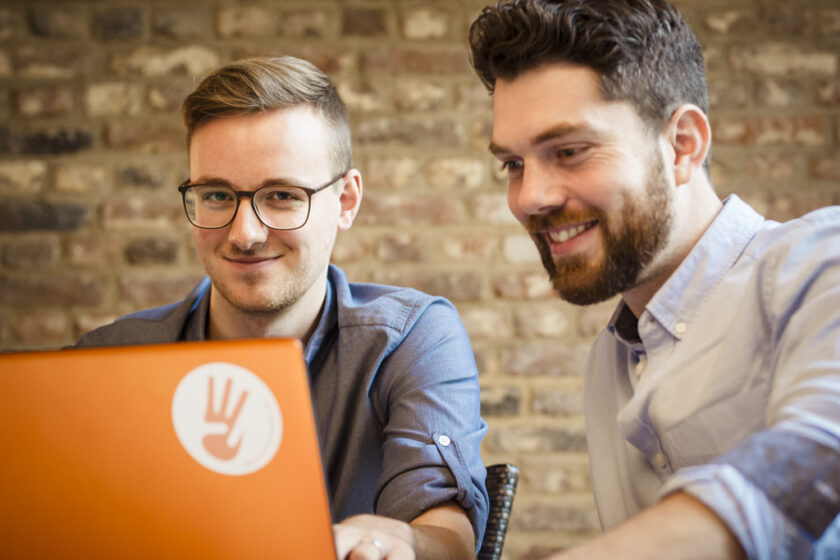
Student Lena Hey conducted the interview with alumnus Sebastian Schulz, co-founder of Wertewandel. Sebastian studied “Business Administration – Rethinking the Economy” at Alanus University until the autumn semester of 2014 and subsequently founded the company Wertewandel together with his fellow student Milan Wolfs. In 2016, Sebastian Schulz and Milan Wolfs received the EXIST start-up grant worth 123,500 euros for their start-up idea, a funding program of the Federal Ministry for Economic Affairs and Energy co-financed by the European Social Fund. In addition, the two entrepreneurs were once again awarded the Werkstatt N Project seal this year.
 Copyright Test