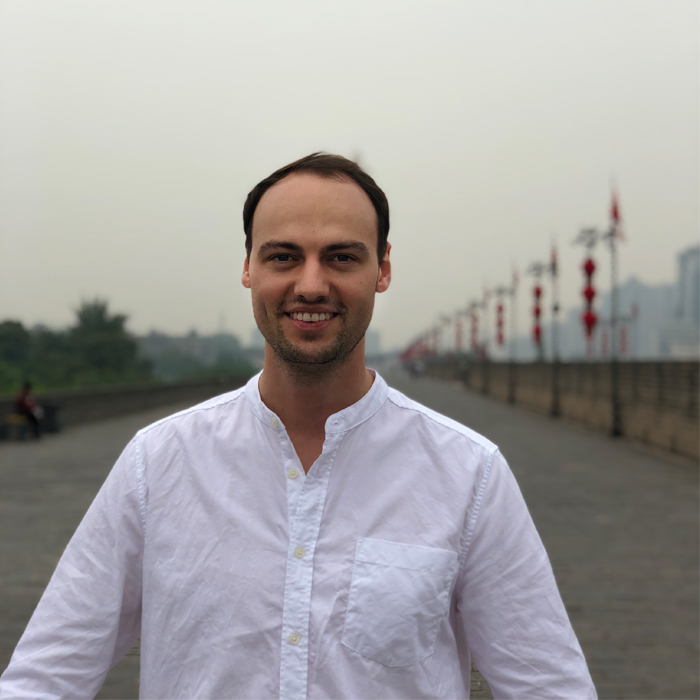
Interview with our alumnus Jona Stinner
14/04/2020 - Jona is a doctoral candidate researching cryptocurrencies and blockchain-based applications.
Jona is a doctoral candidate researching cryptocurrencies and blockchain-based applications.
Where am I & what am I doing?
Since December 2019, I have been working as a research associate and doctoral candidate at the Faculty of Business and Economics at Witten/Herdecke University. The private university offers degree programs in business, politics, philosophy, psychology, human medicine, dentistry, and nursing science. Similar to Alanus University, students in the interdisciplinary Studium Fundamentale learn to develop different perspectives on a problem and to situate their own discipline methodologically.
My work as a research associate involves preparing and conducting courses in the Banking & Finance department as well as supervising seminar papers and final theses. As a doctoral candidate, my research focuses on cryptocurrencies and blockchain-based applications. Numerous academic questions arise in this field, as the foundation of the technology was only laid about a decade ago with the pseudonymous publication of the Bitcoin protocol and has been in constant development ever since. At the height of the financial crisis, Bitcoin promised a cryptographically secured, anonymous, and decentralized monetary system that functions independently of central entities such as central and commercial banks. The fascinating innovation lies in the network’s ability to perform the substantial functions of a central authority itself—namely processing transactions and establishing consensus about the current balances of each participant. Or in other words: since there is no central administration in the decentralized Bitcoin ecosystem to manage assets and resolve conflicts, the system must reach consensus on its own. The security of the network is based on its decentralization: every participating party can download a complete copy of the ledger, verify transactions, and append them to the history. However, with Bitcoin’s rapid growth, various weaknesses also became apparent, such as a limited maximum number of transactions and enormous energy consumption. According to estimates, the cumulative electricity consumption of the Bitcoin ecosystem currently exceeds that of numerous countries, including Austria, Greece, and Portugal. To address these weaknesses, strong development of more scalable, efficient, and sustainable consensus models has been underway for several years, and my research fits into this context. At the moment, for example, I am analyzing whether price fluctuations influence decentralization and could therefore endanger the network. Much like the internet in its early days, many advocates see blockchain as a key technology with the potential to fundamentally change the organization of economic interactions. Against this background, it is incredibly exciting and gives me great pleasure to think through the latest innovations and take part in their development.
How did I get here?
After completing my bachelor’s degree at Alanus University, I first went on an extended trip through Southeast Asia and then completed an internship with a Hamburg-based venture capital firm. I quickly became certain that I wanted to continue studying, and so I began a master’s degree in Corporate Management & Economics at Zeppelin University in Friedrichshafen. During my third semester, I had the opportunity to study at Peking University in China. My time there was incomparable—especially the strong contrast between the country’s culture and language and those of Germany was an incredibly exciting experience. The stay also inspired my master’s thesis, in which I examined how the spread of major sharing economy platforms affects sector-specific employment, mobility prices, and income inequality in China (for those interested, an insight into my work can be found in the following article). Even after completing my master’s degree, I had not had enough of academia, and I am very pleased to be able to pursue further research questions in the coming years and hopefully answer them in a well-founded way.
How did my time at Alanus University shape me?
Looking at various aspects, I think back on my time at Alanus University very fondly. Building on the specialist knowledge taught there, I benefited greatly from the combination of theory and practice in particular. In my experience, this works incredibly well in a practice-oriented degree program such as Business Administration: during my practical phases at dm-drogerie markt, SAP, and Postbank, I was able to apply the theories I had learned, reflect on them critically, and develop my own extensions for the respective challenge.
I experienced the Studium Generale as a very enriching education in philosophy, sociology, psychology, and art history. In addition, the acting modules once again made it clear to me that it is almost always worthwhile to leave your comfort zone and engage with something (initially) unfamiliar.
The comprehensive business education and the multidisciplinary course content foster independent thinking, self-organization, and the development of curiosity and openness to new things—skills that are very important in my current work. I also often and fondly remember the lively student life in Alfter and Bonn, where I had the chance to meet many interesting people through numerous study groups at the university, parties, and sporting events.