Five Questions for Christian Reinecke
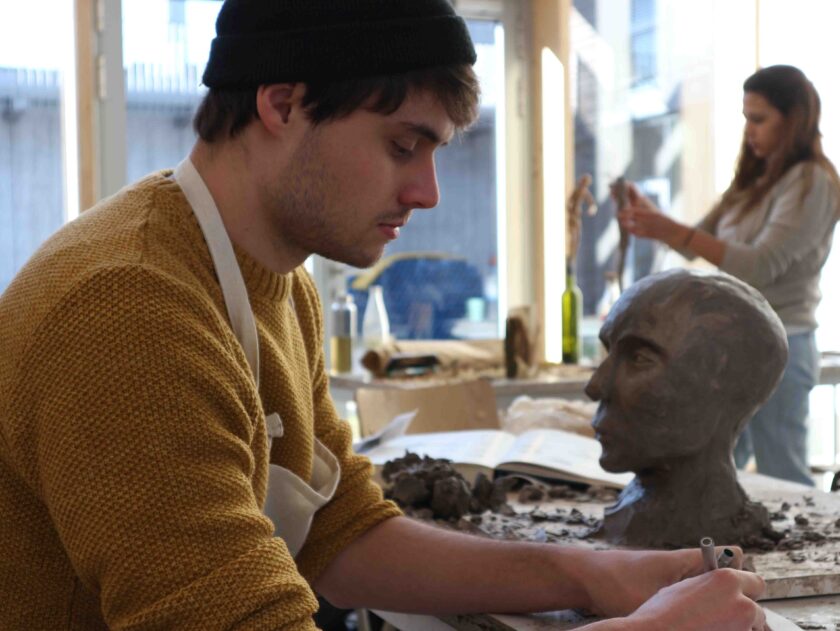
28/07/2020 - Christian Reinecke is studying Architecture in his sixth semester and is currently writing his bachelor’s thesis on how urban planning can address the separation of several districts in southern Bonn caused by the railway line. In the interview, he also explains what makes studying Architecture special for him and how he finances his studies.
Christian Reinecke is studying Architecture in his sixth semester and is currently writing his bachelor’s thesis on how urban planning can address the separation of several districts in southern Bonn caused by the railway line. In the interview, he also explains what makes studying Architecture special for him and how he finances his studies.
1.) You are studying Architecture in your sixth semester. What is special about the degree program?
In Architecture, we deal very fundamentally with built space. What is special is that space itself is not something material and can therefore be many things: a living space, a workspace, or even an urban space. Designing these spaces is therefore not only a craft task, but also a philosophical, artistic, and social one.
2.) What is your favorite course/seminar?
In artistic subjects such as the study of form or freehand drawing, I feel the greatest vibration and attraction to the work. I see artistic activity and thinking as essential prerequisites for creating good architecture. The term architecture can be translated as the art of building. That is how I understand it and my work.
3.) You are currently writing your bachelor’s thesis. What topic are you working on?
Together with three fellow students, I am working on an area in southern Bonn between Kessenich, Dottendorf, and Gronau. The railway line has separated these districts from one another and left an urban planning wound. In our bachelor’s thesis, we ask how urban planning can deal with such situations and formulate architectural-typological proposals. In the end, we are essentially asking what contribution architecture can make to the city and how we want to live in the future.
4.) You use the reverse intergenerational contract of Chancen eG to finance your studies. How does this form of financing work?
My tuition fees are being paid now, and in return I will later finance other students’ places at university. The Chancen eG model is based on solidarity, which is very important to me. If I earn more later, I will pay back more than I received. If my salary is below a certain income threshold, I pay less or nothing at all. Overall, this creates a community in which people help one another. Alanus University supported me in this and helped me obtain the funding.
5.) What advantages does the reverse intergenerational contract have for you?
Very concretely, the reverse intergenerational contract gives me financial independence during my studies. I do not have to take on a part-time job just to survive. When my funding began, I was able to leave my job as a cashier in a supermarket and concentrate fully on my studies and everything around them. This also allowed several projects to emerge alongside my studies, which led to my being accepted into the German Academic Scholarship Foundation last year and thus receiving further material and non-material support for future projects.