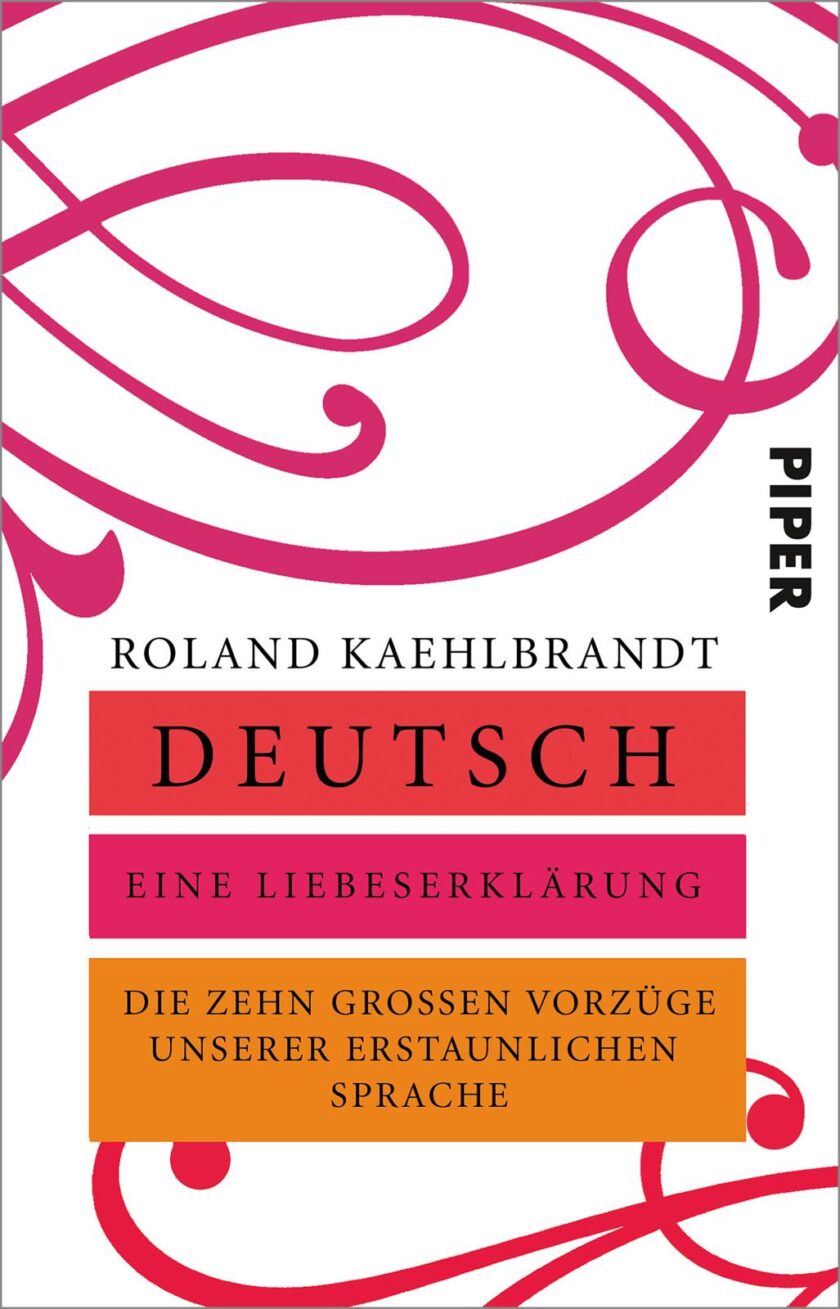
Book release: “German – A Declaration of Love. The Ten Great Strengths of Our Remarkable Language”
29.10.2022 - What the German language can do! Here you can read an exclusive excerpt from the new book by Prof. Dr. Roland Kaehlbrandt, Honorary Professor of Language and Society at Alanus University.
What the German language can do! Here you can read an exclusive excerpt from the new book by Prof. Dr. Roland Kaehlbrandt, Honorary Professor of Language and Society at Alanus University.
The German language: gifted in relationships, empathetic, and expressive
Excerpt from the new book by Prof. Dr. Roland Kaehlbrandt: “German – A Declaration of Love. The Ten Great Strengths of Our Remarkable Language”. Munich 2022, Piper Verlag (paperback, 255 pages, €12).
If we witness discourtesy in the German-speaking world, it is certainly not the fault of the German language. On the contrary, as if German knew how common brusqueness is among us, it has placed in our hands a wealth of friendly, communication-enhancing particles. They are used particularly frequently in German.
Of all things, the German language is supposed to encourage friendliness? Some prejudices suggest otherwise. German, said the French philosopher Voltaire, was a barbaric jargon fit to be spoken only to horses. Emperor Charles V also declared that he spoke to God in Spanish, to his mistress in Italian, to friends in French, and to horses in German.
And yet German, of all languages, offers an abundance of charming little words capable of positively influencing our behavior and making contact with others easier. These are words that were often judged critically at school: they were said to be filler words or patch words, to be avoided because they supposedly meant nothing real; they were said to be words of embarrassment used to conceal one’s own hesitation. Instead, people were told to use their minds, choose their words carefully before speaking, and then they could safely do without these filler words.
Completely wrong! We need them!
It is really as if our ancestors invented these many small friendly words because they knew that quite a few people tend toward rudeness, and so they took precautions. Thus the German language provides small relationship-enhancing words, and they should not be regarded as superfluous; rather, their advantages should be recognized.
“What’s your name, then?” we ask the child of a new neighbor. That sounds kinder and more engaging than the blunt, almost demanding question asked directly: “What’s your name?” The little word then makes the difference.
“Just do it!” is the father’s gentle prompt to his son to switch on the dynamo on his bicycle in the dark, even though, for unfathomable reasons, it is considered uncool among his peers.
If the son cannot quite see the point of his parents’ concern, he still understands between the lines that he should please, please do it simply as a favor to them. The small and inconspicuous just creates the companionable tone that may make it easier for the child to give in. By contrast, what would the plain command “Do it!” achieve in a modern family built on negotiation? Probably nothing but defiance.
“Where on earth is she ?” is the worried question a mother asks a friend because her daughter has not come home and it is getting late. Certainly, this little phrase adds no new factual information to the question of where the daughter is. But it conveys the mother’s concern and thus gives the question its communicative meaning. A plain “Where is she?” would lack precisely that crucial undertone created by this wording.
After all, this is not merely a straightforward request for information that the other person could answer factually, but an expression of concern that something may have happened to the daughter and that this may be the reason for her not returning. So we can see how important, indeed decisive, this wording is. And with that we also recognize how important, alongside the purely factual question, is the shading we give it.
Our little friends, the particles, carry no lexical meaning of their own. But what they do express is the attitude, the mood of the speaker—through these “wrens in the fur of language,” as the linguist Peter Eisenberg almost tenderly calls them. And expressing moods is something these little words do masterfully. With their help, our communicative intention is woven in subtly and incidentally, rather than being trumpeted to the world in grand words.
It is precisely this subtlety of communicative secondary meaning that is the great strength of particles (from the Latin particula, meaning little part). According to counts, in German there are on average 13 particles in every 100 words. This frequent use is a special feature of German. It is therefore not exactly easy to translate a cluster of particles into another language, such as Professor Unrat’s deliberately old-fashioned formula of affirmation in Heinrich Mann’s novel of the same name: freilich denn nun wohl, traun fürwahr.
The use of the reply particle ja is interesting. Often ja is not used in this function, but to express prior knowledge shared by the other person: “She is ja taking her Abitur this month.” If we did not assume that the person we are speaking to already knew about the upcoming Abitur exams, the ja would make no sense. In this way, however, we build a communicative bridge to the other person by invoking our shared prior knowledge.
In everyday life, however, we also keep encountering people who insert such a ja even though there is no way we could know the matter in question. Someone who does this reveals, to their own disadvantage, that they are more focused on themselves than on the other person; otherwise they would realize that what they know is not something we can know, and they would avoid using ja. Particles should not be underestimated. They, too, need to be used correctly.
Incidentally, the particle ja has gained reinforcement. It comes in the form of the exclamation und ja! It underscores the statement that follows and, as a precaution, highlights its legitimacy in advance: “And yes, education for all is essential!”
But if we want to emphasize the correctness of our statements, German also offers other, more classical particles of affirmation: eben or ebendeshalb – and above all genau.
The particle of affirmation genau has by now conquered another function. Exactly! is also used in the middle of a sentence as a marker of structure and confirmation within an ongoing process of thought and formulation: “After leaving school I, exactly, first completed a voluntary social year, and then I, exactly, started an apprenticeship at a bank. I learned a lot there, exactly.”
Curious! It is not the other person who is meant to confirm that they have understood what one wanted to say; instead, one confirms to oneself … well, what exactly? In a kind of inner monologue, of which the conversation partner now becomes an involuntary witness, one confirms to oneself that one is beginning a new thought, or that the thought is just ending. In other words, one makes the work of structuring one’s thoughts visible and draws attention to it, as if a special effort were needed to organize thoughts in language.
There is nothing morally wrong with that, because why should one not admit to thinking hard?
The affirming genau answers several self-addressed questions on the part of the speaker at once: Did it happen the way I said it did? Have I now actually said what I wanted to say? And did I say it in the right place?
As a conversation partner, however, one may also ask: does this display of intellectual-linguistic effort correspond to the richness of the thoughts being presented? For as always, the use of linguistic means is also a matter of appropriateness in relation to the subject, the recipient of the message, and the speaking situation.
The observable spread of genau underlines a characteristic of the German language that we as speakers can use to our advantage but can also, as shown, overuse (like everything made available to us):
Language influences us to make frequent use of these communicatively powerful particles and thus to reveal our speakerly stance toward others again and again, instead of limiting ourselves to the expression of pure facts. That promotes communication. However, using them too often can also be distracting, because as listeners we do not want to follow every mental effort and every moment of self-doubt in others—especially not when they apparently have to struggle even to describe the simplest facts. At the same time, the self-doubt conveyed with genau can sometimes seem quite likable: here is someone who is honestly unafraid to be truthful with themselves and with others, which in turn corresponds to the evidently very popular expression of feelings in German.
The German speech community is inventive. New particles are constantly being added. This also applies to a special class that highlights the intensity of an utterance, known as degree particles. We know, for example, the degree particles sehr, ganz, höchst or ziemlich.
Now children and young people in particular are always searching for striking expressions for which they invent forms of emphasis. And so they have enriched German with a wealth of youth-language and now also colloquial particles, led by the degree particle voll. “Mom, that’s really beautiful!” exclaims a girl at the sight of a rapidly spinning carousel in the window of a toy shop. “Totally mega-awesome,” comments her older sister. Every young generation finds its own age-appropriate emphases and shades of tone.
That enlivens youth language. And even as an adult, in selected contexts one can certainly create an effect by finding something totally unfair.
Exclamations and conversational comments also serve communicative purposes, such as the expression ganz ehrlich, which usually comes at the beginning of a sentence. Its use has increased enormously.
Ganz ehrlich introduces an emotional confession. Usually it concerns rather everyday annoyances that trigger spontaneous reactions:
A: “So in the last second she went and rescheduled her vacation after all.”
B: “Seriously? Honestly: That is so not okay.”
C: “Totally unfair! But honestly: It’s not even the first time she’s pulled something like that!”
A: “Seriously!”
In most cases, the indignation soon subsides again or can turn without much fuss to a new subject. Because after all, it was not meant all that seriously. That is why the modern formula of confession is precisely what characterizes most innovative forms of emphasis: slightly exaggerated—as if it were about revealing a sensitive truth that could only be voiced under a seal of secrecy, indeed in some cases almost a kind of modern confession (just as the songwriters for pop singer Helene Fischer, with a keen feel for what is popular, worked it directly into the title “Mal ganz ehrlich”). In reality, however, ganz ehrlich is a shorthand formula for everyday excitements of all kinds, and that is exactly why it is so popular.
As I said, the speech community is extraordinarily productive in inventing or repurposing particles. The German language encourages it. It can really only benefit conversational culture, precisely when it is—exactly!—once again all about feelings. Honestly!