“Unfreeze Your Brain” Mini-Festival 2025
16/06/2025 - Review of two days of art, business and the future at Alanus University
Review of two days of art, business and the future at Alanus University
From 13 to 14 June 2025, Alanus University’s Campus II in Alfter became an inspiring meeting place for everyone who wants to rethink business, use art creatively, and play an active role in shaping our future. With the “Unfreeze Your Brain” festival, the Department of Business, together with numerous cooperation partners, created spaces for innovative approaches to thinking and acting, interdisciplinary encounters, and the courage to embrace change. The result was two moving days full of workshops, performances, talks, conversations, and activities centered on the themes of art, business, and the future—bringing participants into motion together.
You can get an impression of the festival moments in our event film here.
The festival was shaped by a wealth of ideas, collectivity, and powerful slogans, including:
- “Everything is political” – the call for Corporate Political Responsibility by Katharina Reuter, German Association for Sustainable Business
- “Create the economy the way you want it to be” – by Timo Wans, Myzellium
- “Decolonize your thinking” – by Lavinia Muth
- “Free Your Inner Cow” – by Wapke Feenstra
- “Employee activism aka Green Teams” – by Prof. Susanne Blazejewski and Milan Kiefer
- “A little green is no longer enough” – by Stephan Grabmeie
The marketplace became a lively place of encounter: with activities such as “Places in Common Memory,” a Fairtrade coffee bike, interactive stations, and mini-exhibitions—including SoLaWi Bonn/Rhein-Sieg as well as numerous student contributions. In the “Unfreeze Dialogues” on Saturday afternoon, new movements of thought were sparked together. A special highlight was the ritual performance by Annabelle Wimmer Bakic, which combined art and ritual to create new awareness as an experience.
Anyone who would like to share feedback or thoughts is welcome to contact: kathrin.boehm@alanus.edu.
“Unfreeze Your Brain” was part of the “Summer of Change – Bonn Cultural Festival”, an initiative of the Federal City of Bonn in cooperation with the Bundeskunsthalle and more than 30 other partners www.bonn.de/summer-of-change.
A heartfelt thank-you to everyone who contributed, helped, thought, and asked questions—you brought this festival to life!
Special thanks go to:
Prof. Dr. phil. Susanne Blazejewski, Wapke Feenstra, Alina Gombert, Stephan Grabmeier, Shari Huwer, Milan Kiefer, Nadège Kusanika, Lavinia Muth, Prof. Dr. Katharina Reuter, Jenny Thiele, Roberto Tinoco, Dr. Philip Unterweger, Timo Wans, Teresa Weißert, Jana Windhöwel, Annabelle Wimmer, Prof. Willem-Jan Beeren, Cindy Flückiger, Julia Honer, Anne von Hoyningen-Huene, Inox Kapell, Bianca Lenhard, Alessandro De Matteis, Ulrike de Ribaupierre, Jenny Thiele, Artepreneur, Bundeskunsthalle Bonn, Bund Nachhaltige Wirtschaft e. V. (BNW), Foster Garten- und Landschaftsbau, Myvillages, SoNar, UNO INO eG, Department of Architecture, Green Teams, Kompost Ensemble, Literaturhaus Bonn, Myzelium, PhASe, SoLaWi Bonn/Rhein-Sieg e. V., Fair Trade.
Concept: Prof. Kathrin Böhm and Bianca Orboi, Department of Business at Alanus University
All photos: © Till Fischer
The Department of Business initiated the festival as an impulse for future-oriented & interdisciplinary business practice. The two-day program moved between marketplace and panel, artistic research and political practice. Learning and unlearning go hand in hand #AlanusBusiness.
Download the program here.
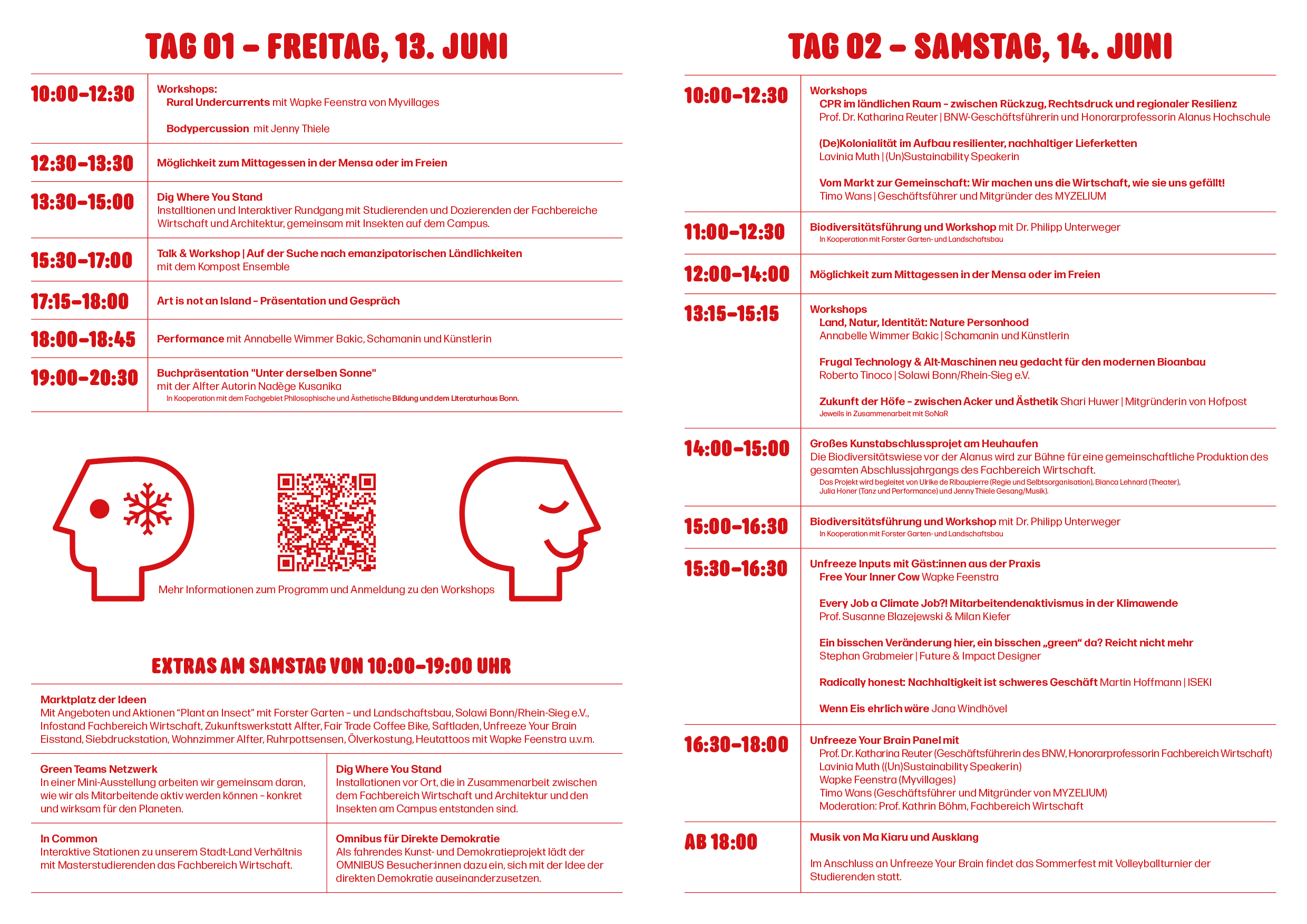
The full program can be found here:
Event film
Pre-program from 31/05
Even before the festival begins, various events set the first impulses and invite active participation.
31 May, 10:00 a.m.–5:00 p.m. | Summer of Change Festival Opening
Bundeskunsthalle, Museum Mile
The “Unfreeze Your Brain” Mini-Festival is an event within the framework of the Summer of Change – Bonn Cultural Festival and will be represented at the opening event with a participatory activity. Summer of Change is an initiative of the Federal City of Bonn in cooperation with the Bundeskunsthalle and around 30 other cultural partners. Further information is available at: www.bonn.de/summer-of-change.
5 June | Demonstration of Iseki agricultural machinery with Martin Hoffmann
ISEKI-Maschinen GmbH is a member of the German Association for Sustainable Business, which is a festival partner. The company distributes fully electric and radio-controlled mowing equipment. Managing director and sustainability advocate Martin Hoffmann will demonstrate an electric cutter bar mower on the biodiversity area on campus and mow the grass needed for the festival.
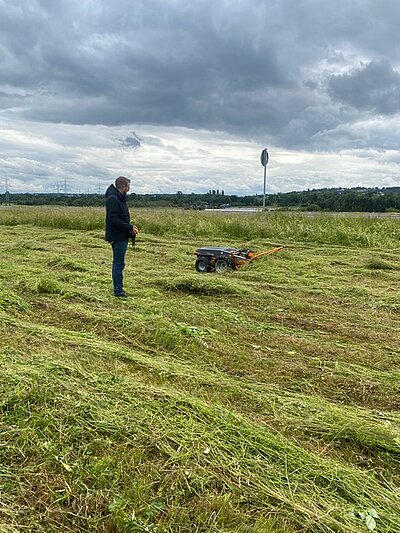
Photo credit: Kathrin Böhm
6 June | Rhubarb harvest in Alfter
As part of the artistic teaching in the Department of Business, an Alfter “Unfreeze Your Brain” ice cream was first created in 2023 and produced by students according to principles of regional, seasonal, and circular business practice. We would like to offer this rhubarb ice cream at the festival and invite interested participants to join the harvest.
7 June, 7:30 a.m.–12:00 p.m. | Scything – mowing and peening course with Ralf Benner
A practical introductory course in the traditional craft of mowing with a scythe. The combined course consists of a 3-hour mowing course with the scythe as well as a compact introduction to peening—guided by Ralf Benner, a trained scything instructor.
An invitation to experience groundedness, rhythm, and technique through your own strength.
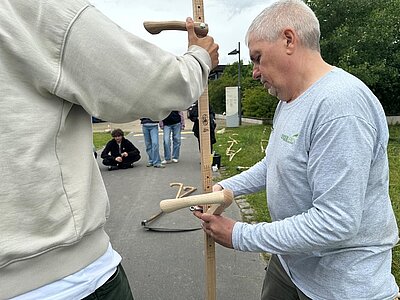
Photo credit: Kathrin Böhm
From 6 June WE/trans/FORM exhibition – On the Future of Building | Bundeskunsthalle, Bonn
In 2025, the Bundeskunsthalle is dedicated to ecological transformation. An important focus of this year’s program is an international exhibition project on sustainable architecture and urban development in Europe: WEtransFORM. On the Future of Building invites visitors to engage vividly with the future of our built environment. The focus is on fundamental design principles for a climate-appropriate renewal of our building culture. These include in particular: strengthening climate resilience / promoting biodiversity / practicing sufficiency / revitalizing existing structures / optimizing cycles / daring to experiment / taking action.
Including a “Rural Undercurrents” contribution by Myvillages. The work of Myvillages deals with the relationship between the rural and the city, examining different forms of production, prejudices, and power relations, while passionately challenging the cultural hegemony of the urban. The collective participates in cooperative projects in various villages and landscapes around the world with the aim of injecting new dynamism into entrenched ideas of local resources and production, agriculture and culture, and internal and external perception..
Exhibition duration: 6 June 2025 to 25 January 2026
Day 01 | 10:00 a.m.–12:30 p.m. – Interdisciplinary Workshops
In the spirit of the Unfreeze idea—breaking open existing patterns of thought and creating space for new visions—2 workshops at the start of the day invite participants to rethink relationships with nature, decoloniality, regional resilience, and community-based forms of economy. Between art, business & land. Registration for open participation in the individual program sections.
“Rural Undercurrents” – Wapke Feenstra | Myvillages
Every place has rural undercurrents – Artist Wapke Feenstra of Myvillages explores the particularity and the characteristics of the rural. This is not about a definition, but about a new understanding, because the rural is everywhere, even if it becomes less visible and perceptible through urban layers. Using concrete examples from Rotterdam South and Kassel, as well as simple drawing exercises, she invites participants to discover their own “rural undercurrents.”
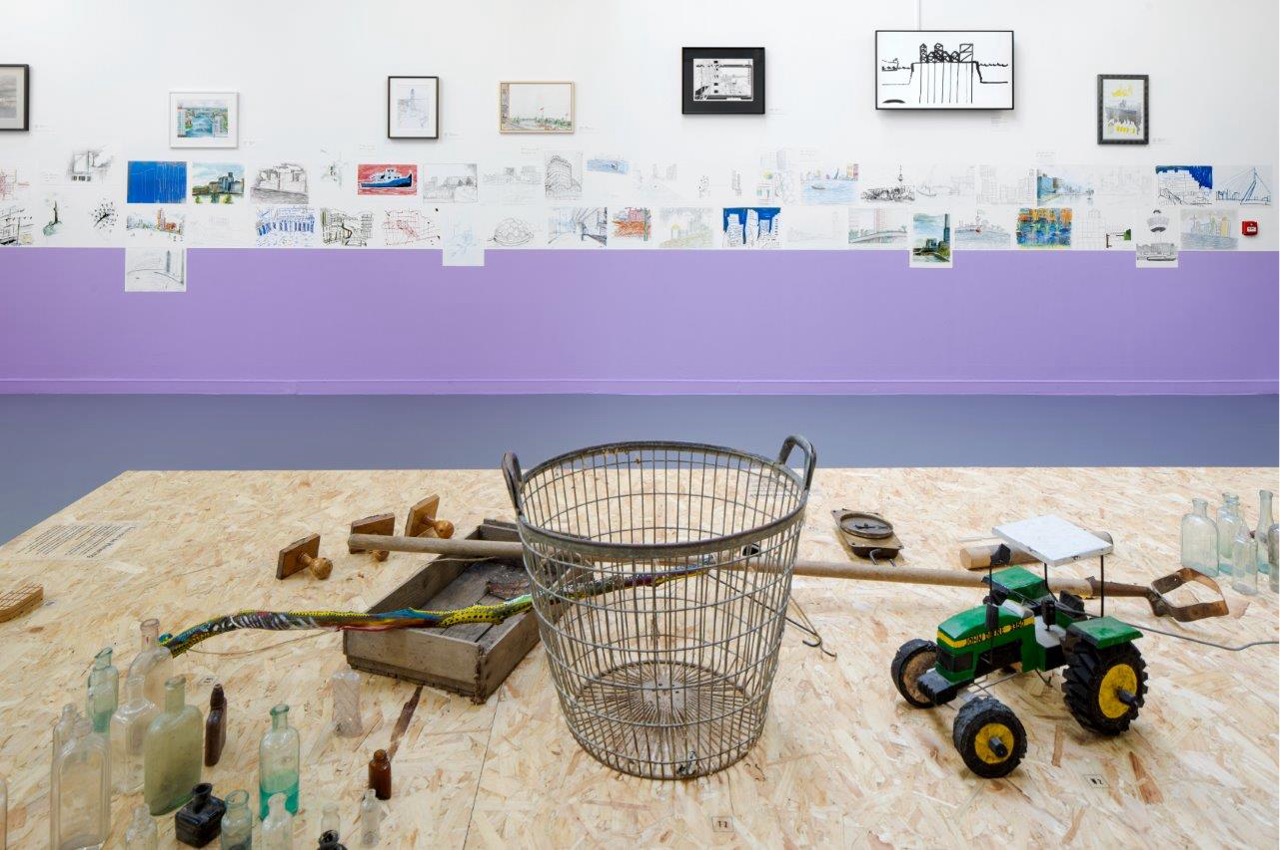
Photo credit: Boerenzij – installation detail TENT-Rotterdam, 2019-2020 – photo Aad Hoogendoorn 2019
“Vocal & Rhythm” – Jenny Thiele
Musician, singer, and composer Jenny Thiele offers an introduction to the instrument “body” and explores sound production with you without external means. Duration of the workshop: 11:00 a.m.–12:30 p.m.
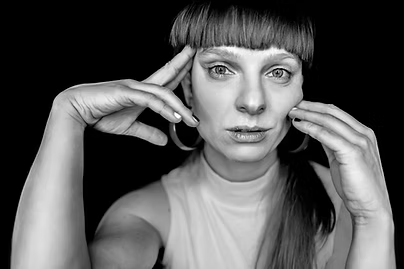
Photo credit: Bernd Vogel
Day 01 | 1:30–3:00 p.m. – Dig Where You Stand
1:30–3:00 p.m. – “Dig Where You Stand” – participatory exhibition and tour
Who actually shapes and uses our campus? In the art module “Dig Where You Stand,” students from Business and Architecture work together to reflect on the specific place, design wishes, and design possibilities. This year there is a third cooperation partner: insects. The concrete results and installations will be presented in a participatory tour and explored together with the insects.
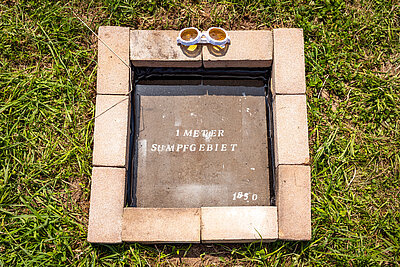
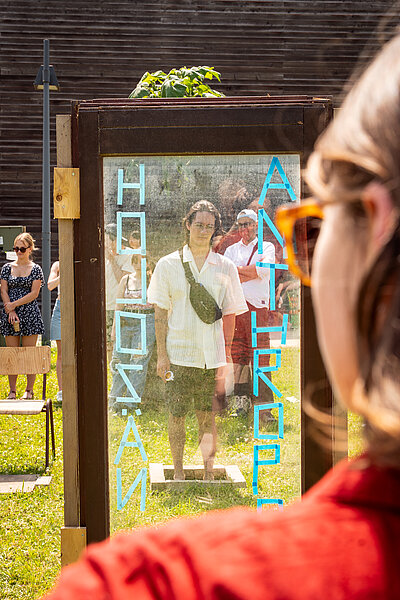
Photo credit: Till Fischer
Day 01 | 3:30–5:00 p.m. – Kompost Ensemble
3:30–5:00 p.m. – “In Search of Emancipatory Ruralities”: Talk & Workshop with Alina Gombert & Teresa Weißert | Kompost Ensemble
With Wapke Feenstra (Myvillages)
What do emancipatory ruralities look like? How do they sound and how do they feel? With this talk/workshop, we want to approach the term and explore the question of how we imagine emancipatory ruralities and what problems and contradictions can also arise through the assertion of emancipatory ruralities. Drawing on the experiences and encounters of Kompost Ensemble, which in recent years has explored subversive, unconventional, feminist, and post-migrant ruralities and sought spaces and openings for them in collaborations, we would like to approach this question.
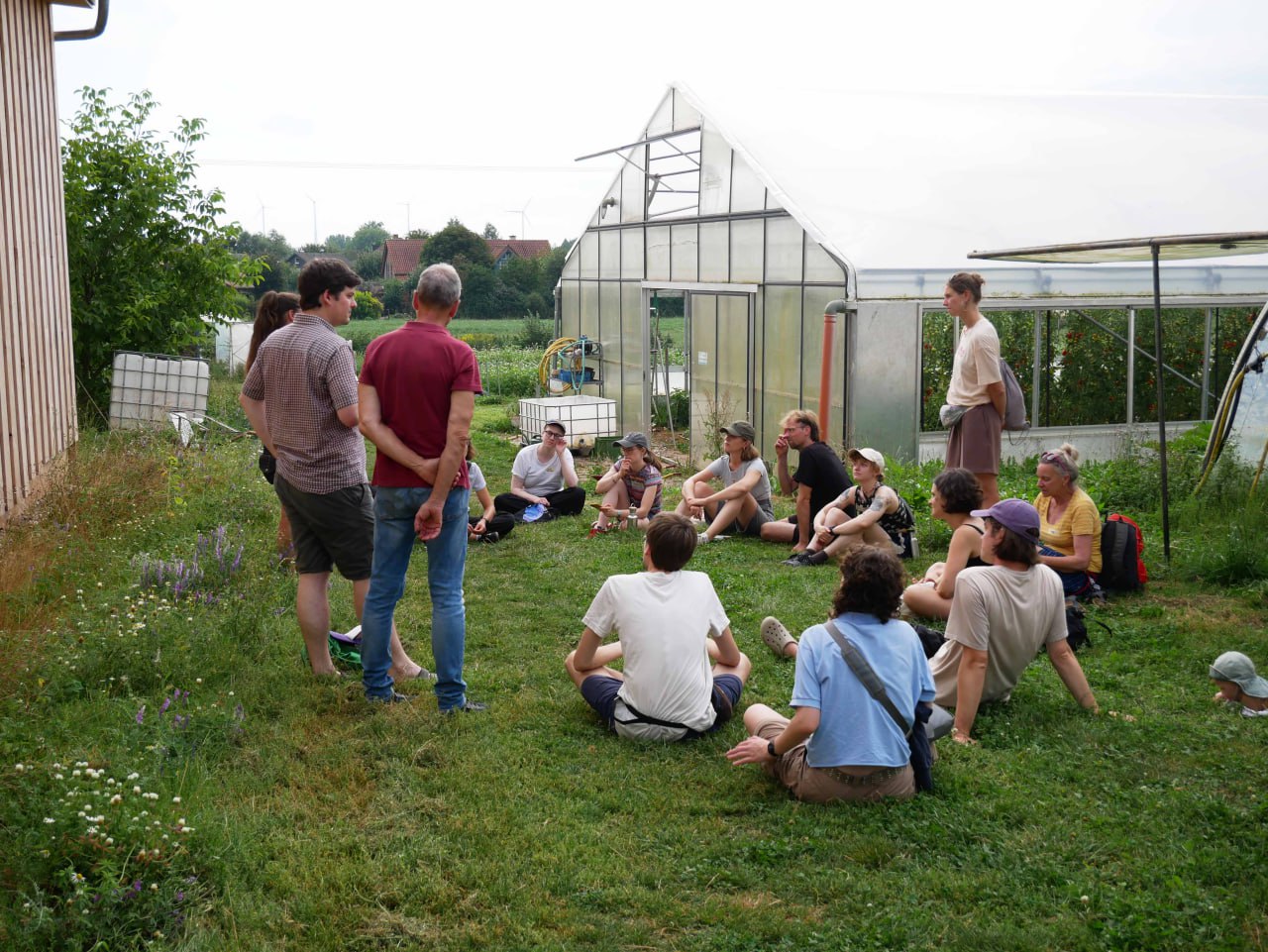
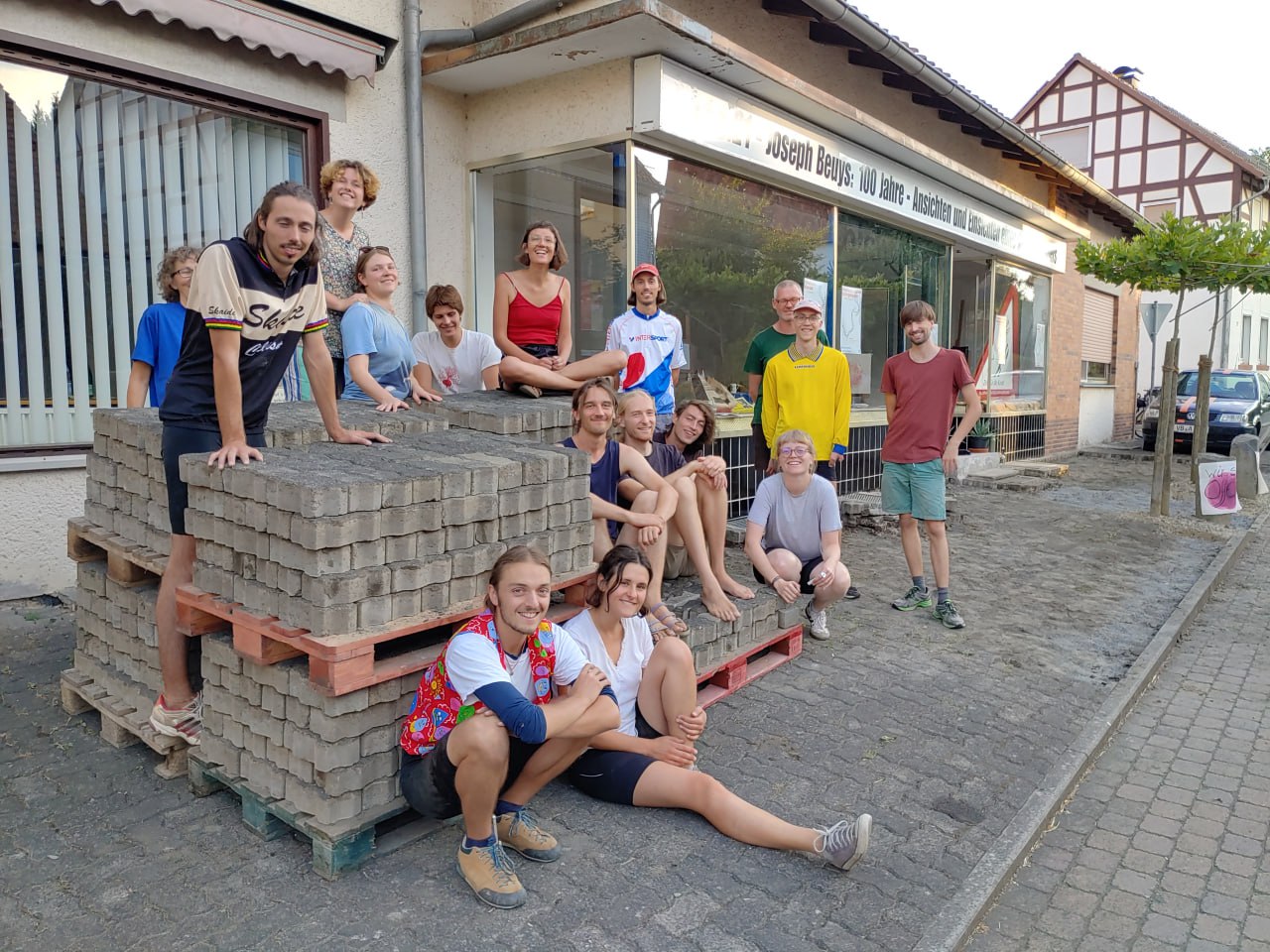
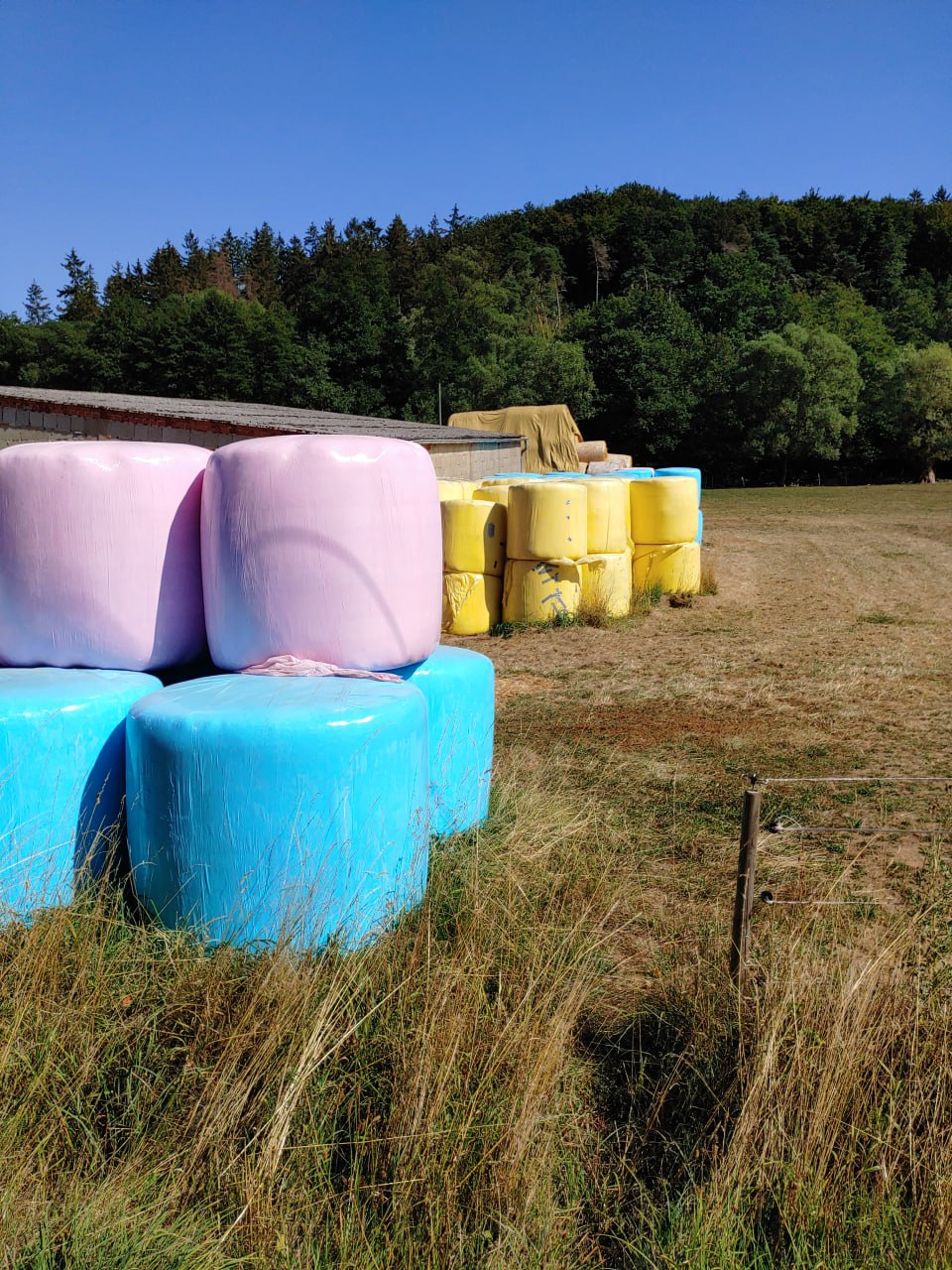
Photo credits: Kompost Ensemble
Day 01 | 5:15–6:00 p.m. – Art is not an Island
5:15–6:00 p.m. – “Art is not an Island” – presentation and discussion
Art can be many things, including economic practice. In the art module “Art is not an Island”, current artistic projects are being researched in which economic organizational structures are specifically at issue. One example is Documenta Fifteen, which in 2023 was organized according to the principle of Lumbung—a collectively managed Indonesian rice barn. Another is the Cercle d’Art des Travailleurs de Plantation Congolaise, whose work was shown at the Venice Biennale in 2014. This concerns the possibilities of a decolonial value chain through the art market, and the exhibition presents research findings on the complex historical and current contexts.
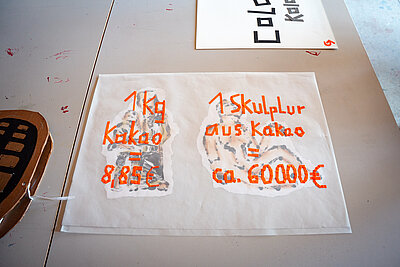
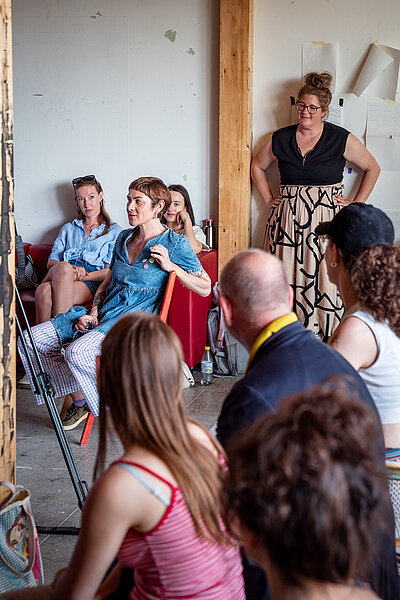
Photo credit: Till Fischer
Day 01 | 6:00–6:45 p.m. – Interactive Performance
6:00–6:45 p.m. – Performance “Nature Personhood: Relation beyond the border” – Annabelle Wimmer Bakic | Shaman and artist
In this performance, art and ritual come together in a ritual performance developed by Annabelle Wimmer Bakic so that new awareness can emerge. This performance is about the personal relationship between human beings and nature in the sense of a subjective encounter with a nature personhood. It aims to break open and question today’s objectifying treatment and reification of nature that predominates in Western society. Participants can immerse themselves in a personal subjective experience that enables them to feel an immediate connection to the earth and contact with universal spiritual wisdom. The goal of the ritual performance is to create awareness of new networks in the sense of an interspecies shared world.
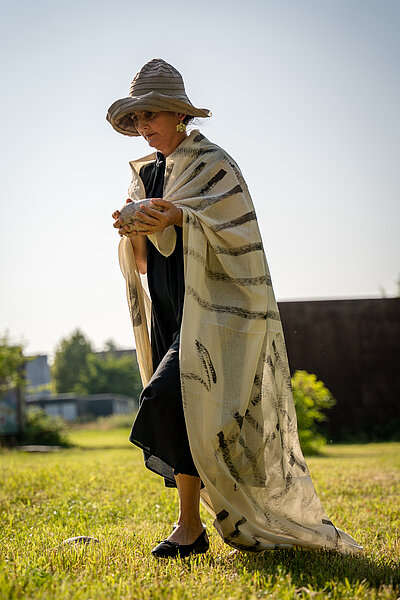
Photo credit: Till Fischer
Day 01 | 7:00–8:30 p.m. – Reading with Nadège Kusanika
7:00–8:30 p.m. – Reading “Under the Same Sun” | Nadège Kusanika | Author
Reading with Alfter-based author Nadège Kusanika. “Under the Same Sun” is a novel that gently and humorously raises poignant questions of home and identity in the everyday experience of being foreign. An impressive novel about family, growing up, and the search for one’s own self in our global world. Closing with drinks.
The reading is a cooperation with Literaturhaus Bonn. Further information and tickets here.
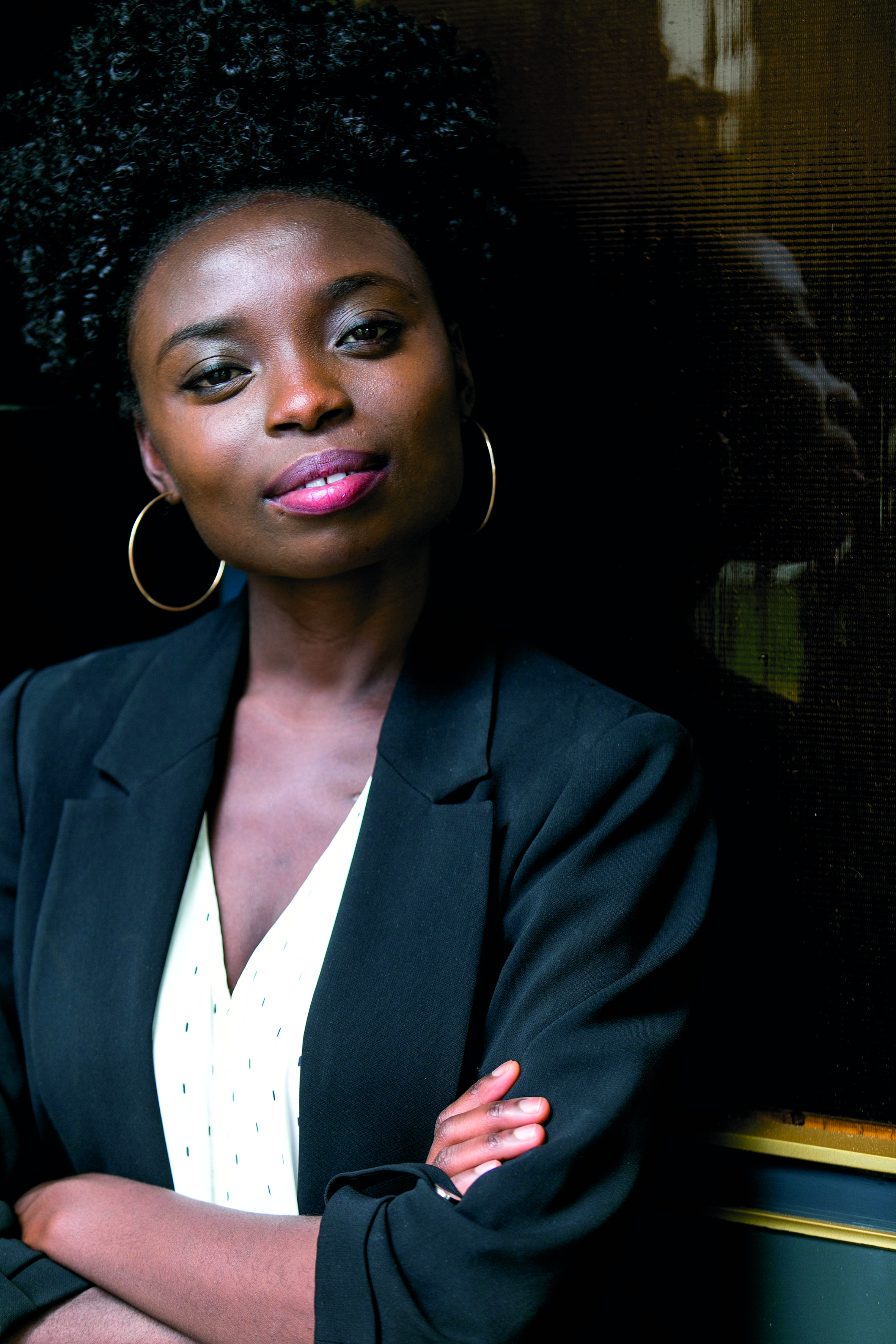
Photo credit: Bernd Fuhrich
Day 02 | 10:00 a.m.–12:30 p.m. – Interdisciplinary Workshops
In the spirit of the Unfreeze idea—breaking open existing patterns of thought and creating space for new visions—three workshops at the start of the day invite participants to rethink relationships with nature, decoloniality, regional resilience, and community-based forms of economy. Between art, business & land.
Workshop 1: CPR in rural areas – between withdrawal, pressure from the far right, and regional resilience – Prof. Dr. Katharina Reuter | Managing Director of BNW and honorary professor at Alanus University
What does corporate responsibility mean in times of a shift to the right—especially outside urban centers? Corporate Political Responsibility (CPR) calls on companies to take a clear stance and strengthen democratic, inclusive structures. Yet in rural areas, the scope for action is often narrower: polarization, structural change, land sealing, and the retreat from community spaces create a tense environment. At the same time, innovative models are emerging here—such as in regenerative agriculture—that point to new ways of dealing with soil, community, and responsibility. The workshop sheds light on how companies in rural areas can take political responsibility, whether traditions may prove obstructive in the process, and what good bread has to do with it.
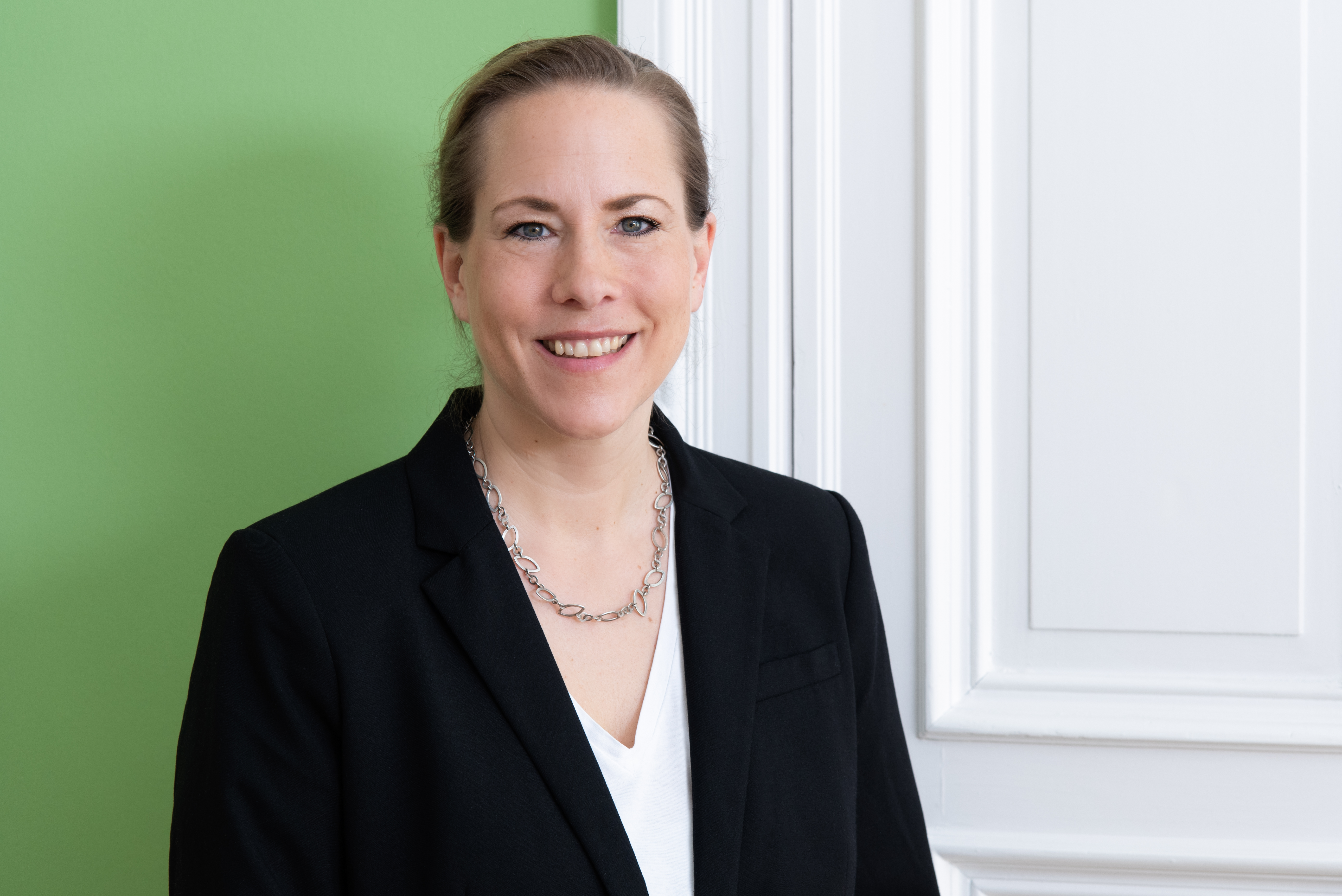
Photo credit: BNW e.V., Caro Hoene
Workshop 2: (De)coloniality in building resilient, sustainable supply chains – Lavinia Muth | (Un)Sustainability speaker
What do German certifications, women farmers in Pakistan, and your cotton T-shirt have in common? They are stuck in a system that preaches sustainability—but reproduces colonial power structures. In this workshop, we address the elephant in the room: how do we build supply chains that are not only ‘green’ but fair? Lavinia Muth reveals why resilience without decolonization is merely cosmetic—and how we should think and practice supply webs differently.

Photo credit: Annamarie-Wagner Langer Fotografie
Workshop 3: From market to community: We create the economy the way we want it! – Timo Wans | Managing Director and co-founder of MYZELIUM
In this practice-oriented workshop, I will share numerous vivid examples of community-based enterprises that we have supported at MYZELIUM—from zero-waste shops and coworking spaces to cultural initiatives and an insulation project. Using concrete success stories, we will explore how these enterprises develop a culture of giving and receiving through community-based models. Through practical methods and real case studies, we will learn how an attitude of abundance rather than scarcity gives rise to resilient business practices that meet human needs while also having a regenerative ecological impact.
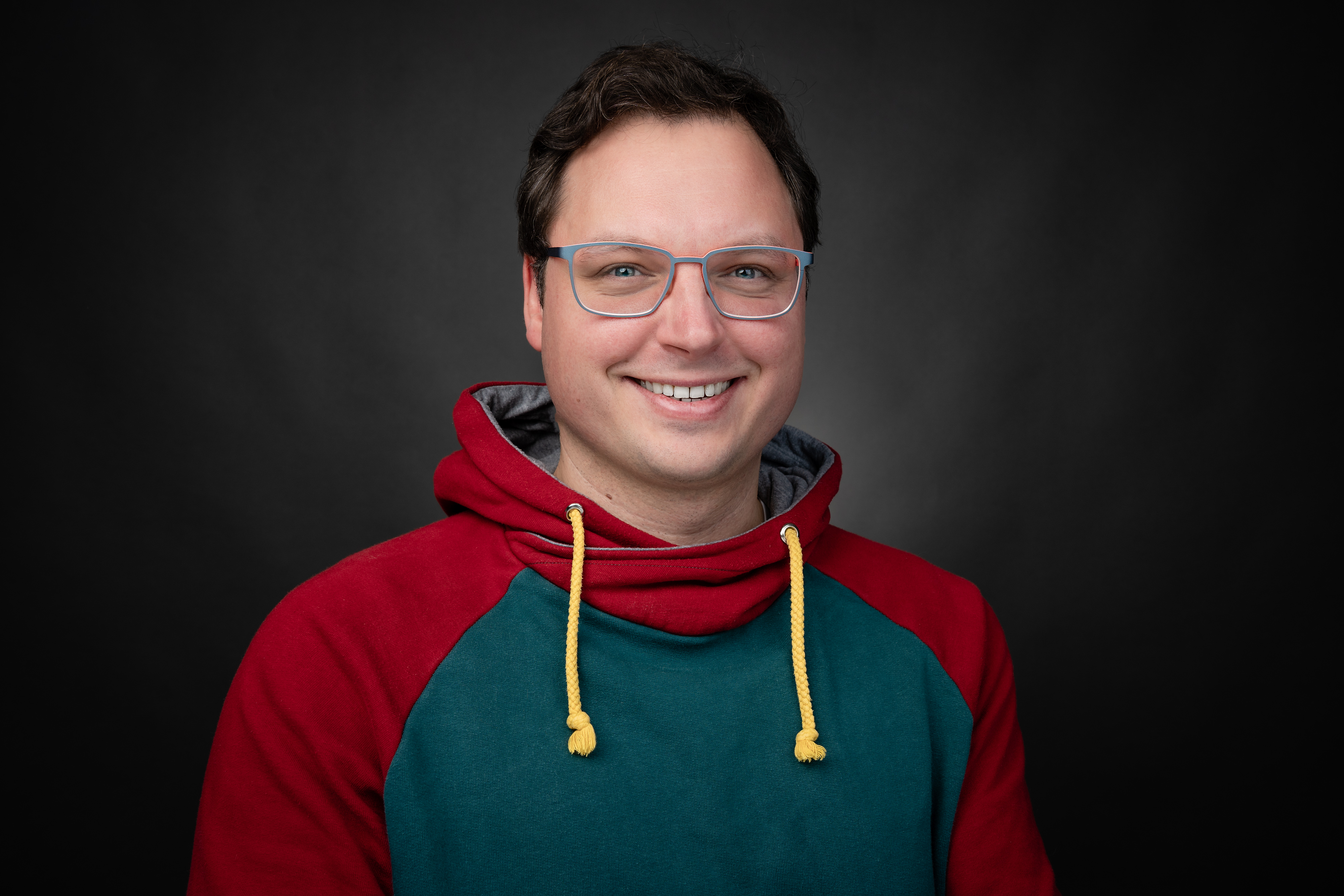
Photo credit: Timo Wans
Day 02 | 11:00&15:00 – Biodiversity Tour
11:00 a.m.–12:30 p.m. & 3:00–4:30 p.m. – Biodiversity tour and workshop
in cooperation with Forster Garten- und Landschaftsbau
How can nature-oriented design concretely contribute to promoting biodiversity? Together with biodiversity expert Dr. Philipp Unterweger, Forster Garten- und Landschaftsbau is creating a tour of the Alanus University campus as part of the festival—with seven demonstration areas laid out and maintained by Forster in a biodiversity-friendly way. An experience for everyone who would like to discover how green spaces can be ecologically enhanced, aesthetically designed, and at the same time sustainably managed. Our goal: together with Forster, we show how biodiversity as a key can shape future-oriented green spaces in companies, municipalities, and private gardens!
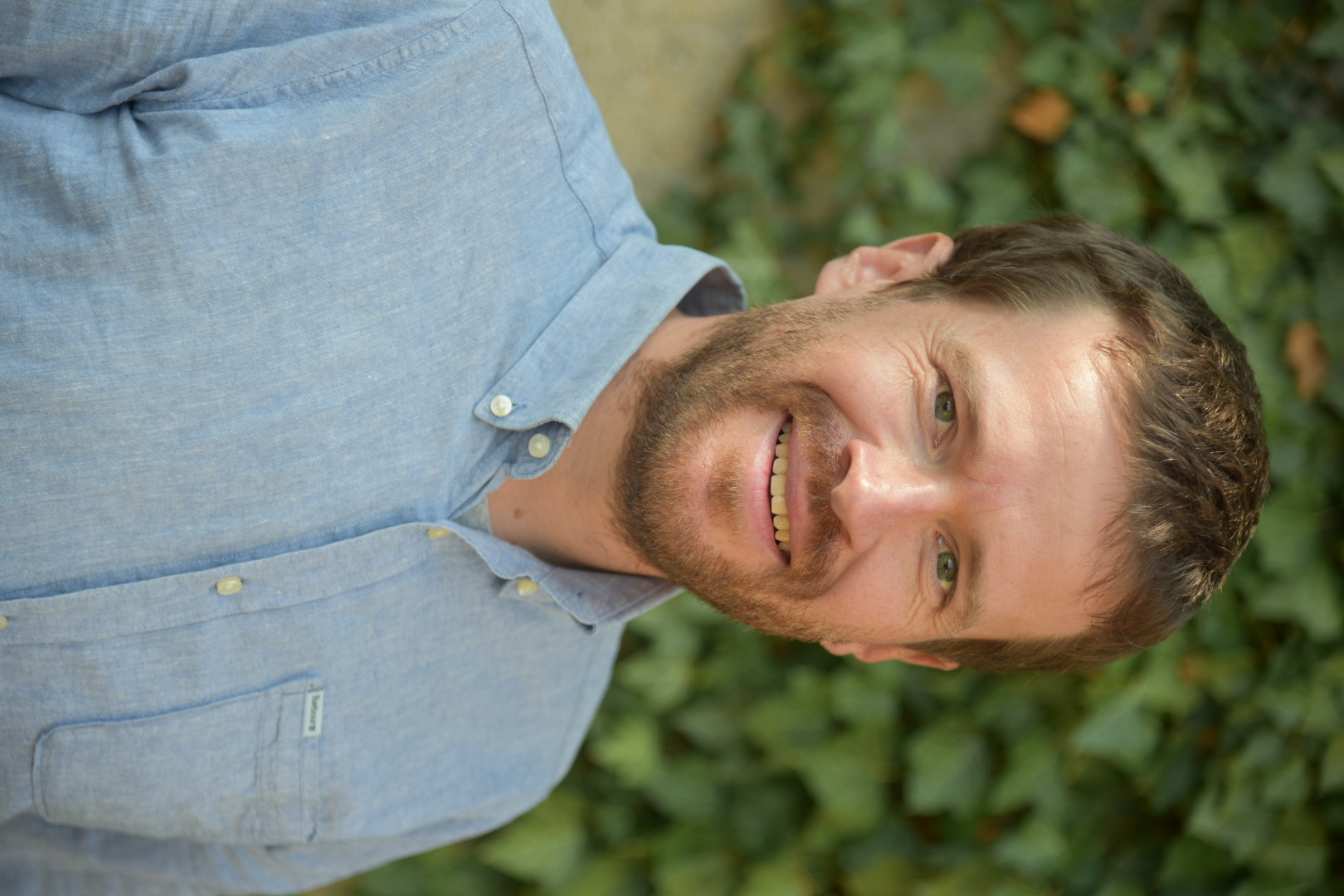
Photo credit: Forster Garten- und Landschaftsbau
Day 02 | 1:15–3:15 p.m. – Interdisciplinary Workshops
In the spirit of the Unfreeze idea—breaking open existing patterns of thought and creating space for new visions—three workshops invite participants to rethink relationships with nature, decoloniality, regional resilience, and community-based forms of economy. Between art, business & land. Registration for open participation in the individual program sections.
Workshop 1: Land, nature, identity: Nature Personhood – Annabelle Wimmer Bakic | Shaman and artist
In this workshop, we will work on a novel, holistic relationship to nature and land in the sense of nature personhood. In this way, we want to gain access to the wisdom of the earth and to interspecies, non-human knowledge. Based on the concept of sacredness, as defined by economist Partha Dasgupta of the University of Cambridge, we will explore the expanded significance of nature for human beings and seek to become aware of what our present Western concept of nature is based on, whether it is still viable or in need of renewal, and what significance human beings could assume for the future of the earth so that the Anthropocene may become an age of new consciousness.
In this workshop, shamanic philosophy meets the latest findings in consciousness research and neurology.
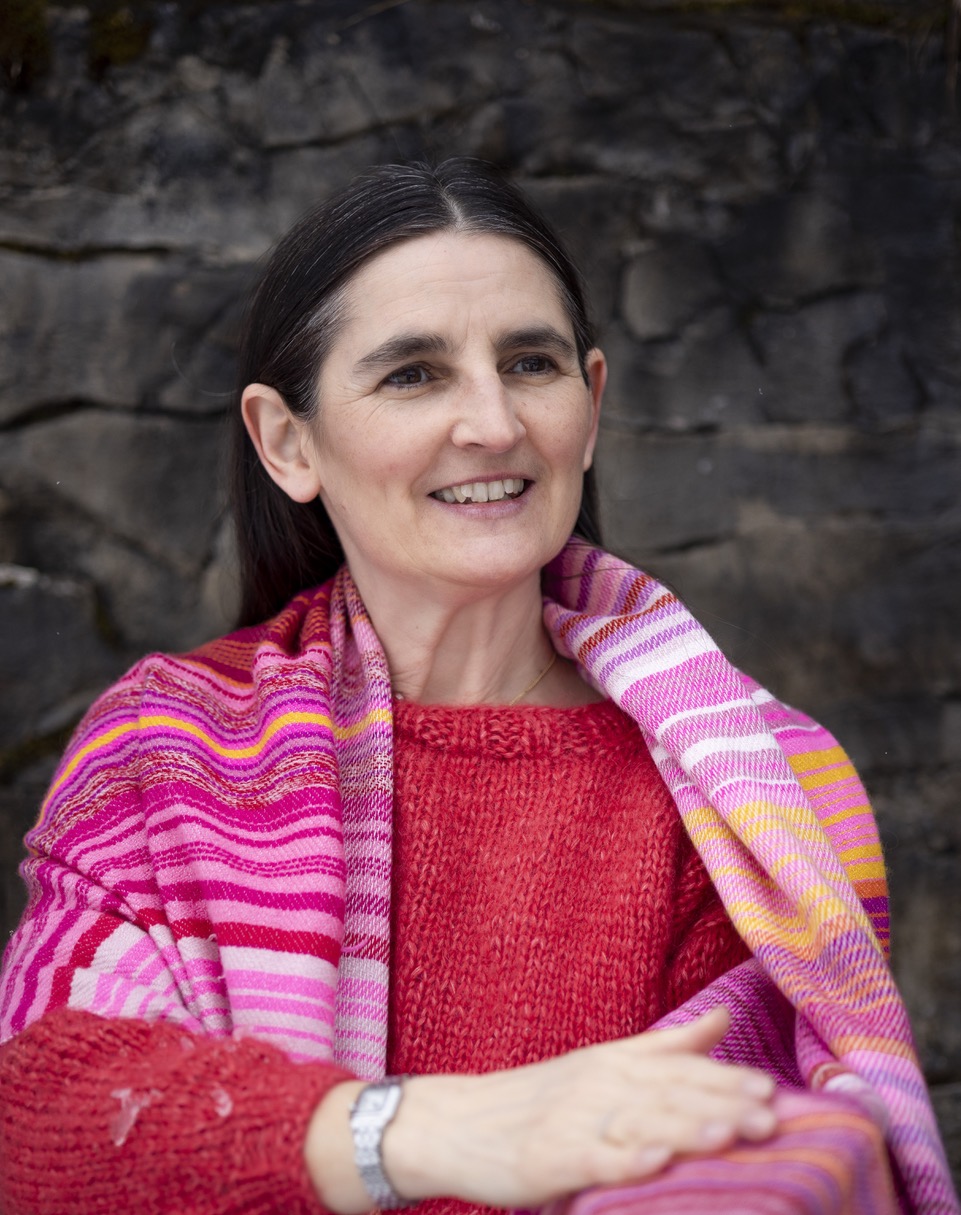
Photo credit: Annabelle Wimmer Bakic
Workshop 2: Frugal Technology & Rethinking Old Machines for Modern Organic Cultivation – Roberto Tinoco | Solawi Bonn/Rhein-Sieg e.V.
For some researchers, Solawis or CSAs are described as a social innovation; beyond that, we understand Community Supported Agriculture as a laboratory for technical innovation. Through our work, we create a platform for a more public-interest-oriented way of doing business in agriculture that puts plants, animals, and people center stage. In my workshop, I would like to use theoretical and practical methods to show how, at Solawi, we have worked together with members and our specialist team on ideas and how these are being implemented. With simple means and lots of creativity, open-source solutions emerge in our wood, metal, and digital workshops that can have positive effects on soil, climate, and biodiversity. I will present theoretical background, literature, and very concrete examples from our practice. In addition, I invite you to think together about which preliminary experimental results are promising for a bio-based circular economy – on-farm and off-farm.
Organized by SoNaR (Founding social enterprises, creating sustainable impact – impact for the Bonn-Rhein-Sieg region). SoNaR is funded under the “Nachhaltig wirken” program by the Federal Ministry for Economic Affairs and Climate Action and the European Union through the European Social Fund Plus (ESF Plus).
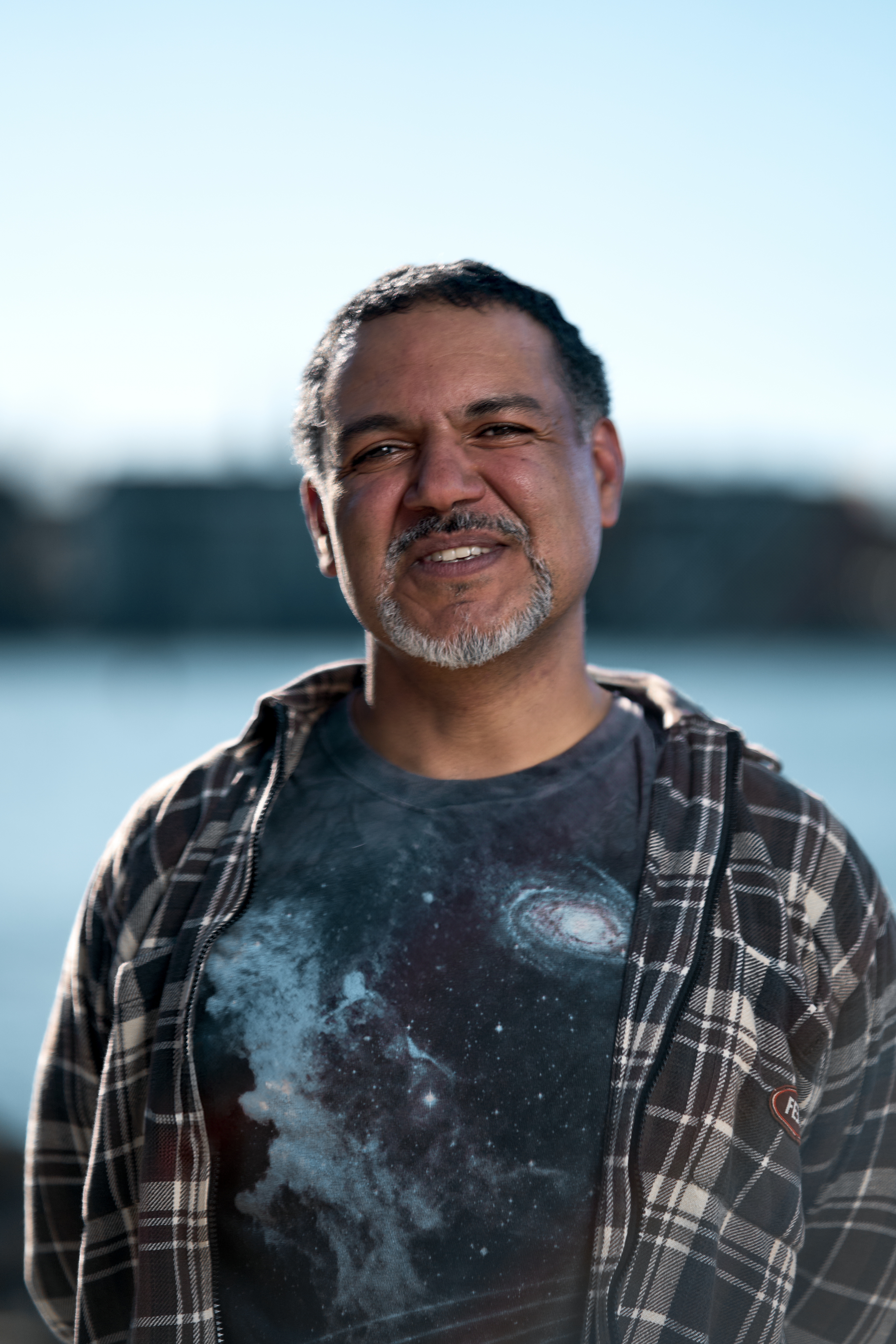
Photo credit: Roberto Tinoco
Workshop 3: Future of Farms – between field and aesthetics – Shari Huwer | Co-founder of Hofpost
The climate crisis and the trend toward ever larger farms with uniform product ranges are challenging agricultural businesses to think anew. One possible path: alternative strategies in direct marketing—whether in the farm shop or via social media. Another: offering products that are unavailable anywhere else. Shari Huwer supports farmers in making their individual strengths visible and developing suitable marketing strategies. In her talk, she reports on her experiences—as a woman in the start-up scene and from her current project, which is bringing nut cultivation (back) to Germany. Together, we will look at the future of agriculture—and discuss the often underestimated role of aesthetics. In the workshop that follows, you are invited to contribute: we will develop unconventional marketing approaches. How do we attract attention—without discounts and without sensationalist sales tricks?
Organized by SoNaR (Founding social enterprises, creating sustainable impact – impact for the Bonn-Rhein-Sieg region). SoNaR is funded under the “Nachhaltig wirken” program by the Federal Ministry for Economic Affairs and Climate Action and the European Union through the European Social Fund Plus (ESF Plus).
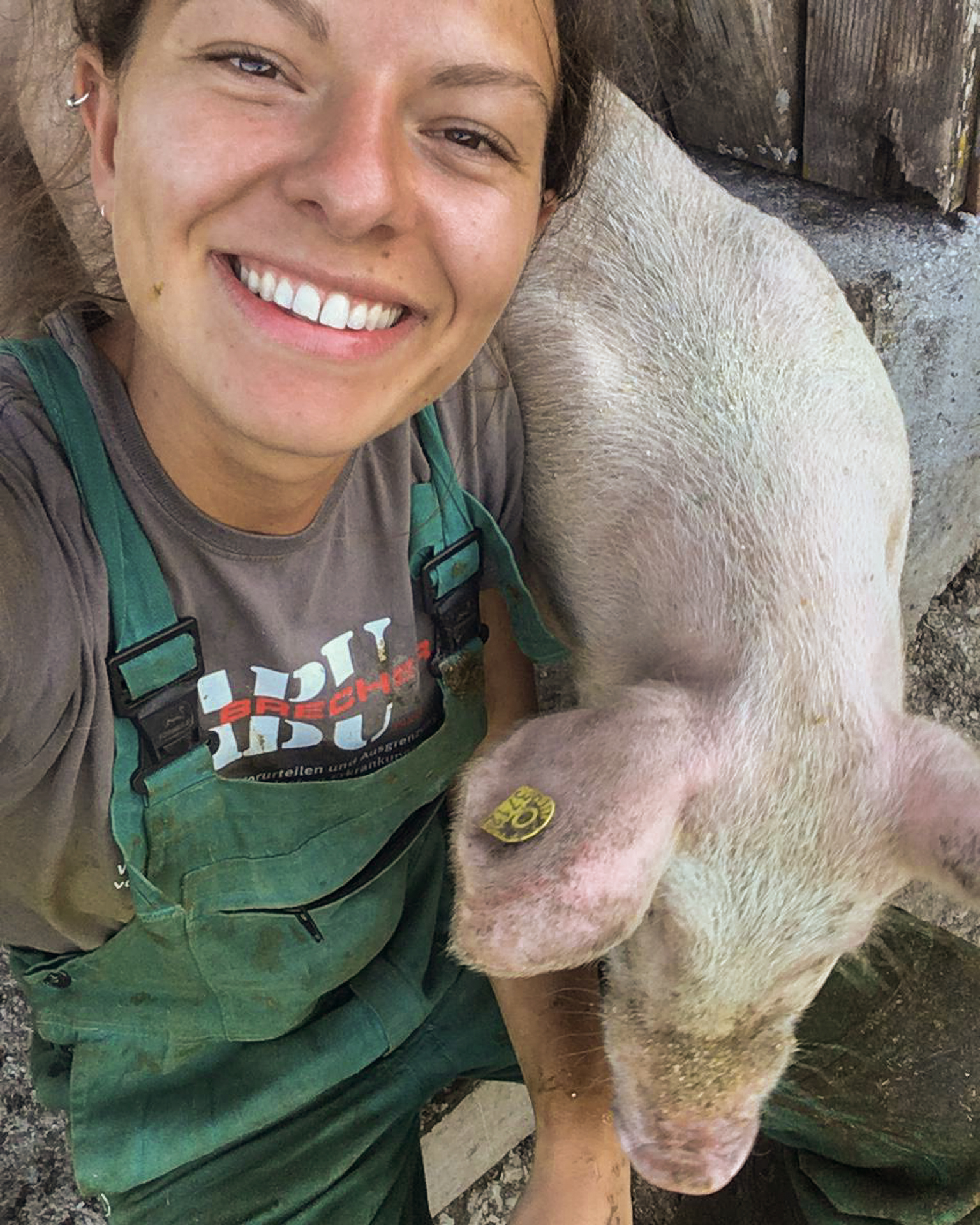
Photo credit: Shari Huwer
Day 02 | 2:00–3:00 p.m. – Performance at the Haystack
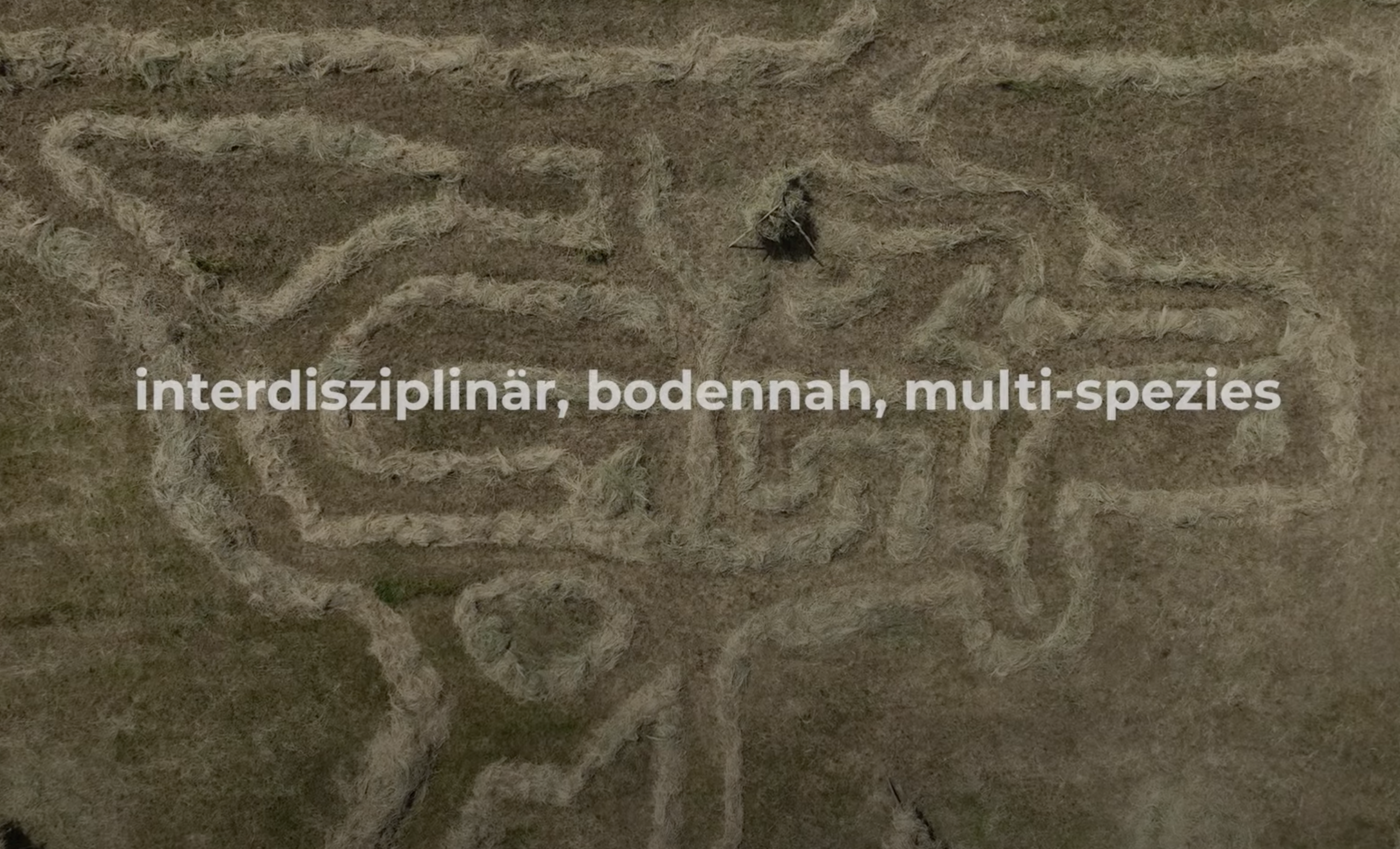
2:00–3:00 p.m. | Major final art project at the haystack
Each graduating class of the Department of Business spends 10 intensive days together staging a jointly chosen theme. Self-organization, bodywork in the team, and a positive imperative (constructive affirmation) are the driving dynamics, and today is the world premiere. We will meet at the haystack on the biodiversity area, which is simultaneously a place of work, experimentation, and presentation. The project is accompanied by Ulrike de Ribaupierre (direction and self-organization), Bianca Lehnard (theater), Julia Honer (dance and performance), and Jenny Thiele (vocals/music).
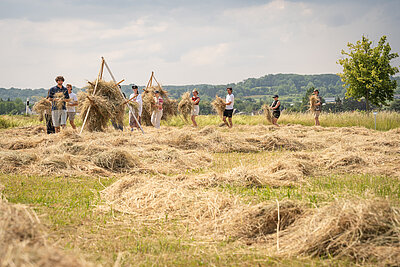
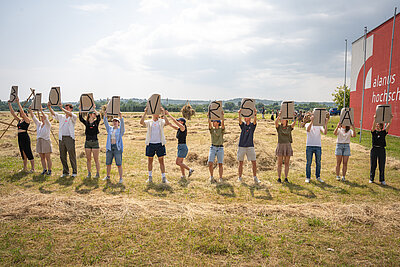
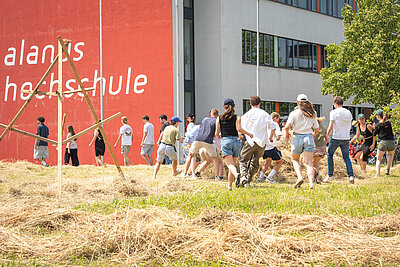
Photo credit: Till Fischer
Day 02 | 3:15–4:00 p.m. – Unfreeze Inputs & Takeaways
In the spirit of the Unfreeze idea, short inputs and dialogues invite participants to break open entrenched perspectives and open up new spaces for thought and action.
In an open, experimental atmosphere, artistic approaches meet practical impulses from business, sustainability activism, and regenerative entrepreneurship.
Whether through meditative practice, radical honesty, or concrete examples of transformation—this session inspires participants to rethink their own role in change and dare to take first steps into unfamiliar terrain.
Free Your Inner Cow – Wapke Feenstra | Myvillages
A guided meditation with pens and chalk.
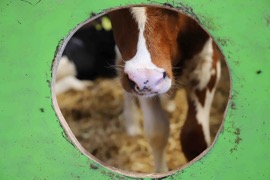
Photo credit: Koe en Landschap/Cow and Landscape 2020-2024, photo Wapke Feenstra 2021
Every Job a Climate Job?! Employee activism in the climate transition – Prof. Susanne Blazejewski & Milan Kiefer | Green Teams Network
Business must change, and we can all contribute: as citizens and consumers, but also in our jobs and roles in the workplace. In the working day between meetings, emails, and the cafeteria, sustainability projects can emerge that reach far beyond one’s own desk. In a workshop, we will work together on how we as employees can become active—concretely and effectively for the planet.
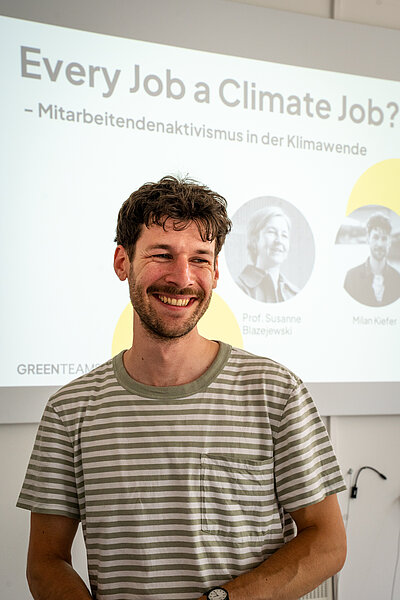
Photo credit: Till Fischer
A little change here, a little “green” there? No longer enough – Stephan Grabmeier | Future & Impact Designer
We are living in times in which transformation is no longer optional—it is mandatory. What is needed now is a radical re:thinking of our thinking and acting. A new understanding of values, business, and responsibility—for people, nature, and the bigger picture. Stephan Grabmeier takes us on a journey to the pioneers of regenerative business. In the context of his new book “Re:thinking Sustainability”, he examined 12 companies that not only preach change, but live it. He has deciphered their success patterns of regenerative transformation—and now shares them with us.
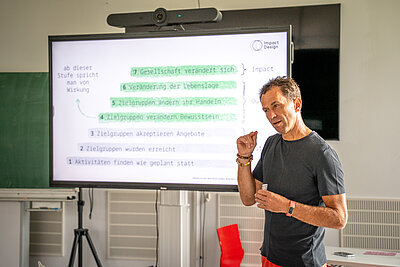
Photo credit: Till Fischer
If ice cream were honest – Jana Windhövel
Jana Windhövel talks about the idea and process of regional ice cream production and what exactly this has to do with different forms of economy.
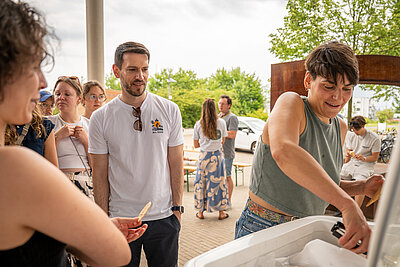
Photo credit: Till Fischer
Day 02 | 4:30–6:00 p.m. – Unfreeze Your Brain Panel
4:30–6:30 p.m. | Unfreeze Panel
Moderation: Kathrin Böhm
Contributions:
Prof. Dr. Katharina Reuter (Managing Director of BNW, honorary professor at Alanus University)
“Don’t be afraid of politics – What paths and spaces do progressive ideas need?”
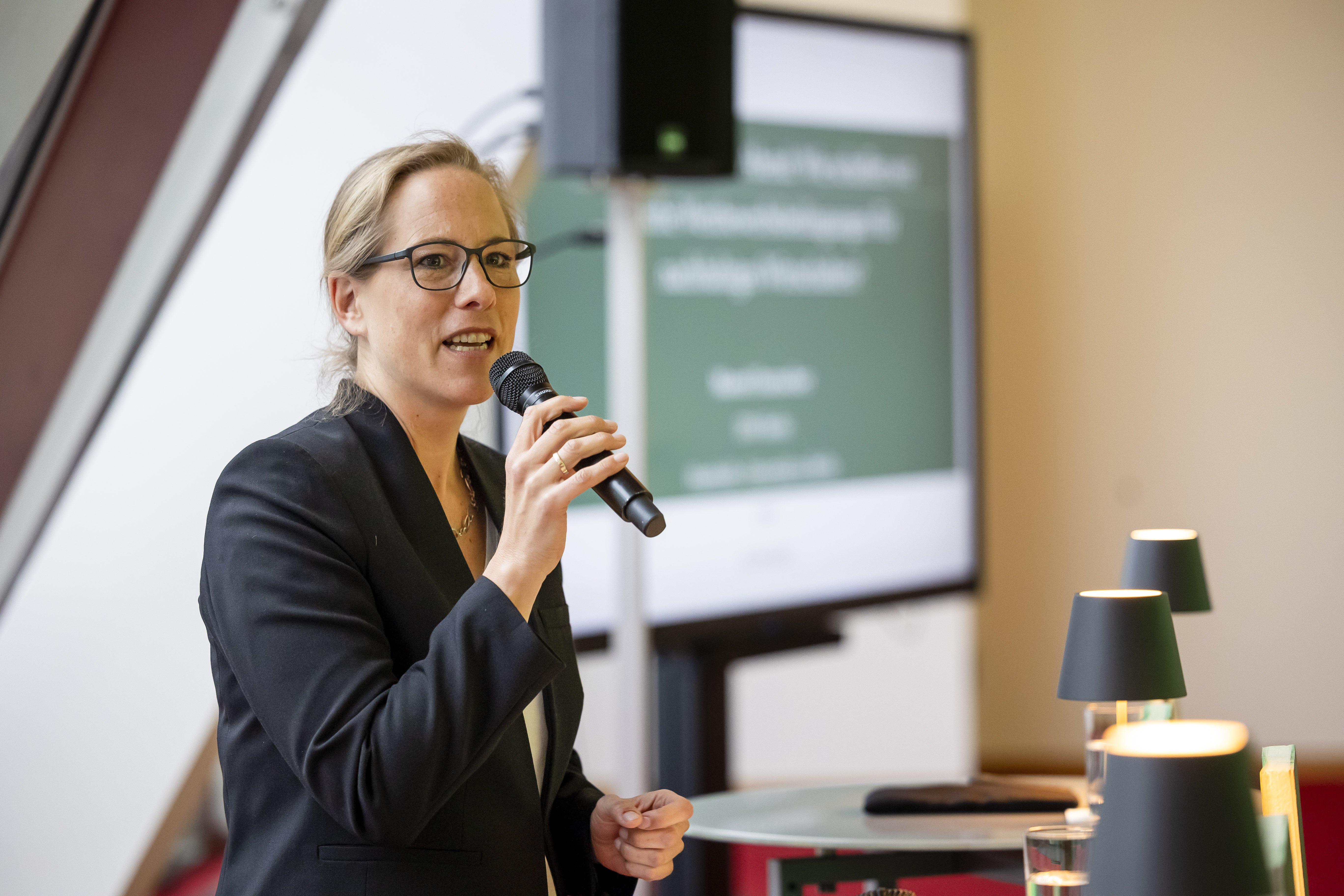
Photo credit: BNW e.V., Jörg Farys
Lavinia Muth ((Un)Sustainability speaker)
“Rethinking decoloniality and business”
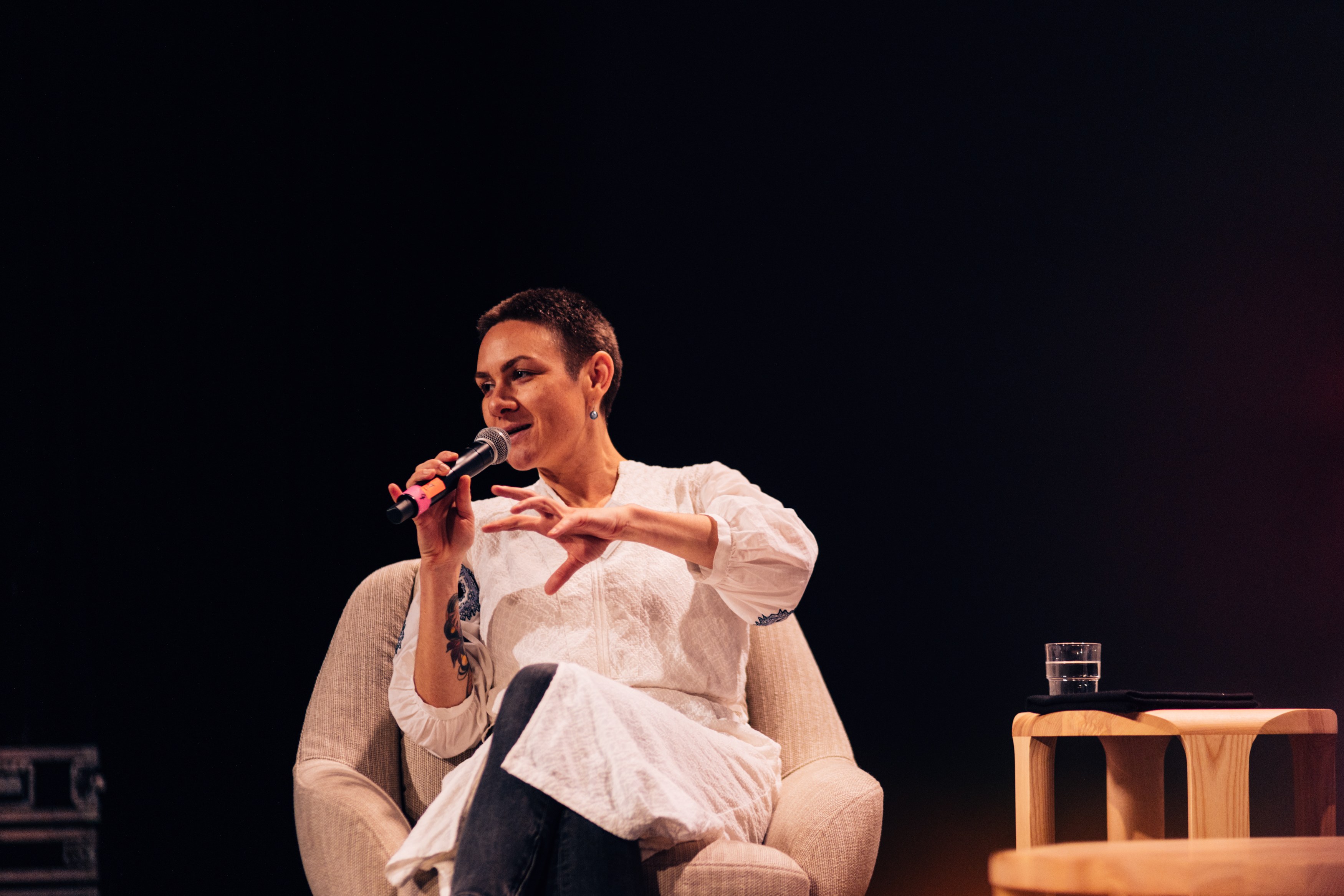
Photo credit: Fashion Changer Konferenz by Cherie Birkner
Wapke Feenstra (Myvillages)
“Casting off urban ways of seeing”
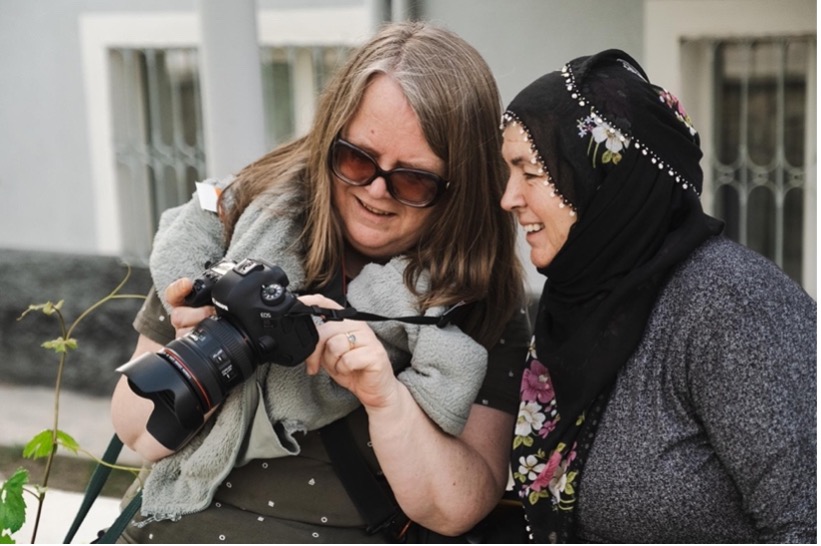
Photo credit: Potato Eaters, research Cappadox Festival 2024 Mete Kaan Özdilek 2024
Timo Wans (Managing Director and co-founder of MYZELIUM)
“The post-growth economy needs growth – Learning from ecosystem service providers”
Photo credit: Timo Wans
Day 02 | from 6:00 p.m. – Music by Ma Kiaru and Closing
from 6:00 p.m. | Music by Ma Kiaru and closing
At the end of the day, the space opens for encounters, music by Ma Kiaru, and conversations in a relaxed atmosphere.
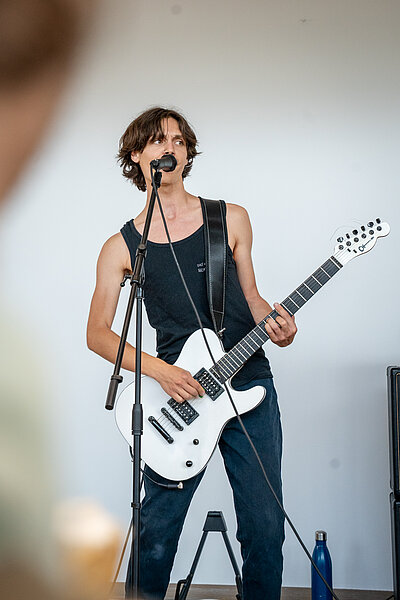
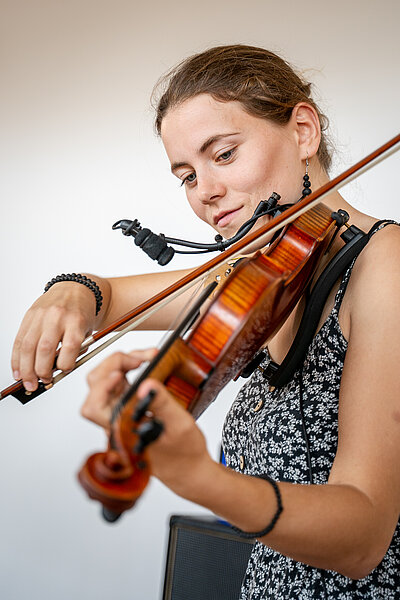
Photo credit: Till Fischer
Accompanying Program: Marketplace and Exhibitions
Alongside the program points, the marketplace invites visitors to explore, join in, and linger. This is where culinary experiences, creative formats, and sustainability come together—a place to unfreeze in the best sense.
Hay tattoos with Wapke Feenstra from Myvillages | Grasses and pasture plants become temporary nature tattoos.
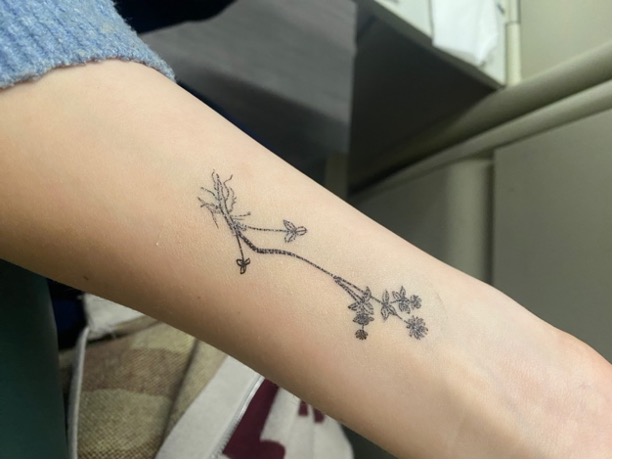
Photo credit: Meadow-Tattoo Clover-3, 2023-25, photo Kathrin Böhm 2024
In Common – interactive artistic stations by the Business master’s course on the topic of city and countryside.
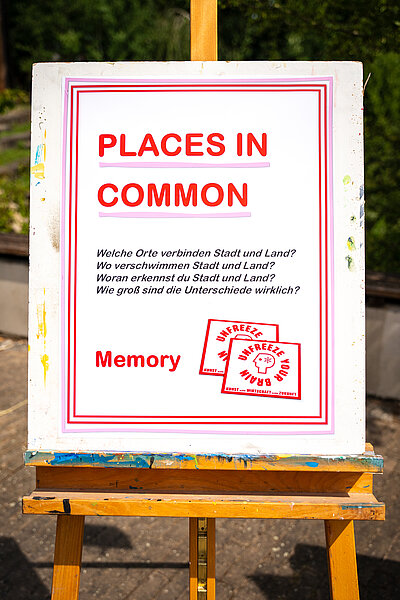
Photo credit: Till Fischer
Information about studying business and Unfreeze Your Brain merchandise – with the team from the Department of Business.
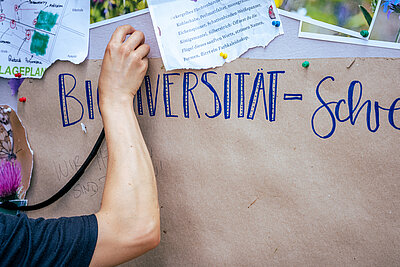
Photo credit: Till Fischer
Fairtrade Coffee Bike – Freshly brewed Fairtrade coffee directly on site.
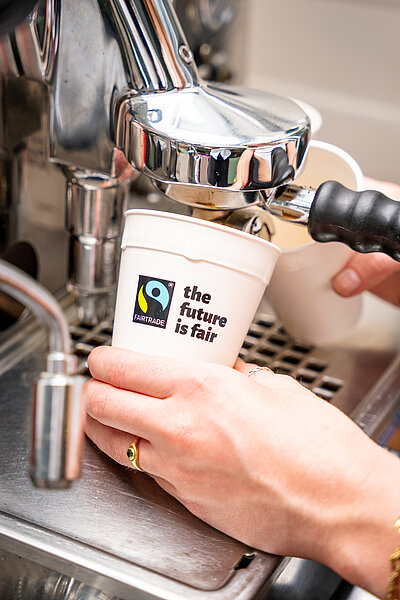
Photo credit: Till Fischer
Screen-printing station – Stop by, print your own motifs, and leave creative traces.
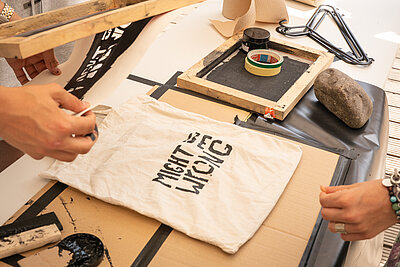
Photo credit: Till Fischer
Unfreeze ice cream stand – with regional ice cream in the spirit of regenerative business and degrowth.
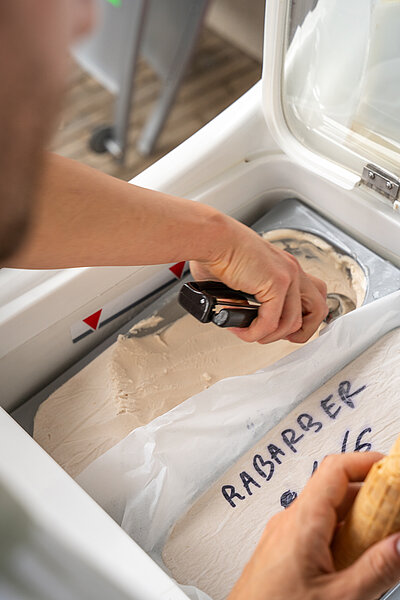
Photo credit: Till Fischer
that’s nuts – Nuts from Germany? that’s nuts! True, but also pretty cool, isn’t it? In beautiful Rheinhessen, Peter Schwalbach planted the first little trees in 2018, and now there are not only buttery walnuts and crunchy almonds from the region, but also 100% walnut and almond oil. You can sample these on Saturdays with Shari Huwer.
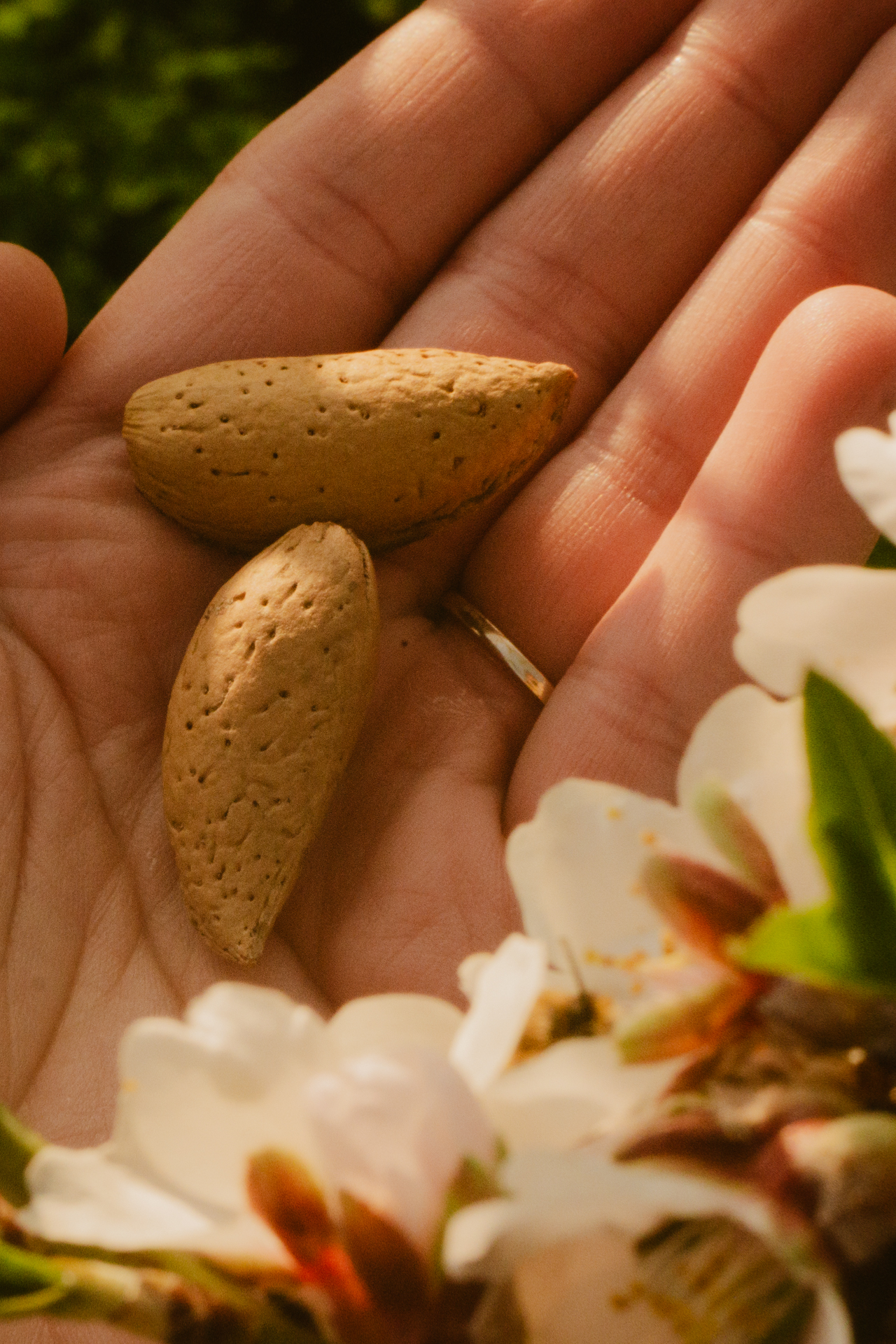
Photo credit: Shari Huwer
Supporters
The “Unfreeze Your Brain” Mini-Festival was kindly supported by the companies Raumtextilshop (www.raumtextilienshop.de) and Lysel (www.lysel.de), the Artepreneur Foundation, UNO INO, SoNaR (Founding social enterprises, creating sustainable impact: Impact Cluster Bonn-Rhein-Sieg Region), Myvillages, and the BNW German Association for Sustainable Business. Heartfelt thanks!