Andrea Barth researches workspaces
03.12.2020 - How is the coronavirus pandemic changing our work environment and our homes?
How is the coronavirus pandemic changing our work environment and our homes?
Andrea Barth researches workspaces and office concepts. Together with Prof. Dr. Susanne Blazejewski, she examines spatial transformation processes that promote new forms of work. In the interview, she talks about changes to work and workspaces through working from home and about her research project.
More work is taking place from home. To what extent is this changing our work?
Due to the pandemic, many employed people had to work from home, regardless of their role and how suitable it was for mobile working. Some had always worked relatively flexibly. “Knowledge work” in particular allows for a flexible approach to place and time of work, and this is being put into practice. For others, however, working from home is new. It is becoming clear that many no longer want to do without working from home in the future. As a university employee, for example, you no longer have to travel to the other campus for every meeting, or you benefit from digitized processes. However, work processes can also become more complicated due to irregular on-site attendance at the university, and spontaneous, informal conversations no longer take place. The sensory experience of places and the “social” aspect of interacting with one another has also diminished. For example, prospective students were previously invited to the university so they could experience the extraordinary atmosphere of Alanus live; unfortunately, that is currently not possible.
Over time, is there more acceptance or more aversion regarding the closeness between work and home?
The current changes and digital possibilities are, of course, bringing work and private life closer together spatially. The “multilocational worker” is no longer geographically “fixed” in their work. This creates opportunities, but also poses challenges. It should be taken into account that employed people work under very different circumstances and conditions. Accordingly, the spatial blurring of the boundaries of work leads both to acceptance and to aversion. For example, studies show that working from home requires more self-organization. This can lead to greater autonomy and empowerment for employees. However, self-organization also requires knowledge, (self-)discipline, and the ability to set boundaries between work and private life. It is important that companies and managers support their employees and protect them from being overwhelmed. Because contrary to common clichés and claims in which working from home is ridiculed or even equated with “not working,” studies show that workplace flexibilization can indeed lead to increased workloads as well. It is likely that the significance and practice of working from home will continue to change further as a result of the pandemic.
How is it possible to draw boundaries from work-related topics within your own four walls?
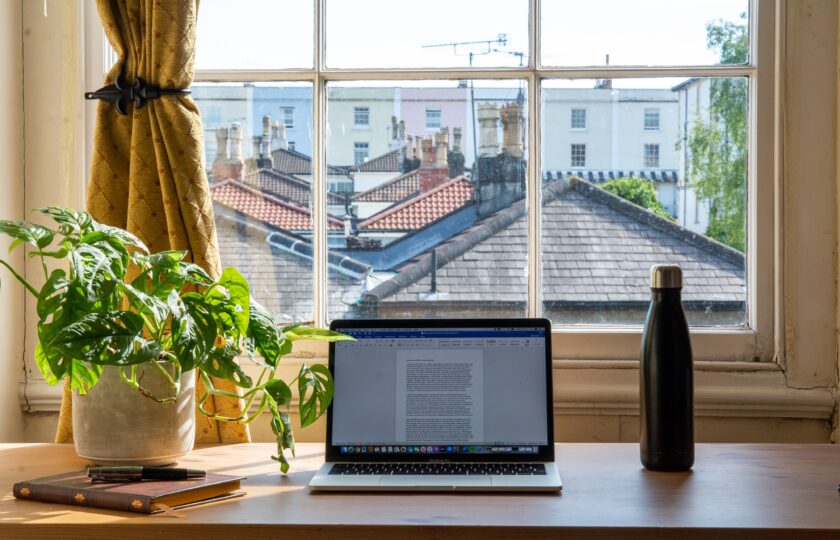
Boundaries to paid work can be drawn in different ways. Paradoxically, by clearly separating work and private life, work is spatially and temporally integrated into the private sphere. Spatially speaking, this means setting up a separate workplace within your own living space and adapting this place with objects similar to those in the office, such as a larger table or an additional screen. Beyond that, time rhythms at home can become more similar to those in the office by creating “periods of concentration” and avoiding disruptions or private conversations at set times. Camera transmission during video conferences also causes the private space to spill over into the professional space. At the same time, however, it is precisely these private moments—for example when children walk through the virtual room or a flatmate can be heard in the background—that give professional interaction a more personal “touch” and bring the “social” back into everyday working life.
Is the significance of on-site spaces changing? How can physical spaces be redesigned, and what needs to be considered?
Yes, in certain industries or areas, a visible change in on-site spaces is already taking place. This change is reaching a new peak with the pandemic. Companies aim to implement new office concepts that promote new forms of work, make work processes more effective, increase employer attractiveness, and also cope with fluctuating space utilization resulting from more working from home. Prof. Dr. Susanne Blazejewski and I examined precisely such a spatial transformation process at an insurance company. As part of a research project, we provided academic support to the company for a year and observed how employees behaved in a new, open, and flexible working environment. Interestingly, it was quite clear that employees were negotiating “what” new work is and, in particular, “how” new work should look, how it should feel, and how it should be lived spatially. Not only the question of “how,” but also “where” which type of work should be carried out changed as a result of the new spaces. The office kitchen becomes a coffee point, the meeting room a playground. Office spaces increasingly became display areas. Employees were intensively involved in the spatial redesign process right from the beginning, which ultimately led to greater acceptance of and satisfaction with the new world of work. Nevertheless, “old” behaviors were also carried over into the “new” world of work, such as the appropriation of individual workstations, which runs counter to the new desk-sharing principle. The social dynamics and the importance of collective meaning-making with regard to new spaces, in particular, should therefore be taken into account in the process of spatial redesign.
Can digital spaces replace physical spaces?
It is assumed that the office of the future will increasingly make space available for collaborative activities such as co-creation and project work, while supporting fewer routine tasks and fewer traditional meetings. We can see that digital spaces can replace physical spaces well in some areas. For example, meetings in the traditional sense, such as the jour fixe or the daily, can be moved into the digital space relatively easily and efficiently. People can “meet” from anywhere at any time with a click of the mouse, and digital spaces now offer a range of interaction possibilities that will probably be expanded further in the future. Identification with one’s job and one’s own work, however, is often tied to physical space and to the company’s artifacts. As already mentioned, the location and the building of Alanus University are identity-forming for many people and also attract our students. The function of the office building as a meeting place and as a manifestation of the company should therefore not be underestimated. It would be interesting to investigate whether and to what extent digital spaces can take on this identity-forming role.
Interview with Andrea Simone Barth
Department of Economics
Chair of Sustainable Workplace and Organizational Design
Photo by Mikey Harris on Unsplash