SPACEmaker!
Prof. Willem-Jan Beeren
SPACEmaker!
Temporary interventions in Bonn city center
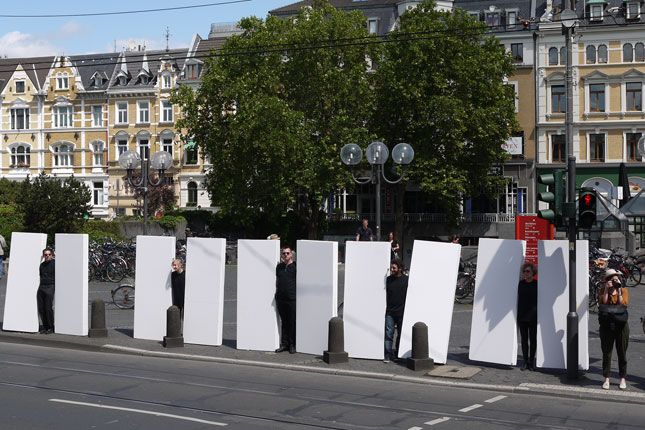
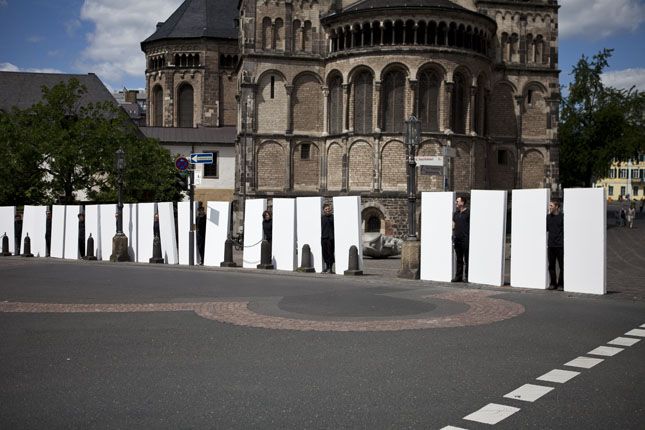
With the help of mobile double-wing wall modules, eleven students from Alanus University and RWTH Aachen became “SPACEmakers” on June 17, 2012.
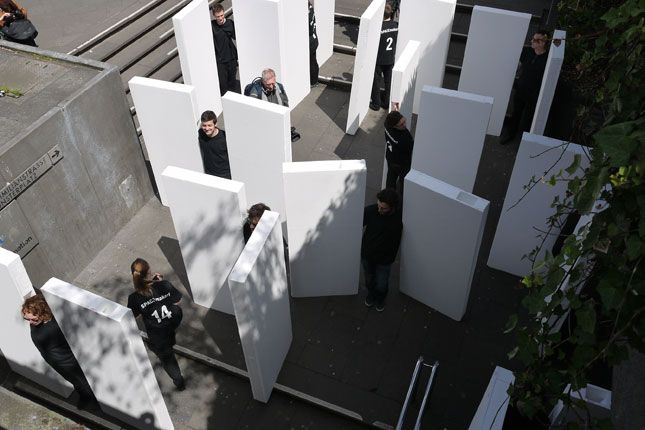
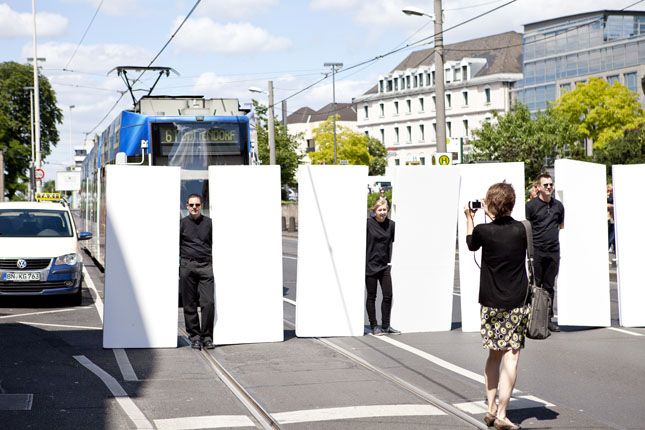
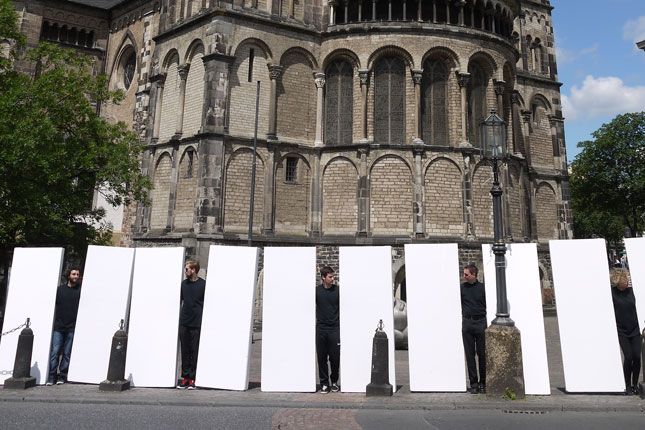
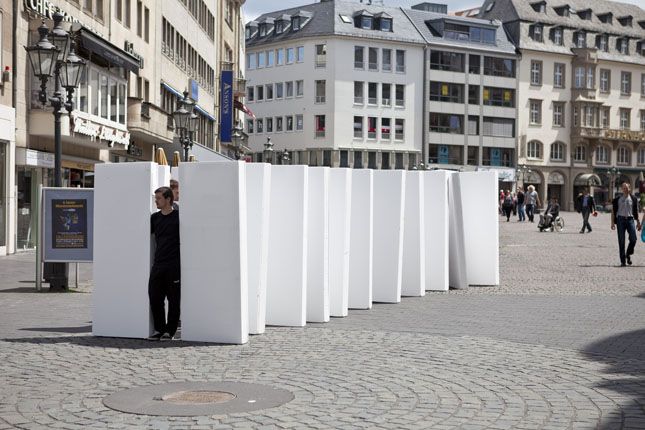
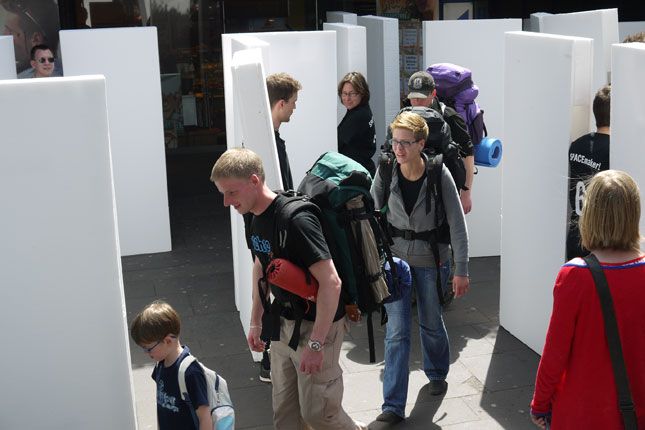
At a total of nine stations in Bonn city center, the students used two-meter-high lightweight structures attached to their arms to create temporary spatial transformations that responded to the specific situation of each location.
At a 1:1 scale, attention-grabbing images were created, traffic spaces were transformed into temporary open spaces, labyrinths were created, pedestrian movements were redirected, and mobile urban spaces were formed. For passers-by and road users, this made it tangible, on the one hand, how strongly the city is shaped by car traffic. On the other hand, the campaign illustrated how many opportunities the city offers for uses beyond motorized traffic. The aim of the SPACEmaker! campaign was to draw attention to traffic in the city and to engage in conversation with interested citizens. The campaign began at 12 noon in front of Bonn Central Station and moved through the city center via several stops, ending at Berliner Platz at around 3 p.m.
The total of nine spatial choreographies were conceived by students of urban planning, architecture, and process architecture under the direction of Professors Florian Kluge and Willem-Jan Beeren from the Department of Architecture at Alanus University in Alfter, as well as Ulrich Berding from the Chair of Planning Theory and Urban Development at RWTH Aachen.
SPACEmaker! was organized on the occasion of AKTION_BAUKULTUR, which took place nationwide on June 16 and 17, 2012, in twelve cities. In this context, further interventions could be seen in Berlin, Dresden, Hamburg, Hanover, and Munich, among other places. Artists used them to draw attention to weaknesses in their city’s traffic planning. Waiting times, noise, safety risks – public traffic spaces are often “no-go areas” that people avoid if they do not absolutely have to pass through them. The Federal Foundation for Building Culture supported the interventions and used them to advocate for better traffic planning in Germany. “The design of traffic spaces is often criminally neglected. Too rarely do we address how comfort and aesthetics can be combined with traffic planning,” explains Michael Braum, Chairman of the Board of the Federal Foundation for Building Culture.
The interventions were the opening event for the Convention on Building Culture 2012, which took place in Hamburg on June 17 and 18 under the motto STATTVERKEHRSTADT. The first day was dedicated to the public with city walks – so-called baukulTours – along the Hanseatic city’s traffic hotspots. On the plenary day, June 18, around 350 appointed participants – clients, planners, architects, engineers, and political decision-makers – gathered and discussed the compatibility of building culture and mobility. The convention concluded with the adoption of the Hamburg Appeal for Traffic Building Culture, which sets out concrete recommendations.
Project team
Prof. Dr. Florian Kluge, Prof. Willem-Jan Beeren, Prof. Ulrich Berding
Cooperation partner
RWTH Aachen, Chair of Planning Theory and Urban Development
Project duration
06/2012