Multivalently potent? Perspectives on Continuing to Build
09/01/2020 - Bachelor's thesis by Alexander Jerosch-Herold, Jakob Krauss and Micha Kretschmann awarded 1st prize in the Campus Masters competition
Bachelor's thesis by Alexander Jerosch-Herold, Jakob Krauss and Micha Kretschmann awarded 1st prize in the Campus Masters competition
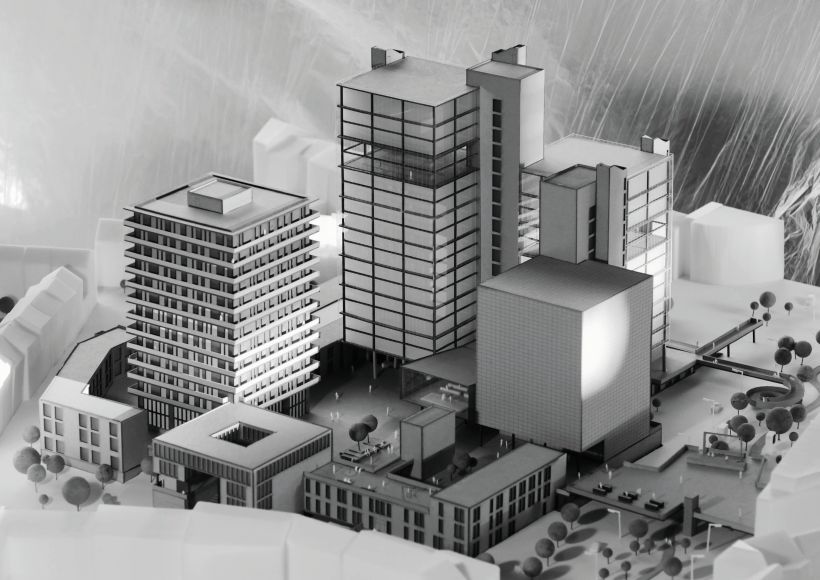
Bonn City Hall: it was intended to become Bonn’s new crown of the city (people were not above comparing it with Bruno Taut’s utopian designs from 1919) and, with its towers, to paint a modern landmark into the city’s skyline. Above all, however, with its administrative apparatus it was meant to be a »house for the citizen«. Yet City Hall became a building the citizens could complain about. Too large, even brutal and bleak, it appears to many people in Bonn, not to mention the Wilhelminian-era buildings demolished for the new construction, which for many represented a piece of personal and urban history. Today, Bonn faces the question of how—and whether at all—to move forward with City Hall.
The award-winning design by Heinle, Wischer and Partner did much to accommodate the image of a modern city center at the time. The expanded Oxfordstraße paved the way for motorists, giving them the route they needed to cement the east-west axis into the city layout. The functionally segregated, car-oriented city of the second half of the 20th century, with its modern, partly transparent architecture, was considered desirable in the still young democracy. Looking at City Hall and its adjacent urban space in 2019, we search in vain for a contemporary, human scale.
In numerous urban development concepts of recent years, we increasingly stumble across the term »reurbanization«. Behind it lies the attempt to reintegrate forms of coexistence lost in today’s functionally segregated inner cities. The city is facing one of its most important current tests, as the question of the city’s very essence re-emerges. What are the social values and architectural qualities that will differentiate the urban from the rural in the future? One of the central characteristics of today’s inner cities is the spatial thinning of social activities. Walter Siebel describes this phenomenon as follows: »In highly urbanized societies (…) the difference in ways of life between city and countryside has shrunk to more or less of the same. It no longer denotes something qualitatively different. The city is no longer the place of a particular way of life.«
Our project advocates preserving and continuing to build on City Hall by showing ways toward a renewed synchronization of urban mentality and architecture. How do we want people to live together in urban spaces today and in the future? And how can Bonn City Hall become part of a transformative reurbanization? The city, and with it City Hall, as a stage, workshop, and home of human coexistence…
Alanus University of Arts and Social Sciences
Department of Architecture
Supervision Prof. Benedikt Stahl and Prof. Swen Geiss