Five Questions for Jaspar Röh
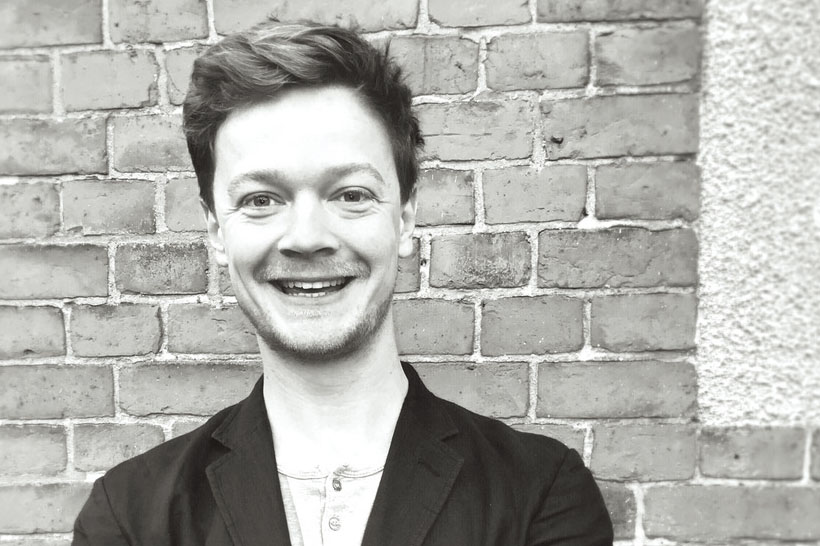
31/01/2020 - Jaspar Röh studies ‘Sustainable Economics’. Alongside his studies, he works for the non-profit organisation Teikei Coffee, which distributes solidarity-traded and sail-shipped coffee. In the interview, he talks about his work at Teikei Coffee and explains the significance of the arts-based practical exercises in the bachelor’s degree programme for him.
Jaspar Röh studies ‘Sustainable Economics’. Alongside his studies, he works for the non-profit organisation Teikei Coffee, which distributes solidarity-traded and sail-shipped coffee. In the interview, he talks about his work at Teikei Coffee and explains the significance of the arts-based practical exercises in the bachelor’s degree programme for him.
1. You are studying Sustainable Economics at Alanus University. What is special about this bachelor’s degree programme?
If a friend who did not study at the university asked me, I would probably mention the artistic content. Economic perspectives are important, but in the end, business is shaped by people. So it makes sense to engage with these concepts in a practical way from time to time. What we have done artistically so far has, for me, primarily been an exploration of myself, my fellow students, and the lecturers, rather than working on a specific subject. That was enriching and has certainly sharpened my perspective on myself and on other people.
Besides the art and the many different courses, the university environment is also something special for me. Conversations at the construction trailer during the summer semester, informal discussions after seminars, occasional talks with lecturers whom I am gradually getting to know better, and the many student initiatives such as the “Public Climate School” last semester or the “Wohnzimmer-Kollektiv” are things I have grown very fond of.
2. What is your favourite course/seminar?
That is a difficult question, because for me it is the mix that matters. Some foundational courses may be a little dry, but I consider them necessary. If I am honest, I am fascinated by the questions of why we structure our economic relationships—such as the way organisations are set up or the mechanisms of price formation—the way we do. In some classes there is more room for this kind of discussion. In those, I feel that I learn the most when the lecturer takes both the topic and the students seriously and truly has their own perspective on it.
3. You work for the non-profit organisation Teikei Coffee. How does the cultivation and distribution of solidarity-traded and sail-shipped coffee work?
Yes, it is a truly wonderful initiative that I help to build alongside my studies. We are guided by the principles of community-supported agriculture: for example, the price should not simply be dictated by the global market, but discussed through dialogue with producers, processors, and coffee drinkers so that it makes sense for everyone. We do not want to pay as little as possible for a commodity—a practice that often creates so-called “external costs” elsewhere—but instead finance the work of the people involved and, in return, receive good coffee that is as ecological and socially responsible as possible. That is how we have already transported coffee by sailing ship from Mexico to Hamburg for two years. A large portion of the coffee is distributed from there to consumer communities throughout Germany. But it is also available in more and more cafés, zero-waste shops, and in our online sample shop.
Although it is demanding, what I enjoy most is maintaining the balance between ideals and practice: simply indulging in ideals helps no one, and orienting yourself only to established practice is not a solution either. When you start doing things differently but at the same time have to remain viable as a business, it becomes really exciting and somehow “real.”
4. What is your role at Teikei Coffee?
It varies greatly, because as a young initiative we have to deal with so many different issues. There are not yet any departments or fixed role descriptions, although we are of course trying to define areas of responsibility more and more clearly. My work really began with taking responsibility for our crowdfunding campaign at the beginning of 2018. I had quite a lot of respect for that because I had never done anything like it before. In the end, we raised 40,000 euros. Since then, I have also been involved in finances, for example. At the moment, we have to work out how to pre-finance the 30 tonnes of coffee and the sailing transport, which is significantly more expensive this year.
In addition, I also repeatedly take on a moderating role during difficult phases in the team, for example when we are developing further or when conflicts arise. Right now, I am dealing with certification and insurance issues.
5. Which people inspire you again and again?
I thought about that some time ago: I realised that even in childhood I did not have classic idols whom I adored and whose posters hung in my room—although there have always been people who impressed me deeply. For a while, these were personalities who were especially full of life, people who really came out of themselves and threw themselves into great adventures. For a time I also read a great deal by Helmut Schmidt and later by the Canadian psychologist Jordan Peterson. Perhaps I like it when people remain true to themselves even in difficult moments and can express their thoughts and opinions with crystal clarity. I believe that ability is very important—in a world as complicated as ours. No matter what I think of another person’s statement: only when someone clearly says what they think do I feel that I am truly facing someone in substantive terms, and only then can I perhaps reach a point where I can think and understand something new.
Recently, however, I have simply been inspired by people who are fully present, who are attentive to the moment, even in small things. I think that is something you can never practise too often.