“Learning with Joy – All the Way to the Abitur”
22/07/2020 - Researchers publish study on the New Upper Secondary Concept at the Evangelical School Berlin Centre
Researchers publish study on the New Upper Secondary Concept at the Evangelical School Berlin Centre
Suggestions for educators seeking new approaches to upper secondary teaching
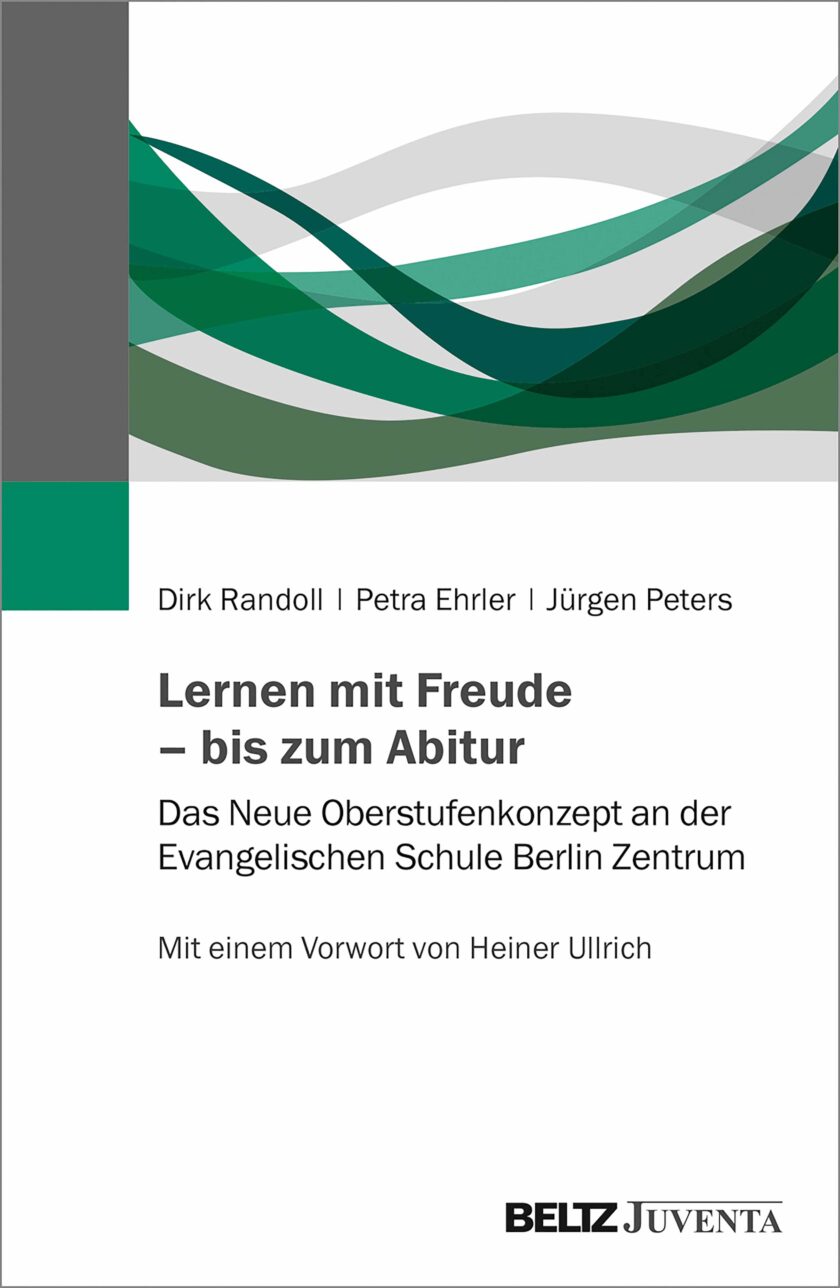
What will the classroom of tomorrow look like? What is needed to enjoy school all the way to the Abitur? How can self-directed, participatory, and autonomous learning succeed? Students, teachers, parents, and experts from the academic advisory board explored these questions and developed a concept for a contemporary upper secondary level at the Evangelical School Berlin Centre (ESBZ). They were supported by the educational researchers Prof. Dr. Dirk Randoll, Dr. Jürgen Peters, and Petra Ehrler, who evaluated the project over a period of three years (2016–2019) and have now published the findings with Beltz Juventa under the title “Learning with Joy – All the Way to the Abitur. The New Upper Secondary Concept at the Evangelical School Berlin Centre”. The aim of the study, conducted at the Institute of Educational Science and Empirical Educational and Social Research at Alanus University and financially supported by the Software AG Foundation in Darmstadt, is to provide upper secondary teachers with scientifically evaluated and proven examples from school practice.
Headteacher Caroline Treier emphasises that the academic support, which developed alongside the introduction of the New Upper Secondary level, has been a valuable enrichment: “The study shows the results of our many years of work. It also provides us with impulses for reflection.” With the publication, she says, it has been possible to make innovative pedagogical approaches visible. The concrete examples in the book positively invite readers to adopt and further develop them.
“Older students want to determine their own learning path and adapt it to their individual needs,” says Ehrler. Against this background, “Pulsar Weeks,” “Learning and Working Skills Workshops,” and “Learning Expeditions” were developed at ESBZ, partly replacing the traditional course model in upper secondary education and creating space for independent work. In doing so, teachers actively involve students in shaping learning processes—in the spirit of a school as a democratic community. “This makes young people feel that their abilities, wishes, and ideas are taken seriously,” the authors write. The study shows that the reform pedagogy-inspired methods are highly accepted by both students and teachers. However, they also changed the demands placed on educators, as learning support rather than the transfer of knowledge takes centre stage. In the foreword, educational scientist Prof. Dr. Heiner Ullrich (Johannes Gutenberg University Mainz) states that, with this successful enrichment of course-based teaching, ESBZ currently serves as a beacon for the design of the upper secondary level leading to the Abitur.
“The aim of the book is to document the experiences gained over the years at ESBZ in such a way that they become understandable and comprehensible for those interested in education,” say the researchers responsible for the evaluation of the New Upper Secondary level. For this reason, the new learning formats are described in detail in the 246-page publication and illustrated vividly through selected examples from classroom practice. More than 2,500 students and 300 teachers took part in the evaluation, which included an anonymised online survey after each completed learning unit as well as personal interviews. The results are intended to encourage practitioners at other schools to adopt parts of the innovative learning concept. “As many as 90 schools have already expressed interest, and some have even already implemented the New Upper Secondary level,” says Dirk Randoll.
Dirk Randoll, Petra Ehrler, and Jürgen Peters: Learning with Joy – All the Way to the Abitur. The New Upper Secondary Concept at the Evangelical School Berlin Centre. Beltz Juventa in the Beltz Publishing Group: Weinheim and Basel 2020, 246 pages, 29.95 euros. ISBN 978-3-7799-3992-4.
About the authors: Petra Ehrler works as a research associate, Dr. Jürgen Peters is a lecturer with special responsibilities, and Prof. Dr. Dirk Randoll has been conducting educational research at Alanus University in Alfter near Bonn since 2002. All three work at the Institute of Educational Science and Empirical Educational and Social Research.
Also read the interview with Professor Dirk Randoll and Petra Ehrler about the study on the website of the Software AG Foundation.