“I woke up and realized that I have to fight.”
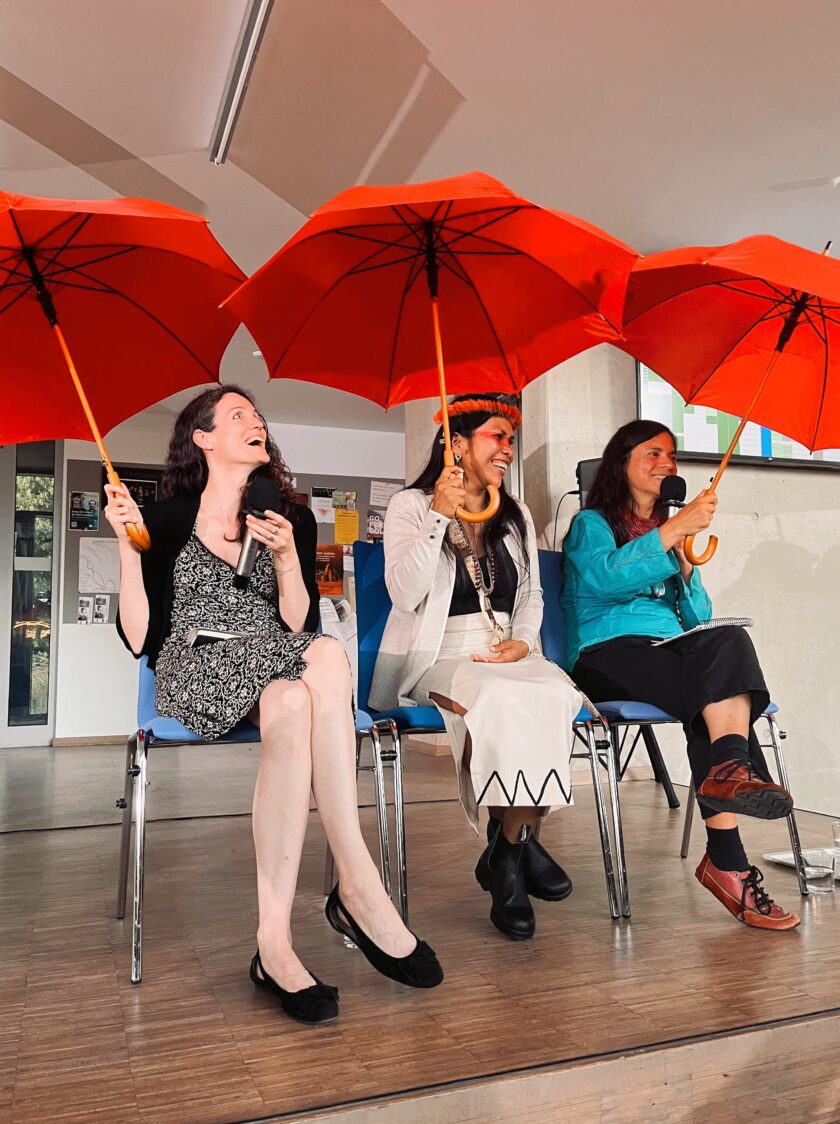
09/06/2022 - The “Guardian of the Rainforest,” Nemonte Nenquimo, visited Alanus University on 7 June. According to Time Magazine, the Waorani leader and climate activist is one of the 100 most influential people in the world! Here you can find student Christina Hunold’s event report and the video of the event.
The “Guardian of the Rainforest,” Nemonte Nenquimo, visited Alanus University on 7 June. According to Time Magazine, the Waorani leader and climate activist is one of the 100 most influential people in the world! Here you can find student Christina Hunold’s event report and the video of the event.
I can’t remember the last time I saw so many visitors gathered in the foyer. Even the floor and the balustrades were occupied. And although it was so crowded, there was an almost reverent silence when Nemonte Nenquimo began to speak and allowed us to share in her life. In her life and in the resistance she is advancing together with, and on behalf of, so many people. Because, as she made very clear, the way things are going now means that prosperity is a struggle for life and death for many people. She spoke about the value of the collective in contrast to the individualistic tendency that causes us to lose touch with the environment and with one another. About a capitalist system that has permeated our consumption-oriented understanding of education and robbed entire peoples of their dignity and of a say over the very basis of their lives. Mother Earth, she says, does not want to be saved; she wants to be respected, and she will not let herself be saved but will swallow us all if we continue like this.
The moment when her interpreter needed a moment to explain to her what sustainability was, so that she could respond to the question about the connection between sustainability and spirituality, was the most striking for me. A many-voiced murmur rose out of the otherwise prevailing silence. For this word is so omnipresent for us that we apply it to every area of life. But what is a person to make of it whose culture has always existed in harmony with the environment? The realization that the very existence of the term sustainability stands for the advanced loss of an existential connection between human beings and the basis of their lives was therefore especially significant to me.
Her appeal to those present, before we left the foyer again, was to take change into our own hands, to make the struggle of Indigenous peoples more visible, and to carry it forward. Because even today, she said, many people are still unaware of the situation, and much well-intentioned donation money does not reach those for whom it is intended. What is needed is concrete action instead of fine words.
The event with Nemonte Nenquimo at Alanus University was made possible thanks to the initiative of our professor Andrea Sunder-Plassmann in cooperation with Amazon Frontlines, Flourishing Diversity, and One Resilient Earth.
More about Nemonte Nenquimo