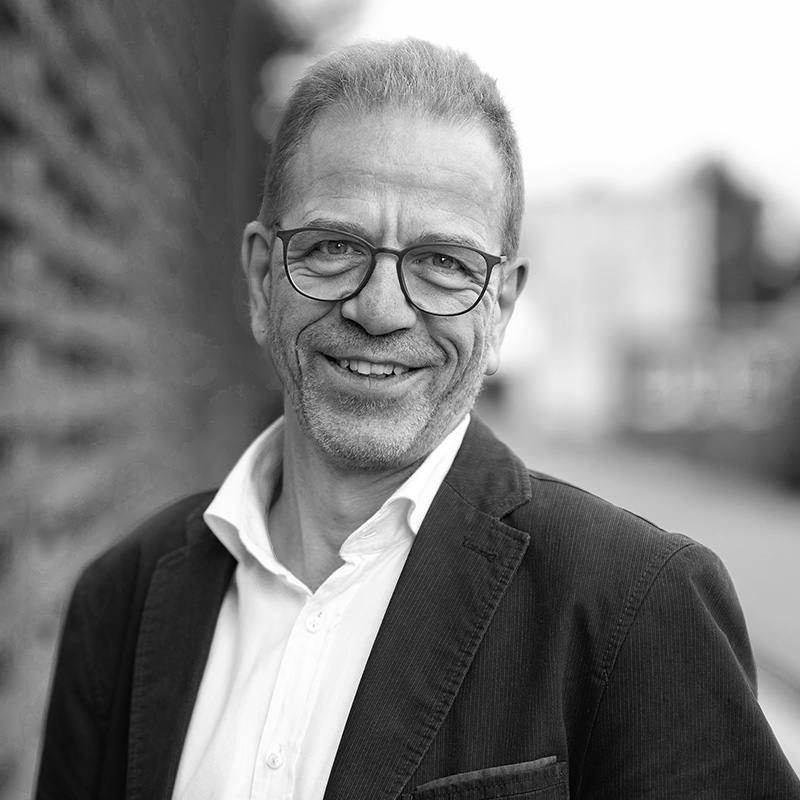
Prof. Dr. Thomas Maschke
Rector, Professor of Inclusive Education with a focus on emotional and social development
Phone: 02222 9321 1928
Education and professional career
since 01/09/2024 // Rector of Alanus University of Arts and Social Sciences
since 2019 // Professor of Inclusive Education with a focus on emotional and social development
2018 // Awarded a Dr. phil. at the University of Passau
since 2010 // Patron of the in-service remedial teacher seminar at Lake Constance
since 2011 // Visiting lecturer at the Institute for Waldorf Education, Inclusion and Interculturality
2009 – 2011 // Visiting lecturer at the Academy for Waldorf Education, Department of Curative Education
2006 // Awarded a Dr. paed. at Comenius University Bratislava (SK)
1998 – 2009 // Visiting lecturer at the Free University for Anthroposophical Education Mannheim, Department of Curative Education
1995 – 2014 // Head of the Kaspar Hauser School
since 1990 // Class teacher at curative education schools (initially in Brachenreuthe, then at the Kaspar Hauser School in Überlingen)
1982 – 1990 // Studied education, special education and disability education (teaching qualification for special schools), as well as Waldorf education in Würzburg, Bremen and Stuttgart
1981/82 // Civilian service at a children’s hospital in Würzburg: care and support for “severely multiply disabled” children
1981 // Abitur in Lüneburg
Selected publications
Books, edited volumes
- Beckel, Larissa/Maschke, Thomas/Stein, Fanny (eds.) (2024). Bildungsgerechtigkeit. transformation – empowerment – sustainability. Salzburg: Residenz Verlag.
www.residenzverlag.com/buch/bildungsgerechtigkeit
- Barth, Ulrike, Maschke, Thomas (eds.) (2021). Dimensions of educational spaces. Experiencing – Encountering – Learning. Vienna and Salzburg: Edition Kunstschrift im Residenz-Verlag.
www.residenzverlag.com/buch/dimensionen-padagogischer-raume
- Maschke, Thomas (2021). Playing together. Practising perception and encounter. With illustrations by Sabine Maschke. Vienna and Salzburg: Edition Kunstschrift im Residenz-Verlag.
www.residenzverlag.com/buch/miteinander-spiele
- Maschke, Thomas (ed.) (2019). Educational innovation: impulses from progressive education and inclusive education. Series an:regung pädagogik, volume 1. Vienna and Salzburg: Residenz-Verlag.
Reviews of Maschke (ed.) (2019)
H. Greving in: Menschen.
- Maschke, Thomas (2018): Waldorf education and inclusive learning – impulses for discursive developments. Passau.
- Barth, Ulrike; Maschke, Thomas (eds.) (2014): Inclusion. Shaping diversity. A practical handbook, Stuttgart: Verlag Freies Geistesleben.
Review of Barth/ Maschke (eds.) (2014)
In: Behinderte Menschen. Journal for living, learning and working together. No. 6/2015, p. 83.
- Feuser, Georg and Maschke, Thomas (eds.) (2013): Teacher education under review. What does the inclusive school need?, Gießen: Psychosozial-Verlag.
Reviews of Feuser/ Maschke (eds.) (2013)
- Kaschubowski, Götz and Maschke, Thomas (eds.) (2013): Anthroposophical curative education in schools, Stuttgart: Kohlhammer.
Review of Kaschubowski/ Maschke (eds.) (2013)
In: Behinderte Menschen. Journal for living, learning and working together. No. 6/2015, p. 85.
- Maschke, Thomas (ed.) (2010): … on the way to a school for all. Integrative practice at Waldorf schools, Stuttgart: Verlag Freies Geistesleben.
Review of Maschke (ed.) (2010)
In: Behinderte Menschen. Journal for living, learning and working together. No. 6/2015, p. 87.
- Maschke, Thomas (2008): Integrative aspects of anthroposophical curative education in theory and school practice, Frankfurt/ Main: Peter Lang.
Selected articles, book chapters
Maschke, Thomas (2024). Pupils with special educational needs in emotional and social development. In: Buchka, Maximilian & Brockmann, Michael (eds.). Pupils with special educational needs in the classroom. Case studies – specialist knowledge – impulses for primary school practice. Stuttgart: Kohlhammer. pp. 52 – 65.
Maschke, Thomas (2024). (School) achievement as a central issue of educational equity, with a focus on inclusive learning. In: Beckel, Larissa/Maschke, Thomas/Stein, Fanny (eds.). Bildungsgerechtigkeit. transformation – empowerment – sustainability. Salzburg: Residenz. pp. 47 – 62.
Maschke, T. (2020). Playing together: learning workshop for communication and social interaction – a practical report. In: U. Stadler-Altmann, S. Schumacher, E. A. Emili, E. Dalla Torre (eds.). Playing – Learning – Working. Cooperation and collaboration in university learning workshops. Bad Heilbrunn: Klinkhardt-Verlag.
Maschke, T. (2019). Individuality in community: on the development of inclusive Waldorf education. In: A. Wiehl (ed.). Study book on Waldorf school education. Bad Heilbrunn: UTB im Klinkhardt-Verlag.
Barth, U. & Maschke, T. (2019). School inclusion between aspiration and reality. Implementation of school inclusion in German Waldorf schools. In: Journal “Seelenpflege in Heilpädagogik und Sozialtherapie”, vol. 38, issue 3 (pp. 35 – 48). Dornach.
Maschke, T. (2019). Differentiated parental choice – school inclusion between aspiration and reality. In: H. Barz (ed.). Education and school – parent study 2019: attitudes of parents in Germany towards school policy. Münster: Waxmann.
Maschke, Thomas (2018). Inclusive education. In: Barz, H. (ed.): Handbook of educational reform and progressive education. Wiesbaden: Springer VS.
Maschke, Thomas (2017): Democratically inclusive school: how does it work? Perspectives from Waldorf educational theory and school practice. In: Lobell, Peter und Martzog, Philipp (eds.): Paths to teacher personality, Opladen (Verlag Barbara Budrich).
Maschke, Thomas (2016): Curative education competence. In: Journal “Punkt und Kreis” 46, Echzell-Bingenheim (Anthropoi).
Maschke, Thomas (2015): The need for development – and the right to it! A pedagogical essay, in the journal “behinderte Menschen”, vol. 38 issue 6 (special issue “Anthroposophical lifeworlds”), Graz and Linz (A), December 2015.
Maschke, Thomas (2015): The development of inclusive education; in: Lehrerrundbrief 102, Stuttgart 2015.
Curative education teaching – or: how teaching can promote individual development; in: Grimm, R. and Kaschubowski, G. (eds.) (2008): Compendium of anthroposophical curative education, Munich: Ernst Reinhardt.
Changes in curative and special education diagnostics; in: Gäch, A. (ed.) (2004): Phenomena of change. What challenges curative education and social therapy face, Lucerne (CH): SZH.
Current research focuses
- Teaching in heterogeneous learning groups: didactics and methodology under the conditions of different forms of differentiation
- Curative education diagnostics in their relevance for the development of a general pedagogy
- Support and development planning
- Differentiated instruction
Research profile
Research field 1: Inclusive education
Waldorf education and anthroposophical curative education still occupy a niche within educational science discourse. Their practice is certainly recognised in (specialist) regional contexts – yet a well-founded discussion of their theoretical foundations hardly takes place in general (cf. Schieren 2016).
The following guiding research questions arise from this observation:
- What are the main characteristics of Waldorf education and anthroposophical curative education respectively, with a focus on their expansion/development into inclusive Waldorf education?
- How can their respective specificities and qualities be made available to the general professional and academic discourse, including and especially with the claim and possibility of contextual expansion or further differentiation?
Projects
- Annual research symposia (since 2016) “Waldorf Education and Inclusive Education in Dialogue” (together with Ulrike Barth) with participants from the universities of Düsseldorf, HU Berlin, Bremen, Passau, Erfurt, Frankfurt/Main, Mannheim University of Applied Sciences, as well as associations and schools.
Thematic focal points:
- Foundations of Waldorf education and inclusive education. Publication:
Maschke, Thomas (ed.) (2019). Educational innovation: impulses from progressive education and inclusive education. Series an:regung pädagogik, volume 1. Salzburg: Residenz-Verlag. - Dimensions of (inclusion-)pedagogical spatial design. Publication:
Barth, Ulrike & Maschke, Thomas (eds.) (forthcoming). Dimensions of educational spaces. Experiencing – Encountering – Learning. Series an:regung pädagogik, volume 4. Salzburg: Residenz-Verlag.
Also contribution to the conference “Participation – School – Development” (9 and 10 May 2019) at PH Zurich (together with Eduard Arnd, Ulrike Barth and Christina Hansen) - Cross-university cooperation with Moscow State Pedagogical University (MPGU):
3rd All-Russian scientific-practical problem seminar, 21/03/2018, - Moscow State Pedagogical University (MPGU):
Theoretical and practical foundations for the education of people with severe intellectual disabilities – supported development
Lecture: “Professional relationship-building as the foundation of education”
Research project and excursion with students (together with the University of Passau) 2019: “Inclusive Education as a Global Aim of Further Education” - Empirical study on individual support systems in German Waldorf schools:
2 preliminary studies (2018 and 2019) were conducted as pilot studies for an intended extensive study in 2020/21 (updated due to the pandemic: 2020 – 2022). The working hypothesis derived from these studies (based on the interim results obtained) is that there are pupils with an identified specific support need at all German Waldorf schools (figures from the Federation of Free Waldorf Schools, cf. Maschke 2019a and 2019b), but only in a few cases are there conceptually developed and institutionalised in-school support systems, which are to be characterised as school-specific in each case.
As a consequence of these findings, a guideline for establishing such systems (including pedagogical and social law foundations) is being developed and published (2022).
Research field 2: practical development of social skills
Problems that arise among pupils (at school) as a result of specific developments in the area of emotional and social development can and must be understood in the context of the development of perceptual and communicative abilities.
Guiding research questions:
How can children and young people be supported in developing the ability to make diverse and differentiated perceptions, especially in social terms?
What expanded options for action can be developed or supported on this basis?
Projects
- Establishment of a university learning workshop for the development of further social competences through cooperative forms of play (winter semester 2018/19)
- Currently conceptualising a university learning workshop and establishing it from winter semester 2021
Publication: Maschke, Thomas (forthcoming). Playing together. Practising perception and encounter. Series an:regung pädagogik, volume 3. Salzburg: Residenz-Verlag.
Also contribution to the 12th International Conference of University Learning Workshops (13 – 15 February 2019), Free University of Bozen, Brixen campus: Playing – Learning – Working. University learning workshops between cooperation and collaboration.
Forum: “Playing Together” (together with students from the Mannheim learning workshop)
Memberships
- DGfE (German Educational Research Association)
- Association for Anthroposophical Social Work (anthropoi federal association)
- Federation of Free Waldorf Schools
- NeHle e.V. (International Network of University Learning Workshops)