Unlocking Hidden Potential
27/04/2021 - Aesthetic Education in the Pedagogy Degree Program
Aesthetic Education in the Pedagogy Degree Program
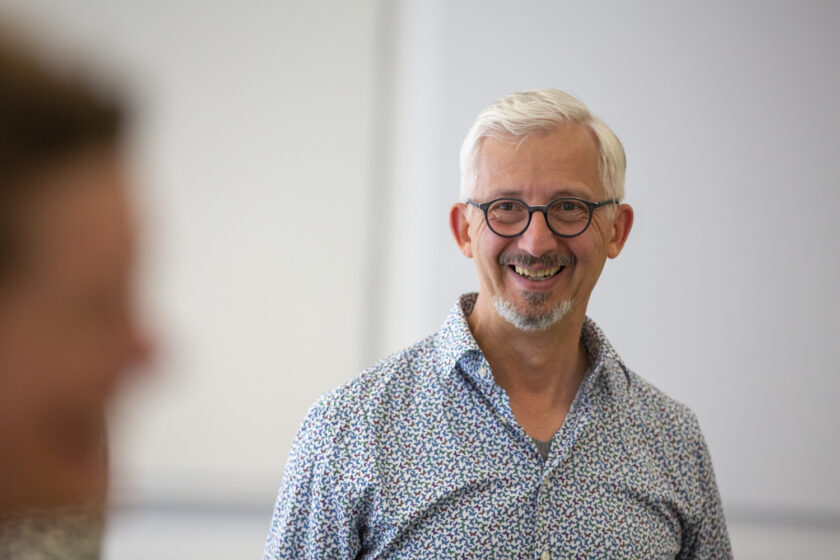
Artistic projects such as creating a play together can unleash unexpected strengths and open up new spaces for experience. Speech and drama pedagogy not only provides the necessary methodological and didactic tools, but also offers students plenty of opportunities for self-exploration. Ulrich Maiwald, Professor of Language and Performative Art at Alanus University, shares his experiences in this interview.
Three questions for Ulrich Maiwald, Professor of Language and Performative Art at Alanus University of Arts and Social Sciences in Alfter/Bonn.
What do you understand by aesthetic education, and what role does it play in the training of educators?
For me, aesthetic education encompasses three central aspects. First, it is about engaging perceptively with art and aesthetics and thereby broadening one’s personal perspective on the world. Second, it also involves being creatively active oneself, experiencing the means of artistic expression and learning how to use them. Third, through an aesthetic engagement with the world, we also come to know ourselves and our potential better and can develop further in this way – so it is also about self-education. In pedagogy, we need not only subject-specific competence but also practical competence. Art is an ideal field of learning for this, because I can never stop at knowledge alone. What I engage with intellectually and emotionally in the artistic process – by developing ideas, dealing with my own inner life, but also with the material itself – only becomes perceptible when I also put it into practice. Thought and feeling must therefore be translated into action. In addition, in pedagogy we influence children and young people not only through our specialist knowledge, but at least just as strongly through our personality. Here, art offers a protected space and a space for experience in which I can come closer to myself, because in acting, for example, I may allow myself freedoms that might perhaps lead to tensions in public life. In courses for students, such as speech and drama pedagogy, methodological and didactic considerations naturally also play a role: What can be developed with children, and when? For several years now, there has also been a certificate course in speech and drama pedagogy that offers corresponding in-depth study. However, the aspect of personality development is also important here. It is then less about teaching competence and more about self-experience – through the artistic material and within the group.
What kinds of reactions do you observe among students?
There is strong demand. The courses are well attended. Students report that the projects allow them to get to know themselves in completely new ways. Many had no prior experience of theatre at all. They discover previously unknown potential and gain self-confidence. In the bachelor’s degree program Art – Pedagogy – Therapy, there is an exciting encounter between visual and performing arts, which at first seem almost opposite in nature. What connects them, however, is that both areas require inner images to be expressed. The students decide for themselves how far they want to go, whether they want to cross their boundaries or rather expand them. Thanks to this basic atmosphere of respectful collaboration, the occasional initial reservations usually disappear quickly – and then things become truly exciting!
For aesthetic education to have a social impact, it needs to move beyond the niches of rather privileged circles. How do you succeed in reaching people who have not already been introduced to art through their family background or school?
I have always consciously worked toward this myself, for example by leading theatre projects at other educational institutions alongside my work at a Waldorf school. That is why I also encourage students to carry out their own projects at a wide variety of institutions. They work together with kindergartens and schools, with schools for people with disabilities, but also with youth centers in disadvantaged neighborhoods. Artistic projects such as creating a play together can unleash tremendous strengths, especially where people are not used to channeling their energy in this way. One student once said to me: “For once, we finally saw something through from beginning to end and made it happen.” It is also important that the result is perceived from the outside: the participants receive applause and appreciation for what each and every individual has contributed. They experience that they can work on themselves and bring something out of themselves – that takes courage, but it can succeed. This experience lasts far beyond the fleeting moment of the performance and continues to have an effect because it allows children and young people to feel self-efficacy and appreciation.
About the person:
Ulrich Maiwald (born 1966) has been Professor of Language and Performative Art at the Institute of School Pedagogy and Teacher Education at Alanus University of Arts and Social Sciences in Alfter/Bonn since 2012. He has directed over 100 theatre projects with children, young people and adults, as well as performative actions with students and young people in public spaces. As a lecturer, he works in teacher training and adult education as well as in various training and continuing education institutions.
(Photo: Nola Bunke)