DIE GROSSE 2026: Alanus University presents its own room at the NRW-Forum for the first time
03.07.2026
DIE GROSSE 2026: Alanus University presents its own room at the NRW-Forum for the first time
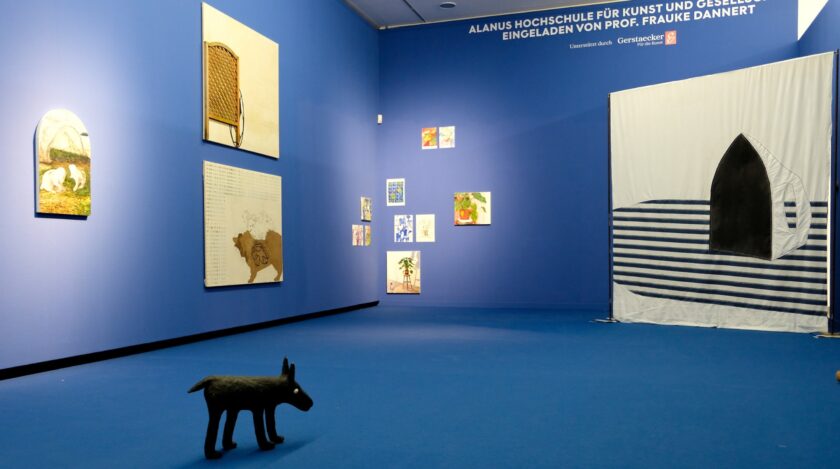
A room entirely in blue, accompanied by birdsong from a nature reserve: anyone entering the NRW-Forum at DIE GROSSE 2026 acoustically arrives on a hill above Bonn. That is where Alanus University of Arts and Social Sciences is located, and this year it is represented for the first time with its own room at the long-established Düsseldorf art exhibition.
Starting on 5 July 2026, eleven students will present around 20 works in painting, drawing, collage, and textile art. The project is supervised by Professor Frauke Dannert, who teaches Expanded Painting at Alanus University. For DIE GROSSE, this collaboration is a first. “It is our first cooperation with a private, state-recognized art university, and with it we are moving beyond the traditional Rhine corridor,” says exhibition director Emmanuel Mir. Last year, Münster Academy of Fine Arts was invited; now the focus is turning to the Rhein-Sieg district for the first time.
Dannert selected the artists during a tour of the university’s studios. The decisive question was which artistic positions would work together in a shared project. The group then developed a joint spatial concept, built a 1:20 scale model, and also took care of transport, packaging, and coordination with the exhibition venue. “A perfect opportunity to practice exhibiting,” says Dannert. After all, artistic work ultimately also includes the less romantic reality of tape measures, transport crates, and organizational emails.
A meadow in the mind
The idea for the blue room emerged from the special location of Alanus University. It is situated directly next to a nature reserve with horse paddocks. The group wanted to bring this setting to Düsseldorf, though not as a painted landscape panorama. Instead, the design draws on the principle of the chroma key process. In photo and film production, blue or green backgrounds are used for shots because they can be isolated most easily and are ideal for various backgrounds. At the NRW-Forum, the blue becomes a projection surface for visitors’ imagination. “Mentally, everyone can place a different background behind the works, for example a meadow,” explains Dannert.
From bulky waste to canvas
Just as varied as the courses of study are the works themselves. Barlas Neumann (23) is formally enrolled in the sculpture class, yet sees himself as a painter. For his large-format works, he uses found objects from the street, including MDF boards, which he mounts onto large canvases, paints, and works over with reduced black lines. “My pictures speak very deeply from within me,” explains Neumann, who is half Turkish and half German and explores identity, transience, and the banality of the everyday. Valérie Linkweiler (25) studies Expanded Painting with Prof. Dannert. She presents drawings of natural structures, which she abstracts through extreme close-up observation. Her gaze focuses on details of the immediate surroundings that can easily go unnoticed in everyday life. The university’s location by the nature reserve thus also becomes visible in her works.
Marwa Ben Aharon (28) came to Germany three years ago from a kibbutz near Haifa. After studying painting at a private school in Basel, she transferred to Alanus University. For one semester now, she has been examining a single plant from ever new perspectives. Her works move between naturalistic oil painting, drawing, pattern, and abstraction. Elisa Gabelli (30) works with delicate paper cutouts. Her transparent-looking collages combine human forms with structures from nature. Manuel Schlembach (29) enjoys sewing large-format textile picture objects. At the NRW-Forum, an oversized iron can be seen among other works. In his pieces, craftsmanship and domestic everyday life meet questions of social background. Schlembach himself came to art by a circuitous route. He first completed training as an electronics technician and worked in the trades before an injury ended his long-standing passion for skateboarding and led him to art.
The connection between Düsseldorf and Alfter is not intended to remain a one-time affair. “The cooperation with the region works. DIE GROSSE is also showing works by former Alanus students who convinced the jury this year,” says Emmanuel Mir.
Around 1,500 applications were submitted for DIE GROSSE 2026. Altogether, the exhibition comprises 171 artistic positions. DIE GROSSE was founded in 1902 and is the oldest and largest artist-organized sales exhibition in the German-speaking world. In 2025, more than 30,000 visitors attended.
Opening: 4 July 2026, 6 pm to 10 pm
Duration: 5 July to 9 August 2026
Venue: Kunstpalast, NRW-Forum and Ehrenhof, Düsseldorf
Participating artists from Alanus University:
Marva Ben-Aharon, Julian Braun, Louise Doyon, Elisa Gabelli, Valerie Linkweiler, Maiwenn Nelke, Barlas Neumann, Manuel Schlembach, Leonard Stascheit, Leon Steinbauer, Mila Wolkenaar
Thanks to: Gerstaecker
Photo: M. Prinz
 M. Prinz