Open-ended and creative
27/04/2021 - Aesthetic education in philosophical reflection
Aesthetic education in philosophical reflection
Practical body exercises in a philosophical lecture on the mind-body problem train students’ perceptual abilities, while a film analysis can provide a captivating introduction to the topic of artificial intelligence. Why aesthetic processes are valuable not only on an artistic but also on an academic level is explained by Thomas Schmaus, Professor of Philosophical Anthropology at Alanus University, in this interview.
Three questions for Thomas Schmaus, Professor of Philosophical Anthropology at Alanus University of Arts and Social Sciences in Alfter/Bonn.
What do you understand by aesthetic education?
The underlying Ancient Greek word aísthēsis means “perception.” This could create the impression that what is meant here is a purely receptive process, one of taking in. However, aesthetics also means becoming creatively active, in the sense of co-shaping—and this applies both on the level of cognition and perception and concretely in action. It is important to us to identify and make these processes accessible, especially against the backdrop of the fact that science and society today are often oriented in a one-sided way toward technology and goals. In aesthetic education, by contrast, we are dealing with creative processes in which the outcome is not determined in advance. This gives rise to important impulses not only for art studies but also for philosophy, society, and economics.
Alanus University places great value on the personal development of its students. To what extent does aesthetic education play a role in this?
Personal development, or self-realization, is of course an important topic in modern society. In its late modern form, however, it is often interpreted as self-optimization or even self-staging. In the sense of aesthetic education, it may be more appropriate to speak of self-formation. Artistic processes are co-creative processes: they take place in exchange with the surrounding environment and with other people, but also with the material. This is beautifully illustrated by the expression “Everyone is the blacksmith of his own happiness,” which could be misunderstood as an image of self-optimization. But in blacksmithing, it is crucial to respond to the material—it may, for example, be brittle and make things difficult for me. In any case, it does something to me. From an aesthetic perspective, personal development is therefore also the ability to deal with what cannot be controlled, to work with what is there, what imposes itself or eludes us. The goal is then not appropriation, but assimilation. Practicing aesthetic processes can support this, including in other areas of life, such as in companies. Of course, it makes sense to make plans—but also to remain open to processes in which something unexpected can emerge and succeed.
The Studium Generale, which is mandatory for all students, deals with broader overarching topics and also offers a philosophical reflection on the content of the degree programs. What can aesthetic education contribute here?
The university aims to teach aesthetic processes in principle on both the academic and artistic levels. In the Studium Generale, we initially focus on the academic approach, but we certainly combine it with creative elements. One example: in a philosophical lecture on the mind-body problem, I deal theoretically with the question of how thinking is embedded in the body (“embodiment”). Exercises in bodily awareness and perceptual training can enrich this discussion because students experience something themselves instead of merely having it described to them. Even different sitting postures and gestures have an immense effect.
About the person:
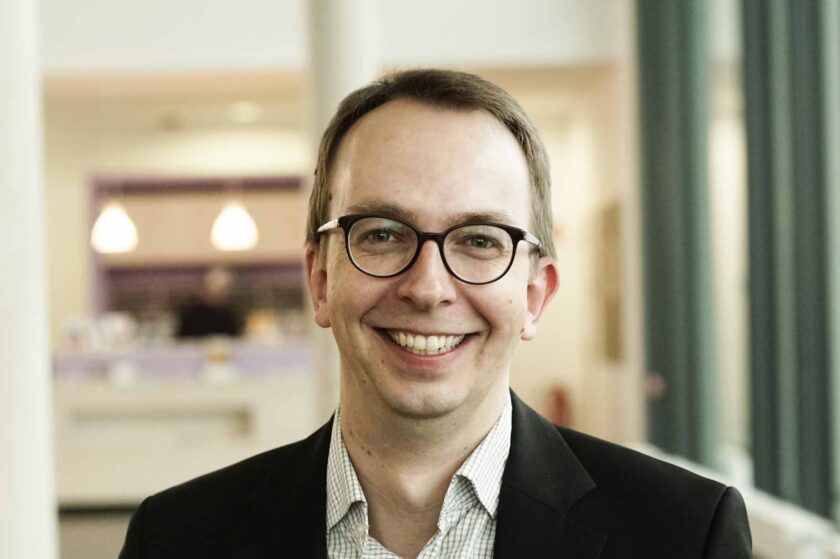
Prof. Dr. Thomas Schmaus (born 1978) has been Professor of Philosophical Anthropology at Alanus University of Arts and Social Sciences in Alfter/Bonn since 2018. There he heads the Institute for Philosophical and Aesthetic Education in the Department of Educational Studies, which also offers the interdisciplinary degree program “Philosophy, Arts and Social Entrepreneurship” that opens up innovative approaches to fields of social and economic action through philosophical and aesthetic education.
(Photo: Antonia Krüger)