Five Questions for Helena Schenk
25.06.2020 - Helena Schenk is studying Painting in her fourth semester at Alanus University. During the coronavirus crisis, she founded the company Pufon, which sells masks designed by artists. We asked her why she started the company and what knowledge from her art studies she has been able to apply.
Helena Schenk is studying Painting in her fourth semester at Alanus University. During the coronavirus crisis, she founded the company Pufon, which sells masks designed by artists. We asked her why she started the company and what knowledge from her art studies she has been able to apply.
1. You are studying Painting in your fourth semester. During the coronavirus crisis, you founded a company. Why?
It was that period when everyone was sitting at home and no one really knew what was suddenly going on. Nobody went out, contact with other people only took place via video calls, and many people suddenly no longer knew what to do with themselves. After a Zoom meeting with my lecturer Michael Reisch, I said to my fellow student Emilio Holguin that what we needed at that time was a good idea. We exchanged thoughts: Emilio thought to himself – if everything is at a standstill right now, many artists are losing their commissions, and local businesses have to close, meaning they can no longer generate income – why not use this time to help address these problems? An idea quickly became reality. Because of the high demand, we took the next step and became self-employed. Within a single day, the basic framework for our company Pufon was created.
2. Pufon: What does it stand for, and what kind of company is it?
Pufon stands for Put yoUr Filter ON – in other words, Put your filter on.
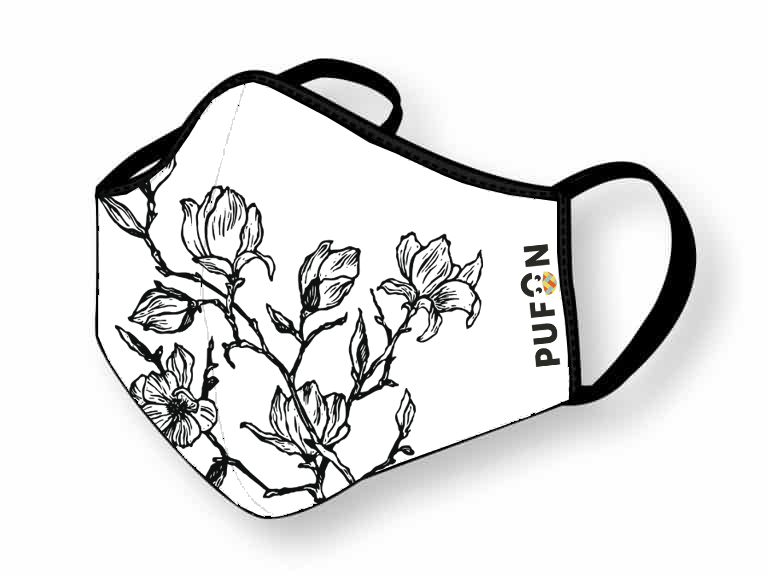
We sell masks designed by artists. The proceeds are intended to support both the artists and the sellers of the masks. We also offer custom logo masks. Essentially, we are a company that creates added value for many people. Just like our masks – they protect the people around us when worn, they look beautiful, and we support those who are suffering because of the crisis.
We have looked closely at the topic of masks. By now, we are able to offer our customers a product that includes several features which, within the available possibilities, we consider very important. Our Pufon masks have an antibacterial filter (they are not FFP masks against Covid-19), are highly breathable, and washable at 60°C. The nose clip helps prevent glasses from fogging up. Overall, the mask is very comfortable to wear and very lightweight.
3. For some time now, you have been selling the masks through an online shop. How did you organize distribution before that?
At first, we sold the masks through Instagram posts or simply while out and about to friends and acquaintances. That worked surprisingly well and was fun, but it was not a long-term solution. We now use two different sales channels: first, the online shop, which also runs via Instagram. Second, our customers can buy our product in 20 small local businesses in Cologne and Bonn, which also earn money from the sale of each mask.
4. You sell masks – a product that is in high demand during the coronavirus crisis. There is currently a mask requirement in some areas. If that requirement is lifted, what will you do then?
First of all, masks will remain an important part of our everyday lives. But of course, we do not intend to produce masks forever and hope that the risk of contracting Covid-19 will continue to decline over the long term. It may be that we will bring Pufon to a close as a complete and successful project. But we are also considering focusing on other products in the future. After all, the supportive and artistic idea can be continued with any product. And of course, the work is also a lot of fun and exciting. It would be a shame not to continue the whole project.
5. Are you able to apply content from your art studies to founding a company?
During my studies, among other things, I learned to question my own work and to place it in relation to its environment. This critical perspective helps me a great deal in building Pufon, because I do not only bring my subjective perspective into decision-making processes, but can also place everything in context and relation. This means that I do not lose sight of the bigger picture and can achieve goals more quickly. However, the willingness to compromise that I need as the entrepreneur of a start-up is new to me. All the more wonderful is the fact that I have realized that not everything one learns has to apply universally.