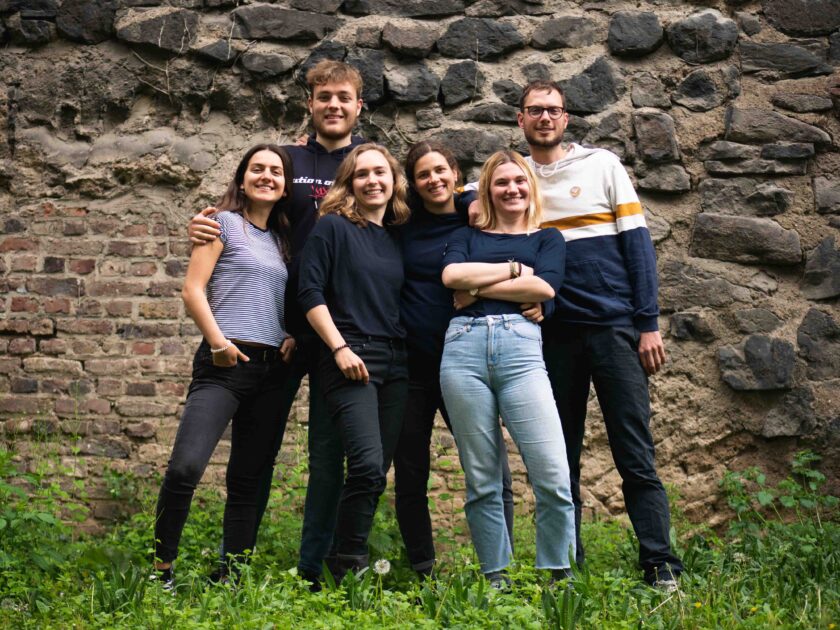
Five Questions for Estella Cron and Jonathan Kümmerle
28/05/2020 - Estella Cron studies Sustainable Management and Jonathan Kümmerle studies Business Administration with a Practice Partner. Both are in the final semester of their degree programs and are actually currently writing their bachelor's theses. Then the coronavirus crisis hit – and together with fellow students they decided to found the company “Himmel un Ääd”. In the interview, they talk about their business idea and explain how they put approaches from their studies into practice.
Estella Cron studies Sustainable Management and Jonathan Kümmerle studies Business Administration with a Practice Partner. Both are in the final semester of their degree programs and are actually currently writing their bachelor's theses. Then the coronavirus crisis hit – and together with fellow students they decided to found the company “Himmel un Ääd”. In the interview, they talk about their business idea and explain how they put approaches from their studies into practice.
1. Estella, you study Sustainable Management and you, Jonathan, study Business Administration with a Practice Partner. Together with fellow students, you founded a company. To what extent are you able to incorporate content from your studies into your work?
Estella Cron: My degree program has helped me open myself up to new perspectives, especially in the areas of alternative organizational design and within the sustainability context. In addition, I was able to consolidate these topics for myself through projects, internships, and professional experience during my studies.
Jonathan Kümmerle: I can see the difference compared with other entrepreneurs. I notice that we have come to know a different kind of business administration. Of course, that is not only due to Alanus University, but also to our personal preferences. But Alanus has succeeded in offering us opportunities through which we can deepen and rediscover our interests. Personally, I am happy to build a company that operates in a future-viable and “purpose-driven” way and thus represents a clear contrast to classic business models.
2. Himmel und Ääd: What kind of company is it?
Estella Cron: We bring producers directly together and make sure that regional structures continue to make their way into the city. We supply people living in the city with organic food. We pay what our producers need and thereby contribute to a partnership-based way of doing business. We also demonstrate that a democratically run company with six managing directors works well and is an incredible asset.
3. What sustainable approaches does your business idea pursue?
Jonathan Kümmerle: We use very few resources, as we have no warehouse, no vehicle fleet, and no machinery. The organic food is delivered to us and directly packed and delivered. We share a cold storage facility with another company. And the bicycles we use for delivery are also part of a sharing network. That means they do not belong to us and are available to everyone else after delivery. The only things we consume are paper for packaging and electricity for cooling. The rest of the materials we use are reusable items that can be recycled or reused – such as our ice packs.
Estella Cron: In addition, our organizational model also pursues sustainable approaches if sustainability is viewed holistically. We organize ourselves democratically, and each and every one of us has equal rights and one vote. We have defined areas of responsibility for ourselves and assigned ourselves to them. In addition, we are currently working on developing a catalog of values – as a guideline for our activities.
4. Did the coronavirus crisis inspire you to found the company?
Jonathan Kümmerle: Yes, the coronavirus crisis also played a part. Georg Neubauer from “Blattfrisch” in Hamburg called me at the beginning of the crisis and asked whether I would like to build something like this with him in Hamburg. My practice partner is in Hamburg, and he thought I was still there. I replied that I was back in Bonn. He then said to me: “That doesn’t matter, you can do it in Bonn as well.” He has supported us with know-how from the very beginning. Georg was inspired by the crisis to find new sales channels and to place an even stronger focus on regionality in the city. As a team, we agreed: we must support and strengthen the structures that we still want to have after the crisis now.
Estella Cron: When Jonathan first told us about the idea from Hamburg, my interest was sparked because I had already been engaging with the topics of agriculture and nutrition for some time. I would see the coronavirus crisis more as a catalyst prompting us to address regionality and agriculture already now, but I would not describe it as inspiration.
5. Did you consult with lecturers before founding the company?
Jonathan Kümmerle: No, everything happened so quickly. We actually did not want to found a company, but only advise and support companies. Because partners dropped out, a few days later we were standing in front of a notary signing our shareholders’ agreement. We then contacted Alanus lecturer Ralph Schneider. We realized that tax law and other bookkeeping details had slipped our minds. Ralph Schneider immediately offered his help. We are very pleased about the collaboration, as we value him highly and experienced him as a very constructive lecturer.