Dialogical Painting
03.12.2020 - An experiential report by Prof. Beatrice Cron and students
An experiential report by Prof. Beatrice Cron and students
“A large suitcase full of ideas accompanies me.” (quote from a student)
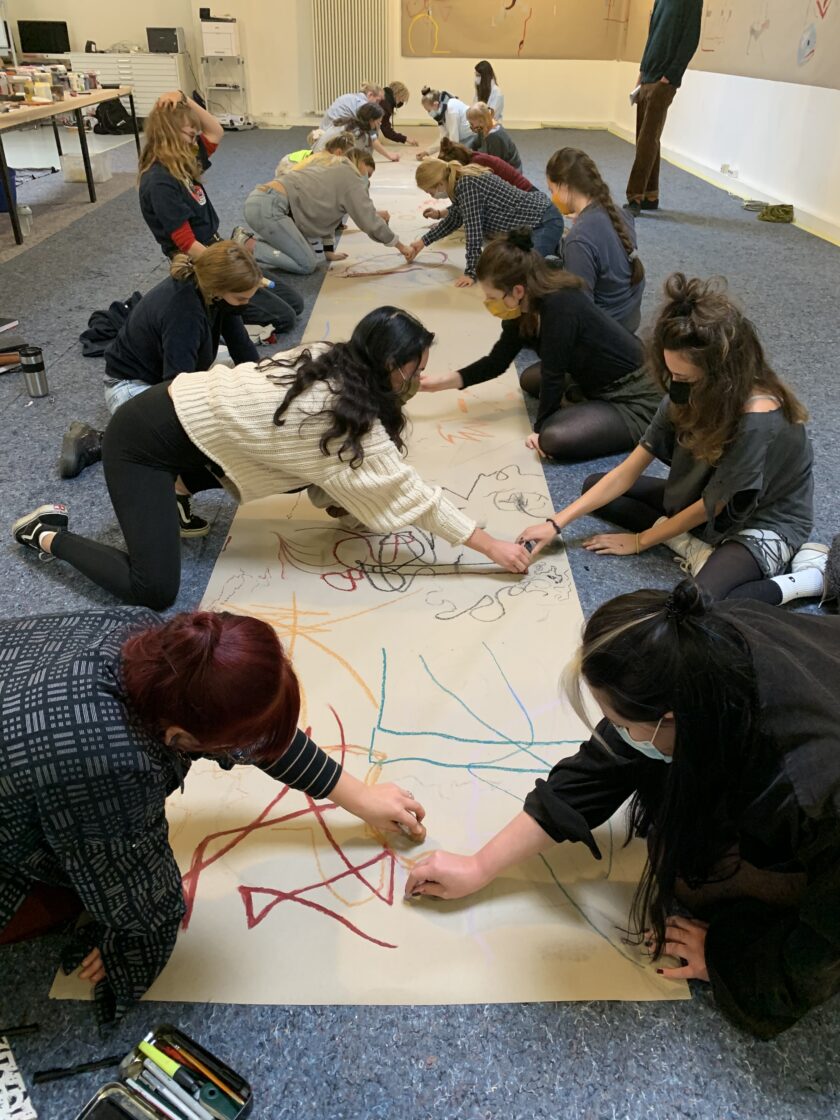
Once again, KPT students were welcomed as guests in the AIB premises. As part of the ‘dialogical painting’ project under the direction of Prof. Beatrice Cron and Oliver Hollatz, we gained new resonance experiences through the combination of painting and movement. Guided by Bennie Bartels and Claudia Huismann, with dance and music, we explored and expanded the relationship between color, surface, and line. Emotional access played a special role in this process. We had to learn to let go of our personal expectations and create inner space for the unfamiliar process of discovering a new visual language. In the group work, we tested boundaries, which was sometimes exhausting and frustrating, but rewarded us with artistic self-confidence. (Maria Zastrau)
We would like to thank everyone involved who made this possible despite the difficult circumstances!
An exchange of experiences from a two-week intensive project with students from the BA Art Pedagogy Therapy degree program at Alanus University of Arts and Social Sciences on the topic of dialogical painting.
“Meaning as spiritual orientation is no longer given to modern people from the outside; rather, it becomes a task that must be found and created. Likewise, the senses today are no longer simply given, but become a task of creative formation. Yet both tasks, when taken up, mean preserving the human being as a changeable being in a changeable world.” Dietrich Eterl: p.12
The creative task of developing a picture together without first creating a concept, but instead responding to the impulses and interventions of one’s fellow players and truly entering into a dialogue, actually means entering into a conversation with and through the canvas, into an event and an action. It is like real life! In this case, it gives the students of the BA Art Pedagogy Therapy degree program at Alanus University, Alfter, a completely new perspective on the artistic process and their own abilities.
The painterly dialogue develops nonverbally, or by agreement between two or more people creating a shared image. The picture may lead to a “representational” depiction that tells a story, or to an “abstract” composition in which forms, lines, and colors enter into relation with one another. Through the impressions, movements, directions, the collision of impulses, and the often continual transformation on the canvas that arise in dialogical painting, a very distinctive choreography can emerge. Group processes become visible:
Who has the final say? Who follows, who leads… who adapts? Often it is a spontaneous inspiration that is just right for what is emerging, but it can also lead to agreements and understanding in which the next step is planned. Changes of role among the participants are completely natural and arise from the process itself.
But what does it mean for the process and the result if we relinquish sole authorship and thereby learn more with and from one another, trust in competencies, and do not have to take responsibility for and do everything alone?
Through multiple authorship, a very distinctive dynamic unfolds that advances creative processes through the development, shaping, and visualization of social interactions.
It can be observed: how am I involved in the process of the picture’s emergence? Do I want to be visible, do I need to be visible, or am I, for example, actively involved in decisions about design aspects but not necessarily visible in the result?
What is it really about?
Is it the final result: achieving a good picture! Do I let the other person go first for the sake of the picture’s quality? Am I capable of compromise? Do I recognize my potential and use it, is it seen by the team members, and do I see their potential…?
Through such questions, this kind of painting demands a high degree of tolerance, respect, but also assertiveness, as well as love for the artistic process. Flexibility is a must, as is a willingness to keep entering into conversation whenever the group dynamic requires it.
One interesting remark from one of the participating students: “Community, adaptation, communication are three absolutely essential keywords for dialogical painting: experiencing oneself as belonging, finding one’s place in the group, and adapting appropriately to any challenges. In doing so, I learned that not only verbal communication plays a role, but rather that the nonverbal level is a language that enables the group to find its different roles and patterns for each individual.” (Nina Panzer)
In the best case, a painterly dance emerges, especially with large formats. Partner dance in particular is a good analogy for dialogical painting. Being led and leading are precisely the roles that are tried out and carried out in continual alternation, and mutual trust plays a major role in creating a good and fruitful dialogue.
“Letting go, not overthinking, letting your body paint… In most cases, I let my head guide the brush. Through dialogical painting over several days, I learned that the body has a free connection with the hand and allows itself, for example through rhythmic sounds (whether from instruments or simply the sound of the pencil striking the paper), to immerse itself fully in the moment and connect with it.” (Nina Panzer)
The dialogical form does not have to take place only within the same medium; through interaction, for example with dance, it can take on a very playful quality in which it is very easy to enter the so-called flow, switch off the mind, and immerse oneself completely in movement. Having a counterpart who acts along, supports, or hinders also encourages this…
“When I painted together as part of a team of 3 people on a large canvas, I experienced… how I have to assert myself, but can also compromise and be open to new things. It is important to coordinate and be considerate, but still to be brave and simply introduce a new impulse. Perhaps it will not be received with much enthusiasm, but it can also be seen as a challenge. I felt safe in a group of three because if one person did not know how to continue, someone else could always contribute something new. It is an interplay and you get to know one another. What am I like in a group? Am I dominant and self-confident, or do I only adapt and follow the impulses of others? How do I use the materials? Am I cautious or bold?” (Lara Dabbous )
Because everything experienced with such intensity and density is much more vivid, independent, and multifaceted in the perception of those involved; it speaks to us and allows us to experience a genuine encounter with itself, the painterly process, and the participants.
“The creative requires a high degree of conscious being. Conscious being is never mere repetition of what has already been thought. The creative is not reordering or synthesis of the old; it must always be filled with living feeling and thinking, that is, with what is germinal and potential.” Hartwig Volbehr: p.97
As early as spring 2020, students in the Art-Pedagogy-Therapy degree program approached the topic of resonance in a dialogical process as part of the painting project. You can find a visual retrospective here.
Literature:
Volbehr, Hartwig: Spannungsfeld Kunst, Berlin, Mayer Verlag 1997 Eterl, Dietrich: Spannungsfeld Kunst, Mayer Verlag 1997
About the author: Beatrice Cron
Born in Basel in 1961, she was admitted to the Basel School of Design in 1982. Her subsequent painterly development was shaped by her apprenticeship years from 1983 to 1987 with the Italian Beppe Assenza and the Australian Paul Pollock. In 1988 she moved to Germany, and in 1991 to Brazil for eight years. Numerous exhibitions in and around São Paulo and intensive work in art education shaped this period. At the end of 1998, the decision matured to return to Europe. The following six years in Hagen, primarily working as a freelance artist, were complemented by international artist exchange projects as well as teaching in art education, including within art therapy schools. Since 2011, she has been Professor of Painting at Alanus University of Arts and Social Sciences.