Art for the Climate
03.12.2020 - Students design hydrogen filling stations for Europe’s largest fuel cell bus fleet
Students design hydrogen filling stations for Europe’s largest fuel cell bus fleet
Regionalverkehr Köln GmbH (RVK) has recently put 35 fuel cell hybrid buses and two hydrogen filling stations into operation. Students from Alanus University were invited to submit ideas for the design of the filling stations as part of a competition. At the ceremonial inauguration of the bus fleet—unique in Europe in terms of its scale—the artistically designed filling stations were presented. Two teams impressed with their designs and implemented them on the four-metre-high and almost 14-metre-long walls of the filling station in Meckenheim and on the 20-metre-high tanks in Wermelskirchen, both RVK operating sites.
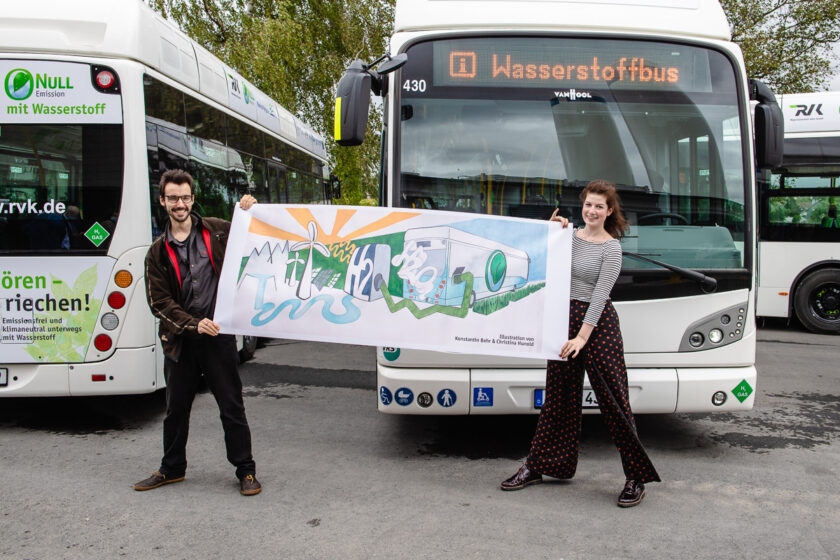
Three painting students won first place in the competition: Anna Dippel, Carlos Herrera and Helena Schenk. For their design proposal, they engaged intensively with the electrochemical process of the fuel cell in the buses. “The fact that scientific progress is being used to protect the environment is a wonderful development and therefore also the subject of our design,” said the students. Their work can be seen at the Meckenheim site. Second place went to Christina Hunold and Konstantin Behr from the Art-Education-Therapy degree programme. They designed RVK’s hydrogen filling station in Wermelskirchen.
As an alternative fuel, hydrogen causes virtually no local emissions in terms of exhaust and significantly reduced operating noise, as the buses are equipped with an electric motor. Eugen Puderbach, Managing Director of RVK, emphasises “the value of this alternative drive system for effective climate protection.” Sebastian Schuster, District Administrator of the Rhein-Sieg district, adds: “We are proud to play a pioneering role that is attracting attention across Europe, and we would like to encourage other regions to set out on this path as well and thereby make a substantial contribution to climate protection.”
The Federal Ministry of Transport and Infrastructure is investing around 14 million euros in the project. Additional funding totalling around 7 million euros is coming from the EU.
Robert Missen from the European Commission, Directorate-General for Mobility and Transport (DG MOVE): Innovation & Research, one of the project’s funding bodies, is convinced of the groundbreaking character of the project: “The replacement of diesel buses with a new fleet of fuel cell buses is a wonderful example of the decarbonisation of transport and the attractiveness of public transport. It is particularly impressive that this is happening not in a capital city, but in a suburban region. In Brussels, we will follow the success of this initiative closely, and I am sure that this will become an EU best-practice example for clean regional bus transport.”
The issue of climate protection through alternative drive systems has been a top priority at RVK since 2009. By the end of 2021, RVK will integrate a further 15 fuel cell hybrid buses into its fleet at the corresponding sites in the Rhein-Sieg district, the Rheinisch-Bergisch district and in Hürth as part of the funding projects.
Photo: RVK
Caption: Presentation of Europe’s largest fuel cell hybrid bus fleet and the RVK hydrogen filling station in Meckenheim (from left to right): Mayor Bert Spilles (Meckenheim), District Administrator Sebastian Schuster (Rhein-Sieg district), Eugen Puderbach (Managing Director RVK), District Administrator Günter Rosenke (Euskirchen district, Chairman of the Supervisory Board of RVK), Lionel Boillot (Project Manager FCHJU), Ministerial Director Johannes Wieczorek (Head of the Subdivision for Climate Protection in Transport, Environmental and Noise Protection at the BMVI) and Robert Missen (EUROPEAN COMMISSION, Directorate-General for Mobility & Transport – Head of Unit B-3: Innovation & Research). The wall in the background was designed by students of Alanus University and is part of the filling station.