A Day Full of Imagination
02.12.2021 - A student reports on a special school project in cooperation with Freie Waldorfschule e. V. and the B. A. Art-Education-Therapy degree program.
A student reports on a special school project in cooperation with Freie Waldorfschule e. V. and the B. A. Art-Education-Therapy degree program.
In the B. A. Art-Education-Therapy degree program, a seminar called “Art Education in Practice” takes place every autumn semester under the direction of Béatrice Cron and Marlene Nockmann. The title says it all – students work together with pupils and carry out a wide variety of projects.
In this year’s project, pupils’ work was exhibited at the bazaar of Waldorf School Bonn-Tannenbusch, and small art workshops were offered.
Below, our student Charlotte Lindner describes how she experienced the bazaar on 13 November 2021.
“A Day Full of Imagination” – written by Charlotte Lindner
Have you ever been to a bazaar at a Waldorf school? If so, then you know how beautiful, warm, and diverse it is there. If you have not yet been to such a bazaar, I hope I can convince you that it is absolutely worth making time for.
I would like to take you a little behind the scenes and show you how the project between the Waldorf school and Alanus University came about.
When I went to a Waldorf school’s Christmas bazaar for the first time, I was overwhelmed. I have rarely encountered so much love and warmth. And this year, I have the honor of contributing to it.
It all began with a meeting at the museum. We female students met the advanced art course of the graduating class from the Waldorf school in Bonn-Tannenbusch for the first time. How could art students and pupils get to know each other better than through their shared interest in art?
The pupils were divided into three groups.
In the first group, projects that had been developed in class were exhibited.
What do you have to pay attention to? How do you present your work? This group had actually managed to transform a simple room into another world. Everything was there, from small stages the size of a shoebox to a life-size set table.
“I noticed that the eurythmy room had been transformed into an exhibition space. I especially liked the serious themes on the small stages, which were presented artistically,” reports a former pupil.
For example: the detective who has just left the scene of the crime to perhaps get a cup of the disgusting, lukewarm, brown brew they try to sell as coffee.
The coat and hat on the coat stand, the basket left behind forlornly, accompanied only by the blue backpack.
Was the bed made? Quickly shove the little casket under the bed… can you still see it? And can you hear the ghosts playing on the white piano? Oh dear, hopefully the candles do not drip.
You were transported into a world of moments – of things that had just happened. Into a world of the past, or for those who know German grammar, into the preterite, the not-yet-completed past. The bread had been eaten, but the crumbs were still lying on the plate. As if a person had just left the room to fetch something or had to leave suddenly and had no time to clear the table. There was so much more to discover that there would not be enough space here to report on everything.
“….I really liked how fittingly all the objects had been chosen to go together,” says another visitor.
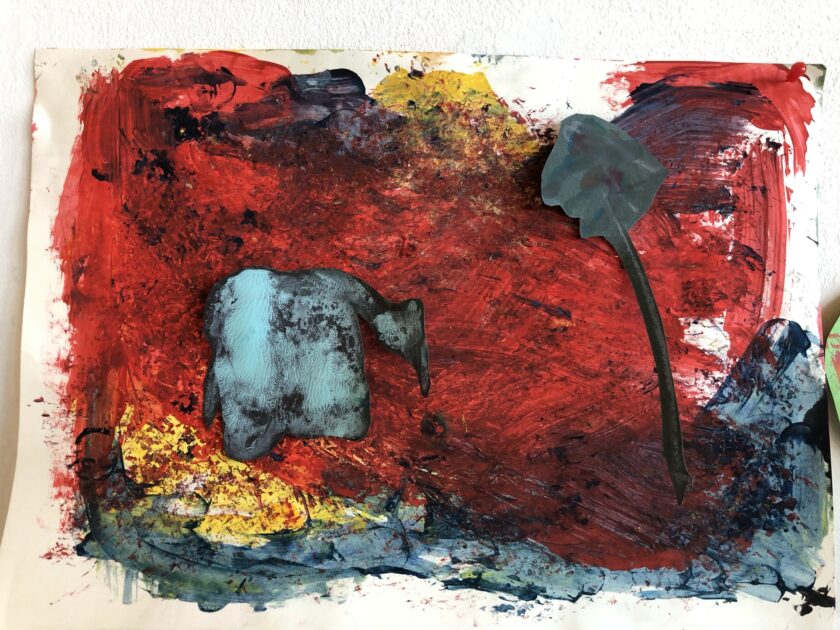
Another group experimented with “chance techniques” and developed a story from them. How does that work? I hope I can explain it better through pictures.
What are chance techniques? Surely your tea or coffee has tipped over at some point and left its traces on paper (usually unintentionally). Perhaps after the first shock you found it quite interesting. Maybe you even recognized something in the stain. And there you have it, you have already encountered a chance technique.
Another technique works like this: you pour paint onto one side of the paper (or onto both sides, however you like) and fold the paper. This spreads the paint across both sides and creates a pattern. In technical terms, this technique is called décalcomania.
So some pupils and female students let their imagination run free and invented stories. These stories were exhibited in the art room.
That is all very nice, of course, but just reading the stories would be boring, so the third group was responsible for organizing small workshops for visitors to the bazaar.
Getting involved yourself, trying out one chance technique or another, or marbling a Christmas bauble. Adults, teenagers, and children alike had fun and were successful. It was a lively atmosphere, with plenty to try out and experiment with. You could let your imagination run wild and even learn something 😉 The children especially had fun, and who knows – perhaps one or two now have a unique Christmas bauble hanging on their tree, reminding them of the Waldorf school bazaar.
Christmas can come!