Five Questions for Fabienne Margue
29/04/2020 - Fabienne Margue is studying Art-Education-Therapy in her sixth semester. The coronavirus pandemic has also changed her everyday study life. She is now using the crisis to engage artistically with performative interventions in public space. In the interview, Fabienne Margue explains how the crisis is inspiring the Luxembourg native and which place of residence she currently prefers.
Fabienne Margue is studying Art-Education-Therapy in her sixth semester. The coronavirus pandemic has also changed her everyday study life. She is now using the crisis to engage artistically with performative interventions in public space. In the interview, Fabienne Margue explains how the crisis is inspiring the Luxembourg native and which place of residence she currently prefers.
1. You are studying Art-Education-Therapy in your sixth semester. The coronavirus crisis has also changed everyday life at Alanus University. The studios are closed. Where have you moved your workspace to?
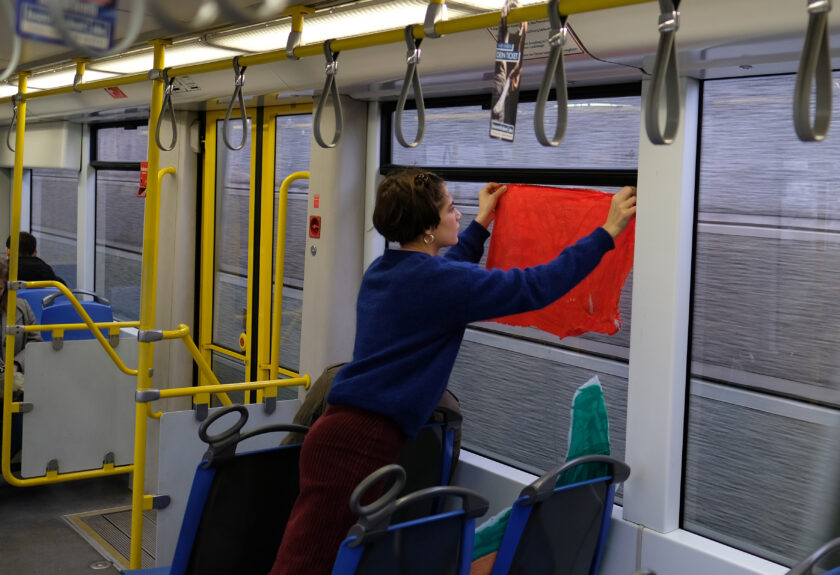
Outside, into public space. In my artistic work, I deal with performative interventions in space and question what influence we have on the space around us and to what extent it, in turn, shapes us. At the moment, I am particularly interested in the role physical space plays in our artistic practice. The closure of the studios prompted me to shift my work entirely into public space and thus to see my surroundings and the people I encounter there as material for my art. Especially now, when art institutions are closed, I find it more interesting and important than ever to bring art outdoors.
2. How has your everyday study life changed, and what challenges are there in the virtual lectures?
I enjoy spending a lot of time at the university and value the intensive and meaningful contact on site. Unfortunately, I find it difficult to be as productive outside the university context as I normally am. Regular exchange about my work and about the artistic processes of my fellow students is very important to me, and I very much enjoy working on shared projects. Unfortunately, the current situation has made this more difficult for me: I find collaboration by phone or video hard because physical presence is very important to me. I really appreciate that we have the option of virtual lectures and can still receive input and stay in touch. In my opinion, however, they are much more demanding and require a great deal of energy; creating interaction requires a particularly high level of initiative and willingness on the part of both students and lecturers.
3. On your Instagram channel, you have been posting performances since the end of March under the title “One intervention in public space per day.” Is the crisis inspiring you artistically?
I had already been dealing with art in public space before the crisis. After the lockdown was announced, I first became aware of the irony of my artistic work under the given circumstances. Then I realized how important precisely this activity is right now. I want to bring things outward and make them visible at a time when we have to retreat inward. In the interventions, I explored the question of interior and exterior space. I engage with the ambivalence between protection and limitation, connection and separation. I also raise the question of home, of private space: Where is it located? How do we define it? And who decides? Through my artistic interventions, I want to create awareness of the surrounding space. The crisis focuses on exactly this topic. I want to encourage viewers to notice what kind of space they move through, why they move through that space, and what and whom they come into contact with there.
4. You originally come from Luxembourg. Did you consider returning to Luxembourg during this time and studying from there?
I actually worked from Luxembourg for a few weeks. It was exciting to continue my everyday university life “normally,” just from a different place. Theoretically, I could be anywhere and continue my studies. However, I decided to return to Bonn because I want to complete my final semester here and take every opportunity to continue working in my familiar context, even if that is only possible under certain circumstances.
5. What do you miss in this extraordinary time?
What I miss most is interpersonal, physical contact, the freedom to interact with other people without restriction. I miss dancing together very much. I long to be in a full room, moving together to music and connecting with one another. The hardest thing for me is not being able to let shared artistic processes develop in the usual way. However, I want to use this situation positively to find out how I can create togetherness through other means.