Five Questions for Barbara Otto
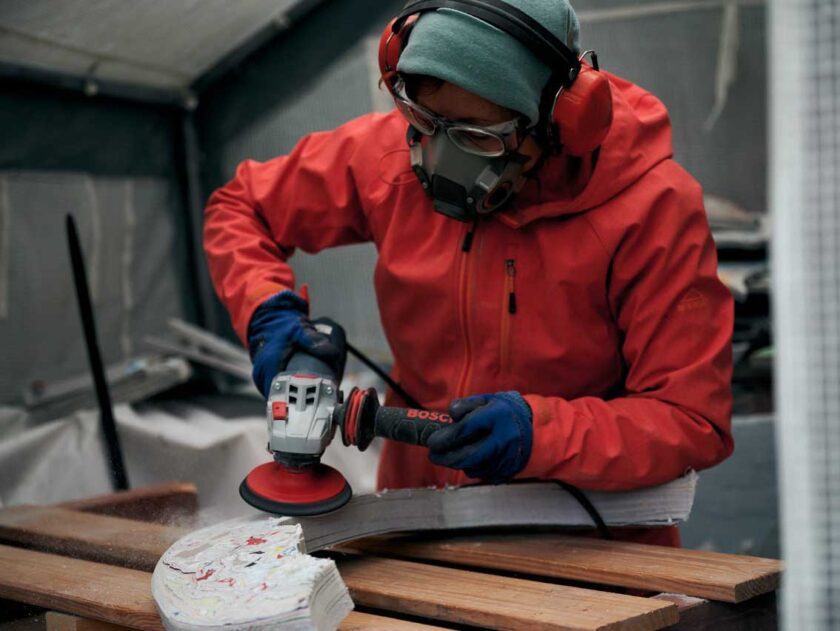
28/07/2020 - Hammering, sawing, carving, forging, welding, grinding – thinking, dreaming – experimenting, learning: Barbara Otto experienced all of this during her sculpture studies. In the interview, the graduate explains why she uses layers of posters from advertising columns for her works and what intention lies behind her exhibition ‘FACE_OFF! The Face in Digital Times’.
Hammering, sawing, carving, forging, welding, grinding – thinking, dreaming – experimenting, learning: Barbara Otto experienced all of this during her sculpture studies. In the interview, the graduate explains why she uses layers of posters from advertising columns for her works and what intention lies behind her exhibition ‘FACE_OFF! The Face in Digital Times’.
1. You studied Sculpture at Alanus University. Which particular impressions have stayed with you?
Hammering, sawing, carving, forging, welding, grinding – thinking, dreaming, experimenting: I was able to experience all of this during my studies. I am especially fond of remembering the two intensive months at the Stone Symposium in Norway with Professor Andreas Kienlin and the participatory land art project in Greece with Professor Jochen Breme. The diverse study programme, divided into compulsory and elective modules, gave me the opportunity to take part in seminars and projects in the Department of Architecture and also to train my aesthetic eye in the field of painting. I also greatly enjoyed the Studium Generale with its symposia, shaped by Gabriele Oberreuter, Isabel Rith-Magni and Willem-Jan Beeren, because art was discussed there in the context of social issues.
2. What new experiences were you able to gain during your time studying?
The most important thing for me was that I was able to experiment in a creative atmosphere in order to find my artistic path. Together with my fellow students, I regularly presented my works in internal and external exhibitions and in doing so learned to face public discussion.
3. In your bachelor’s thesis, you used layers of posters from advertising columns and created objects 100 cm high from them. Do you still use layered advertising posters in your work today?
I like to use materials that contain history and that not everyone works with. This includes, for example, layers of posters that I use as the basic material for my works. For my exhibition ‘FACE_OFF! The Face in Digital Times’, for instance, I created thematic collages.
4. In August, together with Judith Block, you will exhibit installations, sculptural works and illustrative explorations. Are you able to incorporate content and experiences from your sculpture studies into the exhibition?
I very much like to draw on my experiences with theme-specific exhibition projects and the mixed-age community. Judith and I come from different generations. My youth took place before digitisation, while Judith was shaped mainly by it. I accompanied the introduction of computers in my professional life; Judith grew up with them and seeks opposition. This productively shapes our artistic dialogue.
5. ‘FACE_OFF! The Face in Digital Times’: What is the intention behind your exhibition?
For the first time in history, our faces are readable by machines. We are in the midst of a process of change that comes with these technologies. As artists with an investigative spirit, we pursue the following questions: What happens to individuality and empathy when we are recognised everywhere by machines? Do we behave differently in public when the face becomes a digitised instrument of power?
It is estimated that more than 350 million photos taken on mobile phones are uploaded to the internet every day. The company Clearview AI has used this publicly accessible data to create profiles and make them available, for example, to the police. At the same time, we are now recognised by cameras everywhere and data is stored. Does this serve security, law enforcement, or are profiles being created for product marketing? We observe carelessness in the handling of personal data, but also concern about developments that are difficult to understand. For example, demonstrators at public protests try to protect themselves with cloths or masks; this is outlawed worldwide through anti-masking laws. However, the internet also offers the possibility of networking worldwide and drawing attention to grievances. These image-based protests tell of individual fates, environmental offences, state repression and much more. They also speak of resistance and solidarity and thereby gain a new power.
The ‘FACE_OFF!’ exhibition sheds light on the value of the face in the age of facial recognition technology and incorporates the question of one’s own creative agency into a public and well-founded discourse. The works highlight the risks that facial recognition technologies pose to free societies. At the same time, they are also the result of a search for the communicative potential created by these same technologies.
A comprehensive catalogue with detailed texts explains the breadth of the topic. We hope to be able to continue the dialogue and broaden it as well.
Further information about the artist and the exhibition can be found on Barbara Otto’s website: www.face-off-art.de and www.undart.de.