Movement – Five Questions for Anna de Millas
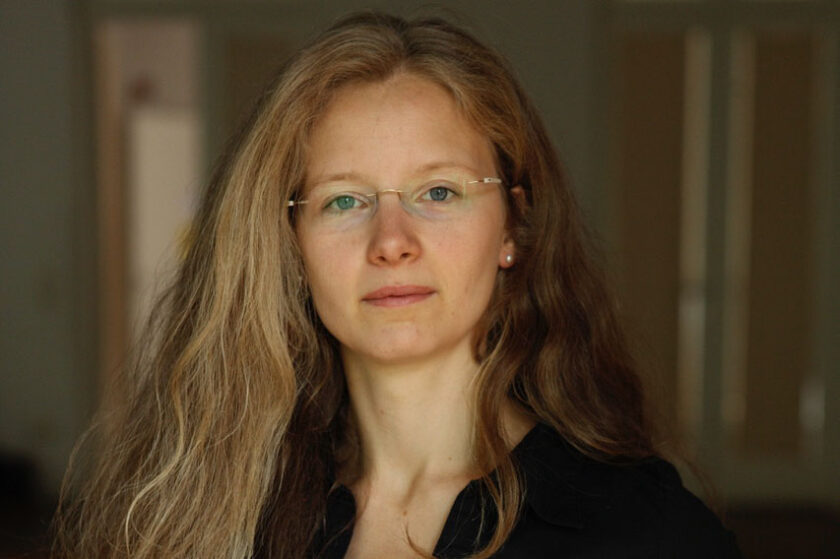
13.10.2020 - Anna de Millas studied Eurythmy Therapy at Alanus University. She wrote her master's thesis on the topic of fascia in curative eurythmy. In the interview, the graduate explains how effective eurythmy therapy exercises are and how eurythmy and fascia therapy can be combined. She also reveals her favorite exercise.
Anna de Millas studied Eurythmy Therapy at Alanus University. She wrote her master's thesis on the topic of fascia in curative eurythmy. In the interview, the graduate explains how effective eurythmy therapy exercises are and how eurythmy and fascia therapy can be combined. She also reveals her favorite exercise.
1. You studied Eurythmy Therapy at Alanus University. What special impressions have stayed with you?
For me, Alanus University is a place where many individual stories have been written and continue to be written. A place where questions are asked and conversations take place that touch on what is essential and hold potential for the future.
Professionally, what I remember most from my studies is the immediate effectiveness of eurythmy therapy exercises. When, after just a few minutes of practice in class, everyone suddenly started sweating, had to use the restroom, or felt relaxed and refreshed, then curative eurythmy had once again directly affected the metabolism or the cardiovascular system.
2. What new experiences were you able to gain during your studies?
Over the course of my studies, I was able to develop a greater clarity about how eurythmy therapy movements provide insight into the current activity of the various aspects of human movement. How is the physical body doing? What is the state of vitality? What emotional dynamics become apparent in the movement, and how does a person shape their movement? Being able to see this and gain clarity about it inspires me—because alongside all knowledge and experience, it offers the possibility of shaping therapy together with the client directly from the moment and according to the situation.
3. You wrote your master’s thesis on the topic of fascia in curative eurythmy. What is fascia, and how can eurythmy therapy and fascia therapy be combined?
The definition of fascia depends heavily on the observer’s point of view—to this day, to the best of my knowledge, there is still no internationally medically valid version. Generally speaking, fascia is understood as part of the connective tissue. It is an organ of fluid and sheathing that divides our body into the smallest units while at the same time connecting everything with everything else. Healthy fascial tissue ensures the best possible supply to all cells, right into the furthest corner, and is therefore fundamentally involved in our health. The various layers of fascia can be influenced, among other things, by independently performed eurythmy therapy movements as well as by manual treatment.
In the combination of eurythmy therapy and manual fascia therapy, I see above all the possibility that manual treatment can loosen tissue that has become stuck together or hardened, and that this can then be independently integrated into the movement and sensory organism through eurythmy therapy exercises.
4. In your master’s thesis, you examined eurythmy therapy in the case of a plantar fascia rupture. What were your findings?
The natural healing process could be supported and complemented by parallel treatment through eurythmy therapy and physiotherapy, and integrated and anchored on the physical, emotional, and spiritual levels of the human being.
In the individual case study, as well as with other clients in my practice, it has become apparent that after a rupture or fracture, physiotherapy can often restore mobility and resilience quickly and effectively. However, this can lead to strong fluctuations in vitality and emotional well-being, as these processes often involve severe pain while overcoming the physical limitations, which can be very stressful.
5. What is your favorite exercise?
At the moment, it is the “Three-Part Walking” exercise—this exercise is so simple and unassuming, and it brings everything into balance.