Perspectives from the Digital Studio
21/04/2021 - How do prospective art teachers study in times of कोरोना?
How do prospective art teachers study in times of Corona?
What defines us as human beings? Which aspects of being human are becoming especially apparent to us in the current situation? These are questions not only asked by philosophy students at Alanus University. They also guide their fellow students in the Master’s degree program in Art Education, which prepares students for teaching at grammar schools, comprehensive schools, and Waldorf schools : In their artistic work in the seminar on Art Teaching at Waldorf Schools , students approach the essence of the human being through art. Through sculpture and painting, they engage together with their lecturers Beatrice Cron (Professor of Painting) and Helmut Hinrichsen (Lecturer in Crafts and Sculpture) with the anthroposophical view of what it means to be human.
The continuous exchange among the students and together with Helmut Hinrichsen and Beatrice Cron is very important to both lecturers. However, since working together in the studio is currently not possible, they are trying to compensate for the supervision of processes and the shared reflection on projects through the active use of virtual spaces and regular conversations. “In this way, we inspire one another,” says Helmut Hinrichsen.
The students send daily photos of their process by email, which are then made available to the entire course and viewed together in a Zoom meeting held every evening.
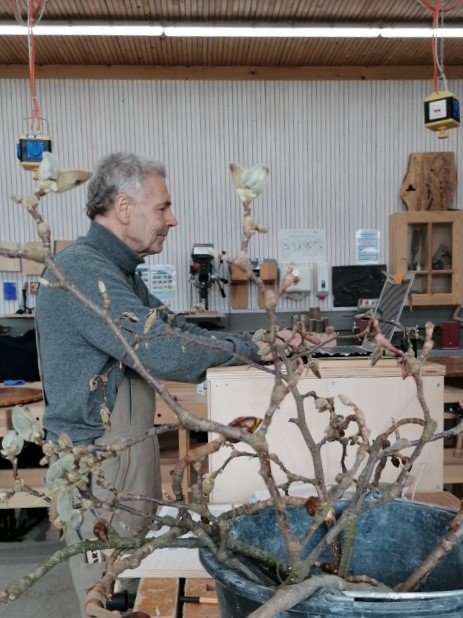
While Helmut Hinrichsen works in the wood workshop at Alanus University during seminar times, thereby keeping this familiar creative space alive for the students, the course participants work from home or in their own studios. To prevent the “Corona blues” at home, the lecturers lead daily activating physical exercises or tasks combined with a walk. Helmut Hinrichsen also advises against setting up the studio where the computer or desk normally is; instead, he suggests finding new places for studio work and, for example, simply working on the floor now and then.
Stefan Adascalitei is one of the students in the Master’s degree program in Art Education and talks in the interview about his experiences in the seminar on art and Waldorf education
What exactly were you working on as part of this artistic seminar?
We worked on experiencing the qualities of certain realms such as “the mineral” individually and expressing them artistically. At the moment, I am trying to give expression to the “human quality,” which is generally difficult to define. It is more about experimenting, about a search for form and color, than about achieving a specific result.
Studio work from home: what are the advantages and disadvantages?
When I imagine “studio work,” I think of an external activity, of an analogue process that I carry out. As soon as studio work is supposed to take place digitally and in a private space, I experience a contradiction. It is not only about the spatial adjustment, but also about the atmosphere, dynamics, and attitude. All the things that my social environment normally influences.
That is why I first notice the disadvantages that hinder my artistic work: My scope is limited to the materials and tools I can find at home. From my room, I experience resonance, stimulation, inspiration, and exchange only to a limited extent.
But fortunately, the lecturers have found individual ways to help us students get started. Through my own small research projects, I find my individual approach to the practical work. Walks and observations with sufficient time are planned for this purpose.
An advantage of this kind of teaching is that I can work at my own pace. The tasks are the same for all of us, but how I shape my work process is left up to me. In this way, I experience a calm and intense concentration that I need in order to immerse myself in a creative process. You could also put it the other way around and say: creativity is encouraged because we create more with limited possibilities and simple materials.
With a good balance between assigned tasks and artistic freedom, it usually works very well. But that requires a great deal of motivation and one’s own creative drive. If I have not found access to my work in this way, however, I miss the community that otherwise brings me back and spurs me on in face-to-face classes or simply inspires me. And once I am out of “the flow,” distractions quickly appear in a private space…
In your opinion, how well does the digital support of artistic processes work?
In terms of content and theory, digital spaces offer us a wide range of possibilities. Many cognitive processes can be supported better. Artistic processes, on the other hand, rely on community; they are themselves, to some extent, a social process. Therefore, in my opinion, they can only be supported digitally to a limited degree.
A slightly exaggerated comparison would be this: everyone knows the wonderful feeling of singing in a choir. Try singing a song together in your next Zoom meeting and compare the results.
Thank you very much for the interview!