Experiencing the Real Situation
27/04/2021 - Aesthetic Education in Art Studies
Aesthetic Education in Art Studies
Out of the studio and into reality: In the bachelor’s and master’s degree programs in Fine Arts, students at Alanus University in Alfter near Bonn also work on projects at the margins of society, for example with prison inmates and homeless people or in abandoned places such as a decommissioned factory in China. Why aesthetic education is also an important part of training perception and personal development here is explained by Prof. Dr. Ulrika Eller-Rüter in this interview.
Three questions for Ulrika Eller-Rüter, Professor of Painting and Art in the Social Context at Alanus University of Arts and Social Sciences in Alfter/Bonn.
What do you understand by aesthetic education?
I understand it to mean engaging with the spheres of the senses. This goes hand in hand with training the capacity for perception: What do the eyes perceive, what do the ears perceive? What happens in the interplay of the various sensory perceptions? It is also about personal development: when I sharpen my senses, I am addressed as a whole person. Visual perception and cognition are closely connected; in German this is beautifully linked even linguistically, for example in the word „erkennen“ or the expression „Mir geht ein Licht auf“. In aesthetic education, then, I am interested in recognizing and understanding the world. And as an artist, I always intervene: I transform material and create a new context of meaning that stands out from what is purely functional.
Can you give a specific example of such processes?
I find the context important. We very consciously do not work only in the studio, but go out, especially to places where one would not normally expect art. In a sense, I travel with the students to the acupuncture points of society. There, as artists, we take a diagnostic look at what is virulent. In this way, through art, we also make social processes visible—not in a missionary or therapeutic sense, but as artists who create something new and thereby form an intermediate space in which both the creators and the recipients can gain new insights.
We have been in prisons and townships, in a Roma village, and at the walls in Palestine. In 2018, we were able to travel to China; it was a joint project within the framework of the city partnership between Bonn and Chengdu. Together with Chinese students, we worked on the abandoned site of an old gear factory on the theme of “Injection and Reflection”. By chance, I met workers there who were illegally living in dilapidated buildings, earning their living as day laborers, and surviving there under the most difficult conditions. Such issues are usually not discussed publicly in China. Artworks were then created from found objects, garbage, and rubble, and were even exhibited in a museum. A month earlier, the Chinese students had visited us in Bonn, and among other things we worked artistically with homeless people at the main train station. We showed each other the “wounds” of society, not just the tourist highlights.
How do the students respond to that?
What is fed back to me is enthusiasm. The students feel that they are experiencing a real-life situation, a meaningful context that inspires them artistically. I have a very committed, international class. Ideas for new projects also come from the students themselves. In this way, we find ourselves in a wide variety of places. Over the years, a wonderful network has also developed through collaboration with other art academies. At present, for example, we are cooperating with a university in Poland, with which we want to create a joint contribution for a transnational art pavilion on the island of Giudecca alongside the Venice Biennale.
About the person:
Prof. Dr. Ulrika Eller-Rüter has been Professor of Painting and Art in the Social Context at Alanus University of Arts and Social Sciences in Alfter/Bonn since 2006. In 2008, she founded the Institute for Art in the Social Context. She works as a multimedia artist and presents her performances and works in international exhibitions. She also initiates and leads intercultural, participatory, and interdisciplinary projects in public spaces, including in Palestine, South Africa, Russia, China, Iran, Lithuania, and Germany.
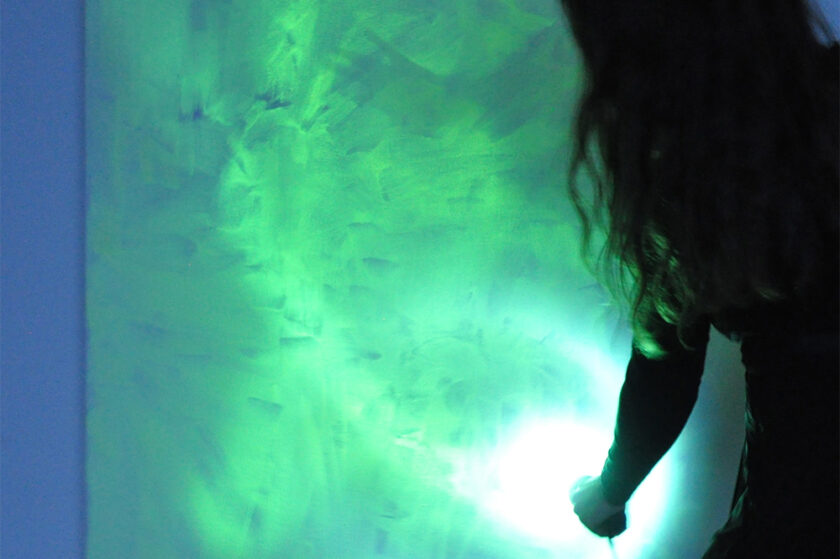
(Photo: Ulrika Eller-Rüter)