Creating space for new ideas
27.04.2021 - Aesthetic education in architecture studies
Aesthetic education in architecture studies
More than freehand drawing, color theory or form theory: in architecture studies at Alanus University, aesthetic education runs through the entire course of study. As a result, bachelor’s and master’s students alike not only acquire professional skills, but also mature personally, as Willem-Jan Beeren, Professor of Architecture and Art at Alanus University, explains in this interview.
Three questions for Willem-Jan Beeren, Professor of Architecture and Art at Alanus University of Arts and Social Sciences in Alfter/Bonn.
What do you understand by aesthetic education?
Aesthetics in the narrower sense is a form of knowledge based on sensory perception. It is about developing refined perceptual awareness and fostering competence in perception. Another aspect is simply recognizing that we are perceptive beings – something that can by no means be taken for granted today, because we tend to operate in a very intellectual way. In the second step, we also want to discover and develop creative competence in a wide variety of disciplines. In architecture, this happens primarily in relation to the design of space. In the degree program, we try to approach this as broadly as possible: from drawing and music to public interventions or performances.
How does this manifest itself concretely in the degree program?
In both the bachelor’s and the master’s program, there are accompanying courses in design and art throughout the entire duration of study. In the first semester, we begin quite classically with freehand drawing, because for our work it remains one of the fundamental skills. However, we see drawing not only as a means of expressing ideas, but more broadly as a form of engaging with the world. In the second semester, we continue with bodywork, for example through Bothmer gymnastics. Exploring the different perceptual levels of the body is a new experience for many. We offer courses in color and form theory or work with photography and video installations. In all of this, we are in dialogue with colleagues from the various departments as well as with external experts. In architecture, many things are very clearly specified, whereas these courses offer considerable freedom – also because there is no immediate pressure to produce something marketable. In addition to professional education, this approach particularly fosters personal development.
Social issues also play a role in architecture. This is reflected in your department’s projects, which often have a participatory orientation. How do you succeed in involving, for example, the residents of a neighborhood?
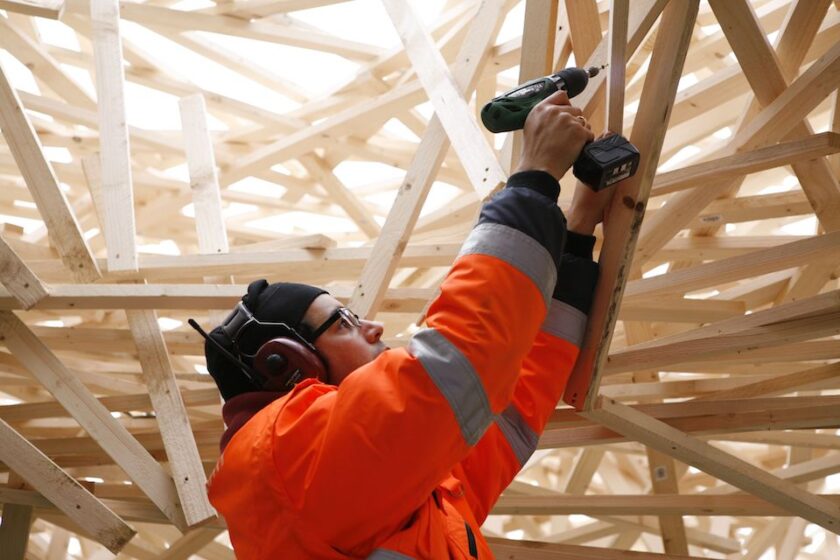
In this context, the format of temporary intervention has proven very effective for us. At the invitation of local partners, we go with students to places where processes of change are pending. At present, for example, we are in dialogue with the city of Wolfsburg, where in June we will activate a square from the 1970s in an outlying district. We want to invite the local people to take part and think together with us about how this square could be designed in the future. To this end, we already spent a week there in the fall with a group, exploring the square, building models and interviewing residents. In the next step, we then stage a starting point together. It is not yet about how the square should be designed in concrete terms, but about creating space for new ideas in the first place. To do this, we want to create something out of the ordinary in order to open people’s eyes to the potential of the square. If everything goes according to plan, we will spend a few days on site in the summer with a smaller group and work with roof battens. It is a popular material: it is inexpensive, reusable and also low-threshold, because everyone knows it and no special prior experience is needed to work with it. In this way, a kind of living sculpture is to emerge, gradually becoming denser and populating the square. We have done something similar quite often before. On the one hand, it is about an appealing image and the aesthetic impression, but just as much about the process itself. Through working together, we enter into conversation. Usually the children come first, and then they bring their parents along. Some also just sit on the sidelines, and of course some complain too – but overall our experiences have been very positive.
About the person:
Prof. Willem-Jan Beeren (born 1975) has been a registered architect since 2006 and Professor of Architecture and Art at Alanus University of Arts and Social Sciences in Alfter/Bonn since 2012. He is one of the founding members of the artist group beispielhaft.com as well as ARGE BEEREN PETRY and realizes projects in the fields of architecture, art in architecture, and public art.
(Photo: Simon Heeremann)