Architecture Meets Archaeology: Visiting the Oberkassel People
13/12/2021 - Creative and hands-on: In the Architecture degree programme at Alanus University, students repeatedly engage with concrete projects. One special example is the Rabenlay viewing platform in Bonn-Oberkassel, opened in 2017 above a विशाल rock face. The idea came from student Ido de Baat. The platform offers a magnificent view over the Rhine Valley – and draws attention to an important Stone Age excavation site.
Creative and hands-on: In the Architecture degree programme at Alanus University, students repeatedly engage with concrete projects. One special example is the Rabenlay viewing platform in Bonn-Oberkassel, opened in 2017 above a huge rock face. The idea came from student Ido de Baat. The platform offers a magnificent view over the Rhine Valley – and draws attention to an important Stone Age excavation site.
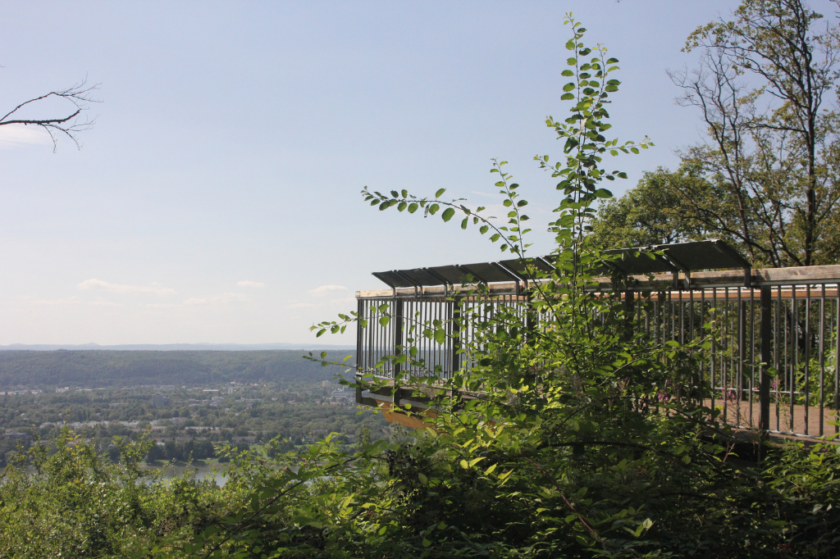
A picturesque panorama: from the left, the view sweeps across to the Drachenfels and as far as Bonn. Far back on the horizon – the Eifel. High above, right at the edge of the escarpment of the well-known rock formation in Bonn-Oberkassel, lies the Rabenlay viewing platform. Beneath the more than 100-metre-high rock face, quarry workers discovered the skeletons of a woman and a man in 1914 – both had been buried at this spot more than 14,000 years ago. To this day, the discovery of the so-called Oberkassel People is considered one of the most archaeologically significant finds from the Late Upper Palaeolithic in Germany. In the double grave, archaeologists found rare Late Stone Age works of art – including a 20-centimetre-long bone staff with a carved animal head and a roughly nine-centimetre-long figure of a female elk.
It was not until 2017 that the excavation site could also be viewed from above via the viewing platform made of wood and steel. What many people do not know: the idea for building a viewing platform came from architecture students at Alanus University in 2013. As one of the two course leaders, architecture professor Willem-Jan Beeren has a great deal to say about the project. “What was great about the project was that it was actually carried through to implementation. It is exactly what we ideally hope for; namely that our ideas on topics or projects are passed on and ultimately realised.” But how did it come about? “The LVR-Landesmuseum Bonn asked us whether we could imagine having our students think about how the site could be redesigned,” Beeren recalls. He then launched a workshop in which around ten bachelor’s students took part. An initial site visit in Oberkassel immediately made the problem with the location clear: “We quickly realised that the site is really out of the way and actually hardly visible at all,” says Willem-Jan Beeren.
Site hidden in the forest
Today, around eight years later, little has changed. Anyone setting off from the Bonn – Oberkassel Mitte tram stop and walking along the wide Franz-Kissel-Weg only comes across a stone by the roadside by chance, pointing to the Nücker Felsenweg. Yet nothing indicates that an important archaeological excavation site is located just a few metres away. After about 100 metres, the rocky path leads through the lush summer greenery of the Ennert forest to an overgrown and ageing information board marking the discovery site of the Oberkassel People. So far, so unspectacular: however, if you continue along the narrow footpath, just a few steps later you are rewarded with a breathtaking view of the steeply rising rock face.
Viewing point: student develops idea
In order to enhance the archaeological value of the location, the architecture students developed various ideas after the site visit in 2013 to make the excavation site more visible. Professor Willem-Jan Beeren: “Most of the students focused directly on the site itself and, for example, tried to draw attention to the location with signage and more attractive access paths.” Student Ido de Baat, who today runs the start-up Novalinq in Haarlem in the Netherlands, ultimately came up with the idea of drawing attention to the excavation site from above the quarry. He designed an oversized picture frame through which the view was to be directed into the quarry. De Baat wanted to incorporate information into the frame about the discovery and the living conditions of the Oberkassel People.
The various projects were ultimately presented to a commission consisting of representatives of the LVR-Landesmuseum Bonn and the relevant state authorities. One participant in this presentation was Dr Thomas Otten, Ministerial Counsellor and Head of the Department for the Protection and Preservation of Archaeological Monuments at the NRW Ministry for Building, Housing, Urban Development and Transport. The current Director of the LVR Museum MiQua in Cologne still vividly remembers the creative results of the student workshop. “However, the results showed that for various reasons no satisfactory solution could be found at the site itself,” says Otten. The commission was particularly interested in Ido de Baat’s idea: “We focused more on the viewing point above the Rabenlay, which not only offers a view of the former site but also far into the Rhine Valley.” The idea of the picture frame was then further developed and led to the design of a viewing platform.
The viewing platform was specifically planned by the Bonn-based firm “die3 Landschaftsarchitekten”. “As a university, we can have students develop ideas, but we cannot provide planning services like an architectural practice,” says Professor Willem-Jan Beeren. What was ultimately built was a curved platform of wood and steel measuring just under 9.40 metres in length. A total of 16 panels now inform visitors about the Stone Age double burial, the surrounding nature reserve, the geology, and topics relating to building culture in the region. The platform was ceremonially opened in September 2017.
Added value for architecture studies
For LVR Museum Director Otten, the platform has proved over the years to be a successful project: “From my perspective, the platform has established itself as a viewpoint on the Rheinsteig, proven its worth, gained a certain degree of recognition and achieved the most important goal: namely to make a forgotten and invisible, yet significant site known and tangible.” Numerous reviews on the internet confirm Otten’s positive impression, even if the platform and the adjacent hiking trails seemed somewhat deserted in August 2021.
What added value did the project have for students? “We were and are able to use it to show that practical and real-world topics are a central component of our Architecture degree programme,” says Willem-Jan Beeren. In addition, the project in Oberkassel impressively demonstrates that real-world topics are tackled in the Architecture degree programme right from the start. “For our students, it is of course wonderful that the work and ideas developed during their studies are taken seriously.” Beeren believes that projects at Alanus University can be realised much more quickly than at large universities primarily because of the close supervision in small study groups.
Numerous other student projects realised
As in Oberkassel, many other projects have been implemented in recent years – for example at the Freie Waldorfschule in Görlitz, Beeren reports: “In his bachelor’s thesis, one student worked on the redesign of an empty goods station for the Waldorf school. The project was then actually continued in the form of a commission and realised.” One of the most recent study projects is the construction of the so-called Workbox in the business park in Meckenheim near Bonn. In this project, two bachelor’s students worked with sustainable and renewable building materials and were able to construct the experimental house in collaboration with the Department of Architecture. The Department of Architecture regularly reports on many other projects worked on by students and partly realised in its online magazine “mag”.
A visit to the Rabenlay viewing platform is worthwhile at any time of year: the simply designed structure blends perfectly into the surrounding landscape. Along the wide, paved paths there are numerous signs and wooden barriers indicating that nature should be protected and visitors should stay on the paths. Anyone who undertakes the roughly half-hour walk uphill via Berghovener Straße and Kucksteinweg is rewarded with a magnificent view, especially on clear, sunny days. And, almost incidentally, learns something about the Oberkassel People, who found their final resting place here around 14,000 years ago.
Photos: Julian Kallabis