Learning with Head, Heart, and Hand
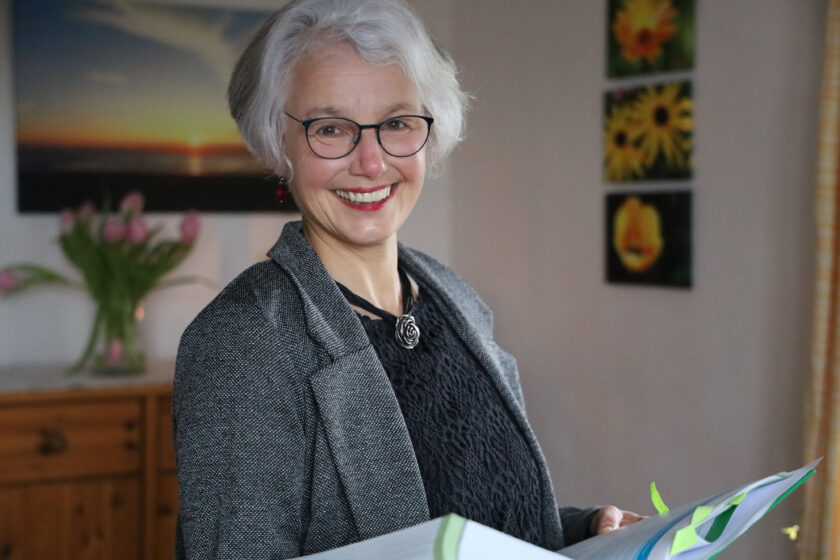
09/02/2022 - In the Bachelor's degree program in Childhood Education, students learn in small groups. Petra Lambert, an alumna of the part-time Childhood Education degree program, talks about the individual and intensive support she received during her studies, the exchange with her fellow students, and the atmosphere of the program.
In the Bachelor's degree program in Childhood Education, students learn in small groups. Petra Lambert, an alumna of the part-time Childhood Education degree program, talks about the individual and intensive support she received during her studies, the exchange with her fellow students, and the atmosphere of the program.
How would you describe the learning environment at Alanus University, and what significance did it have for your learning?
The part-time Childhood Education degree program at Alanus University is divided into weekend seminars and block weeks, which I experienced in advance as clearly structured and well scheduled. This made planning much easier for me, allowing me to balance my responsibilities in family life and work at the same time during my studies.
The seminars were each characterized by a very diverse selection of methods, which made the theoretical input feel very engaging to me. This became especially clear once again during the lockdown phase, when the individual lecturers also incorporated a wide variety of digital methods, which greatly enlivened what would otherwise have been a more tiring Zoom session. The alternation between artistic exercises that addressed a wide range of senses, theoretical input, and the inclusion of small-group or individual work made learning very varied, interesting, and invigorating for me. In this way, I was once again able to experience firsthand how head, heart, and hand were addressed equally in the learning process.
Especially during the block weeks, the content of the individual subjects was thematically coordinated. On the one hand, this made it possible for me to establish theoretical and practical connections with everyday professional life, but also to recognize the interconnections among the individual subject areas, which became increasingly condensed over time. This holistic view of the topic increasingly enabled me to adopt a bird’s-eye view of the broad spectrum of themes in childhood education, while at the same time delving more deeply into individual theories or educational approaches, questioning them more critically, and comparing them with one another. Being able to spend an entire week during the block week focusing intensively on academic topics and reflecting on them in a pleasant atmosphere felt like a “luxury” to me, almost like time out and a pause from family life and work.
Through the academically grounded education and the opportunity to become familiar with a wide range of academic theories, I was able to broaden my view of, for example, Waldorf education and better contextualize it within current academic findings, which in turn allowed me to reflect on my own educational practice from entirely different perspectives.
The degree program showed me that lifelong learning is possible at any age, can be a great deal of fun, and above all has an enormous impact on personal and biographical development.
How did you and your fellow students benefit from one another?
The varied selection of methods, learning in small groups with people from a wide range of educational fields and with very different backgrounds of experience, as well as a well-balanced age structure, contributed greatly to engaging with individual characters, learning types, and personalities on both a professional and personal level. In this way, I was able to further develop my social as well as emotional skills in the area of teamwork/self-organization, which benefited me both professionally and personally.
In addition, through exchanging ideas about different fields of work, I was able to gain new impressions, which also had a positive influence on my professional perspectives.
In particular, the many conversations among ourselves and the exchange about a wide range of learning strategies, including with younger students, were very valuable to me.
Last but not least, the sense of community, solidarity, and mutual motivation were essential in helping us master stressful times or specific challenges, persevere, keep disciplining ourselves, maintain focus on our goal, and above all develop and retain the courage and confidence needed to complete the degree program.
What makes the learning atmosphere so special?
Throughout my entire period of study, I always experienced the lecturers, as well as the staff in the secretariat and the examinations office, as very supportive. Whether it was a matter of a wide range of questions about organizing my studies or the need for subject-specific academic advice, I always found someone willing to listen. In this way, I was able to see how individual solutions were developed when it became complicated to balance work, studies, and family. A brief conversation with lecturers or fellow students dispelled doubts or the occasional feeling of being overwhelmed. In one-on-one conversations in particular, I was often met with a natural sense of appreciation. Overall, this gave me the feeling of not being just some anonymous student among many, but of being taken seriously as a person and, above all, being seen as an equal.
However, this sense of community was not limited to the specific year group of the Childhood Education course alone; I also felt it time and again across semesters and subjects, whether in brief personal encounters in the cafeteria or in the library. In particular, I found the many conversations and exchanges with students from other degree programs in the Studium Generale seminars personally enriching.
The experiences and encounters during my time studying have left me with a relaxed and family-like image of Alanus University, which I look back on very fondly despite some demanding phases.