What does Eva Paul actually do?
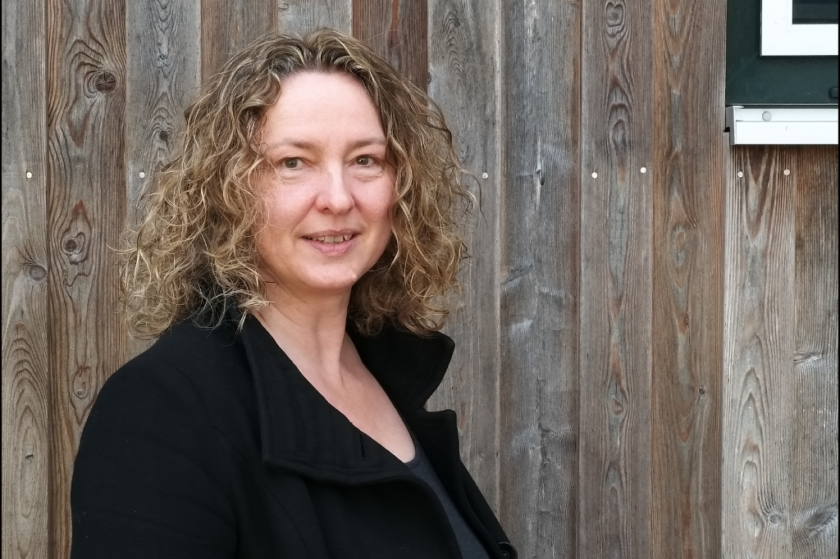
21.02.2022 - “Empowering people, through the creative means of art, to cope independently with crises and illnesses and to experience agency and self-efficacy in a lasting way!” To make this possible, Eva Paul studied art therapy and education, and later psychology as well. After numerous professional positions, including at universities and clinics, she is now Professor of Art Therapy and Dean in the Department of Artistic Therapies and Therapy Sciences at Alanus University of Arts and Social Sciences. In this interview, Eva Paul explains how she came to the university in Alfter, which project she is currently working on, and why she enjoys teaching.”
“Empowering people, through the creative means of art, to cope independently with crises and illnesses and to experience agency and self-efficacy in a lasting way!” To make this possible, Eva Paul studied art therapy and education, and later psychology as well. After numerous professional positions, including at universities and clinics, she is now Professor of Art Therapy and Dean in the Department of Artistic Therapies and Therapy Sciences at Alanus University of Arts and Social Sciences. In this interview, Eva Paul explains how she came to the university in Alfter, which project she is currently working on, and why she enjoys teaching.”
How long have you been at Alanus University? And what are your responsibilities?
Since February 2020, I have been part of the team in the Bachelor’s degree program in Art Therapy/Social Art. As Professor of Art Therapy and Deputy Head of the degree program, I help shape many course contents. The focus of my teaching lies in the theory-practice seminars on the foundations and methods of art therapy (in painting and sculpting), as well as diagnostics and practice (internship modules, supervision). Recently, I also took on the role of Dean in the Department of Artistic Therapies and Therapy Sciences and am delighted to help shape the department at this level and contribute my expertise. At the university level as well, I am able to support the vibrant processes of change in various functions.
How did you come to the university?
Looking back, I can say that I have always enjoyed teaching and passing on knowledge. When, as a preschool child, I learned numbers and was able to do simple addition and subtraction, I was so fascinated that I immediately wrote these digits and equations on large sheets of paper and put them into the mailboxes in my village. I believed that this “incredible discovery” should be shared with everyone. My career aspiration toward art therapy also emerged very early, while I was still at school, out of the need to bring together my artistic, educational, psychological, and medical interests and unite them with my love of humanity, society, and nature. Even then, the connection between theory and practice was very important to me. After studying art therapy and education at the University of Applied Sciences in Ottersberg, during which I had my first daughter, I worked in private practice, started teaching early on, studied psychology in Bremen, and worked for many years at the clinic there as a qualified art therapist and psychosocial specialist. My focus there was pediatric oncology, palliative care, and psychosomatics. Since involving the family system was essential in working with children and young people, and because team processes interested me greatly, I completed further training in systemic therapy and counseling in Heidelberg. Systemic work has shaped me ever since, both professionally and personally. It is an excellent complement to art therapy because it, too, is concerned with creativity—that is, with generating new abilities and perspectives and, above all, with self-efficacy.
After many years of practice and teaching, I found at Alanus University a place where I can contribute my wealth of experience well and where I myself feel that I acquire more knowledge every day. I value this aspect of lifelong and vibrant learning very highly. It is also a defining feature of the part-time BA in Art Therapy/Social Art.
I experience Alanus University as a very special place, with its history, its diverse departments, and its foundation of holistic thinking and sustainable action.
What are you currently working on and researching?
Since I came to Alanus University shortly before the pandemic, I experienced firsthand the challenges of this new situation for all of us and recognized the enormous creative potential in this crisis. In the part-time Bachelor’s degree program in Art Therapy/Social Art, our team developed an online project to support our students during the lockdown—using artistic means. This led to student groups on different topics that acquired social-artistic and art-therapeutic online teaching skills in order to make the strengthening and connecting power of art available to an interested public. This a.l.s o.b project had an immediately tangible positive effect, so we developed a three-part study from it, which took place during the second lockdown. We were able to complete this research project last year, and it will be published shortly. We are currently taking our online project international, which is interesting and forward-looking both in practical and academic terms. The next major project will be research within anthroposophic art therapy, because there are many valuable approaches here that are waiting for a scientific foundation and should be examined in the context of other art therapy approaches in order to develop their full potential. This is a central topic, also with regard to research projects: it cannot be done alone, neither in academia nor in the context of successful projects and processes of change.