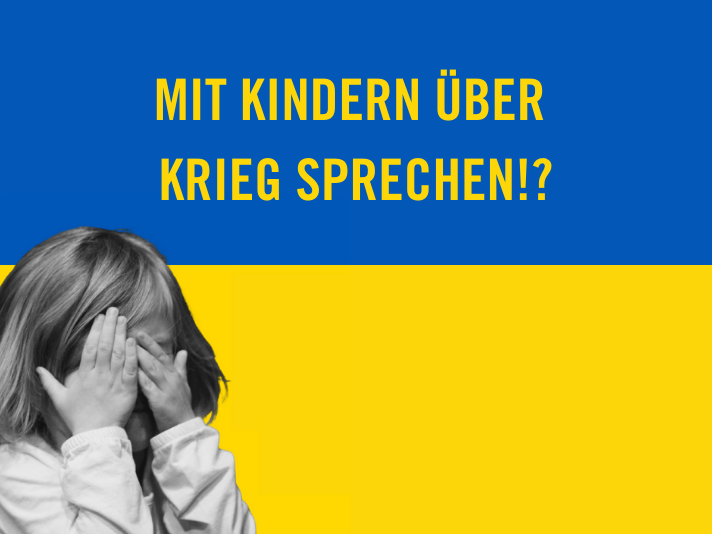
“Talking to Children About War!?”
05.04.2022 - What matters
What matters
Current events in Ukraine are confronting many parents as well as educators with a previously unknown challenge: How do I talk to children about the topic of “war”? Stefanie Greubel, Professor of Childhood Education and Vice Dean of the Department of Educational Sciences, and Lisa Butz, childhood educator and long-standing staff member in the Department of Educational Sciences, responded quickly to the new demand and organized an online forum on the topic at the beginning of March: “Talking to Children About War!?”
A few weeks ago, you held the online forum “Talking to Children About War!?”. The reason is obvious—but what was one key insight from the event?
Stefanie Greubel (SG): Almost 400 people took part in the online event. Many parents as well as people working in education are facing the major challenge of speaking appropriately with children about the current situation and are looking for guidance. The participants’ contributions showed that children have very sensitive antennae for adults’ moods and fears and, in some cases, ask specific questions and voice concrete concerns. In dialogue with practitioners, it was emphasized how important it is to address these concerns and answer questions in a child-appropriate way. At the same time, however, we also warned against portraying war in an overly graphic and detailed manner. Everyday family life should not be dominated by these topics.
Lisa Butz (LB): What especially stayed with me was that some parents reported that their children were playing war. Adults have a major influence on children’s perceptions and opinions through the language they use. We have to be careful that children do not develop racism because they pick up phrases like “the Russians” or “the Ukrainians” and generalize, seeing one group as good and the other as bad.
What are the particular challenges adults face in dealing with the topic of war?
SG: Current events also leave us adults with a feeling of shock and helplessness. Children sense this uncertainty, and many adults tend to share their worries without filtering them. However, this can quickly overwhelm children. It is better to pay close attention to what is affecting the children so that you can respond to it specifically. Children urgently need a sense of security in order to build trust in themselves and their environment. It is therefore important to ensure a supportive environment in which responsibility for and solutions to the situation rest on the shoulders of adults, allowing children an emotionally safe space.
LB: Every person processes such a terrible situation differently. Some adults are in shock and do not know how to deal with it, some suppress these facts, and others inform themselves every day and actively help. We should be aware that children also deal with it very differently: some speak loudly about what is on their minds, some children may not seem affected by the situation, while others may only be processing it internally and we notice nothing at all. When processing the situation ourselves, we should always keep an eye on the child as well. Is the child really not affected by the situation just because they are not talking about it, or are they perhaps expressing their processing through play or in pictures?!
To what extent does communication about the war differ with younger and older children? What should parents pay particular attention to?
SG: The decisive factor is, first and foremost, the children’s individual level of concern. Do they have contact with older children or even refugee children? Do they have specific questions or fears? Parents should take a close look here and respond accordingly. Kindergarten children do not need detailed information or special news programs. However, questions that are asked should be answered in simple words and with examples from everyday life (“sometimes there are serious arguments”). With older children as well, attention should be paid to the impulses they provide, and the amount of information should be regulated accordingly. As a general rule: take time and take the children seriously, present the facts calmly, and emphasize that adults will take care of this problem. It is equally important to explain that people cannot be labeled bad or good solely because of their origin and that something active can be done through donations or other forms of helpfulness. Overall, both parents and educators are well advised to deal with the challenge in a self-reflective and self-calming way and, if possible, to maintain a normal everyday life.
LB: The older the children are, the better they can understand the connections, and the more interested they are in the world and their surroundings. If we adults are unsure in our explanations and struggle to explain something, it is also okay to tell our own child that we do not know the answer exactly either. News for children should be critically reviewed by parents in advance. Although such formats explain what is happening in a child-appropriate way, children should always be accompanied when watching or reading them so that they can ask follow-up questions. Parents should also bear in mind that this may raise even more questions and could be emotionally upsetting. Discussing this with educators in daycare and school can be valuable support.