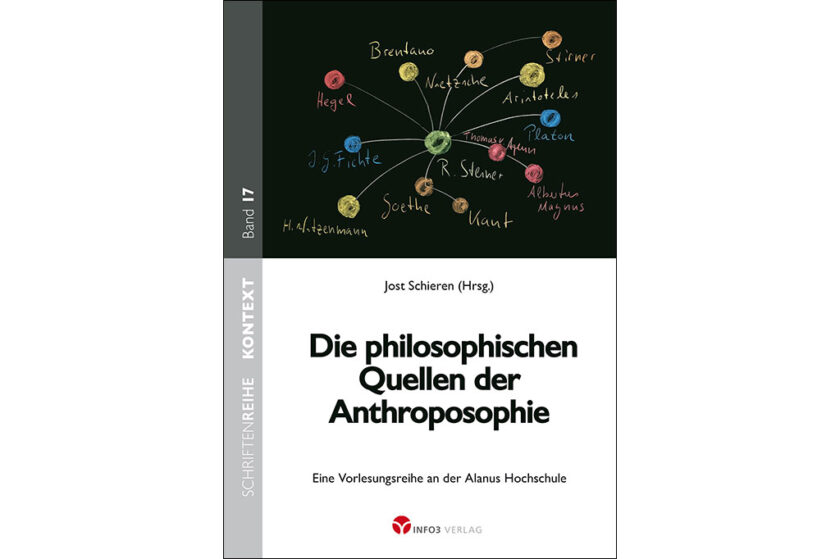
“The Philosophical Sources of Anthroposophy,” New Publication from Info-3 Publishing
03.05.2022 - The authors build a bridge between Anthroposophy and Western traditions of thought.
The authors build a bridge between Anthroposophy and Western traditions of thought.
Five questions for editor Jost Schieren, Professor of School Pedagogy with a focus on Waldorf Education at Alanus University
The book “The Philosophical Sources of Anthroposophy” contains numerous contributions, including those by Hartmut Traub, Wolf-Ulrich Klünker, Axel Föller-Mancini and David Marc Hoffmann. Drawing on major figures in the history of philosophy such as Aristotle, Thomas Aquinas, Kant, Fichte, Nietzsche, Brentano, Husserl, and others, both connections and differences with Rudolf Steiner’s philosophical thought are identified and discussed.
“Anthroposophy is to be read philosophically in this new book.” Could you elaborate on that a little?
Today, Rudolf Steiner is primarily perceived in connection with Waldorf schools, biodynamic agriculture, and anthroposophic medicine. These so-called fields of practice have, to varying degrees, become established components of our society—including in a global context. Yet while the practice of Anthroposophy is quite successful, the theory behind it is understood merely as a crude esoteric worldview. In the process, people overlook the fact that Rudolf Steiner’s Anthroposophy (and his esotericism) also has an original philosophical and scientific core that deserves closer examination. Rudolf Steiner associated Anthroposophy with a scientific claim that, in my view, has still been taken up and further developed far too little. In public discourse, and unfortunately also among many of its representatives, Anthroposophy is treated more as an esoteric doctrine of belief. By contrast, Rudolf Steiner’s philosophical approach has been and continues to be largely neglected. In doing so, one misses the opportunity to recognize and discuss an exciting, deeply humanistic, and enlightened philosophical standpoint in the context of the history of Western philosophy. That is exactly what this publication is about.
With this publication, you connect the aspiration to build bridges to the Western tradition of thought. How do the authors achieve this?
It is indeed the case that Rudolf Steiner tends to be perceived as a solitary figure—both within Anthroposophy and outside of it. The authors of this book overcome this view by showing in their individual studies how Rudolf Steiner can be directly situated within Western traditions of thought and that there are numerous and complex connections to important philosophical themes: for example, conceptual or spiritual realism, concepts of the self and theories of personality, phenomenology, and Enlightenment philosophy. Here, points of connection can be established, but divergences from Steiner’s positions can also be found. These are discussed and explored in the book.
Which important philosophical or anthroposophical points of connection would you particularly emphasize?
At the center is certainly Steiner’s concept of freedom, shaped by the conviction of the autonomous developmental capacity of every individual human being. This is a humanistically grounded concept of individuality with a high ethical standard, and one that is also significant for the practical fields of Anthroposophy. Beyond that, Steiner’s concept of thinking, his epistemology, and his monistic understanding of reality deserve emphasis. In this view, human cognition and human consciousness are not separated from the world in a dualistic way; rather, the human being and the world (especially nature as well) are integral components of one reality that is constitutively brought forth in cognition. This also has consequences for a new ecological awareness.
To what extent does the book discuss the uniqueness of Steiner’s transmitted body of work?
Rudolf Steiner’s Anthroposophy is rightly understood as a spiritual worldview. Now, with the Enlightenment, we have, so to speak, scientifically overcome and also abolished spiritual-mystical worldviews. In Kant’s sense, rationality and spirituality belong to two different realms. One belongs to the world of science, the other to the world of faith and religion. This separation is also strictly implemented socially. Steiner, however, presents a spiritual worldview that at the same time lays claim to scientific validity. That seems to run counter to the project of the Enlightenment. Yet this is precisely what is interesting and new in Steiner’s approach: thinking rationality and spirituality together, creating a symbiosis here. In the end, this leads to a spirituality that is meant to be rationally reflected and scientifically validated, and to a rationality that is spiritually expanded. The philosophers of German Idealism, especially Schelling and Hegel as well, had already thought in this direction.
In what context should Anthroposophy be placed today? What would be the gain for our time?
I think that Anthroposophy is not viable outside a scientific context. That is precisely its concern, and so far it has not been taken up strongly enough. Anthroposophy offers perspectives of meaning that are widely sought today. It presents integral ways of seeing in which the human being and nature are conceived as a unity. It offers holistic models of thought and action that are called for in economics, education, and ecology. And at its center is a productive, creative image of the human being that assigns a central place to artistic activity and aesthetics. Since all of this also represents ideals and educational aims of Alanus University, I am pleased that the studies in this book were presented for the first time as part of a lecture series at Alanus University.
Jost Schieren (ed.)
The Philosophical Sources of Anthroposophy
A lecture series at Alanus University
(Kontext Series, Volume 17)
Info3 Publishing, Frankfurt am Main 2022
344 pages, paperback, €24.90
ISBN 978-3-95779-157-3