Redrawing the Economy – Alanus University goes Documenta!
06.10.2022 - What are business administration students doing at Documenta? And what does that have to do with sustainability, the common good and commons? Students of Business Administration at Alanus University of Arts and Social Sciences explored these questions at Documenta fifteen on the weekend of 10 and 11 September 2022.
What are business administration students doing at Documenta? And what does that have to do with sustainability, the common good and commons? Students of Business Administration at Alanus University of Arts and Social Sciences explored these questions at Documenta fifteen on the weekend of 10 and 11 September 2022.
“We know that economic activity cannot be profit-oriented alone if it is to remain viable for the future. What interests us about Documenta is the ideas art offers on sustainable economic activity. So it is about how business and art can complement one another. And we will certainly benefit from the freedom that art provides,” says Kathrin Böhm, Professor of Art in the Corporate Context at Alanus University in Alfter near Bonn.
Community-oriented collective economic activity, under the guiding concept of “Lumbung,” was at the heart of this year’s Documenta, curated by the ruangrupa collective. In their home country of Indonesia, this refers to a rice barn in which surplus harvests are stored and managed collectively. According to Kathrin Böhm, this unique intersection between Documenta as the world’s most influential art exhibition and the Department of Economics at Alanus University, which focuses on sustainability and the synergies between business and art, was the deciding factor for the excursion to Kassel.
In her personal travel report, Kathrin Böhm explains what is special about Documenta fifteen and what lies behind the “Lumbung” principle:
Business Administration goes Lumbung
Documenta is a non-profit limited liability company, a significant cultural and economic institution that has grown since 1955 and invited the artist group ruangrupa from Jakarta as the curatorial team for Documenta fifteen. This year’s exhibition was organized under an economic motto and structured accordingly: Lumbung. Lumbung is the Indonesian term for a collectively managed rice barn governed by principles of collectivity and fairness—in other words, an economic practice oriented toward social, ecological and economic sustainability. This is a radically new approach compared with previous Documenta exhibitions, which primarily presented social issues but did not necessarily implement them on a one-to-one scale.
Key questions that we also addressed in our module “Art is not an Island” in the bachelor’s degree program “Rethinking Economics” are: What does it mean to implement Lumbung within the institutional framework of Documenta? How can the collectively managed rice barn be integrated into the established processes of a non-profit limited liability company? How will artistic practice change operational processes? So where, exactly, does art sit and how does it operate in a corporate context? This made it clear to us as early as May that we wanted not only to understand and analyze Documenta as a practical example, but also to participate in this economic experiment on site.
Drawing Doulas in Kassel
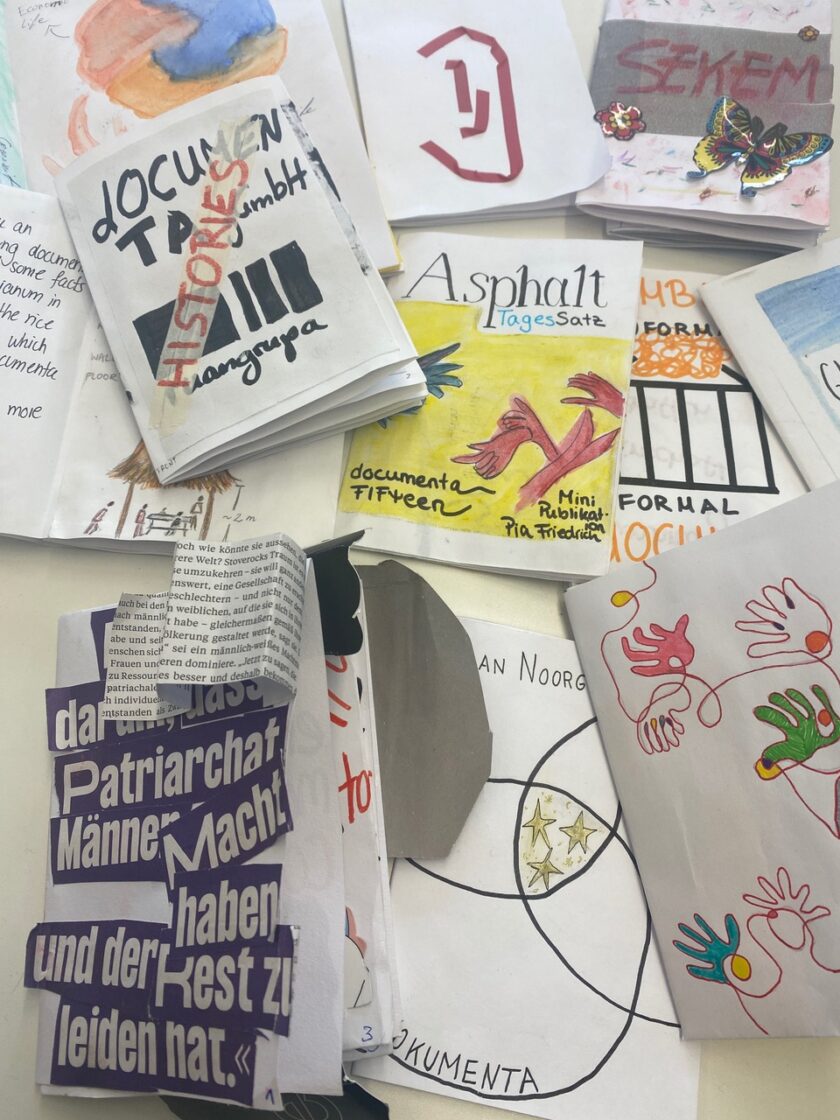
Equipped with our self-produced “Re-drawing the Economy” booklet, we set off for Kassel as Drawing Doulas. Drawing Doulas are people who support others in recognizing and documenting their own economic competence and diverse forms of economic activity. We chose this approach because much economic competence that takes place outside the market is neither recorded nor perceived as successful.
In addition to the art campaign, the students also used their time in Kassel for networking and engaged with the current criticism surrounding Documenta. They also met members of ruangrupa as well as other local actors for whom collectivity, the common good and economic viability are central concepts: Upländer Bauernmolkerei, Kommune Niederkaufungen, Kulturzentrum Schlachthof and Frauentreff Brückenhof.
Art as a regenerative system
Ruangrupa itself also uses drawing and drawings to make the principles of Lumbung accessible to a broader audience*. Until now, the proceeds from trade surrounding Documenta flowed back exclusively into private hands such as commercial galleries or individual artists. At the end of Documenta, the art was sold and the money distributed. This time, the shared profit will secure a collective future for Lumbung. The production and sale of the exhibition are being used to initiate a regenerative system, and the exhibition is no longer the end, but the beginning of an artistic movement. These and many other aspects make this year’s documenta an important economic event. Lumbung will continue.
* Documenta has 1 million visitors