INASTE Congress 2025 “Human Intelligence”
11/06/2025 - New Perspectives on Educational Challenges
New Perspectives on Educational Challenges
From 22/05 to 24/05/2025, the fifth international congress of the International Network of Academic Steiner Teacher Education (INASTE) took place in Vienna. Members of academic institutions offering Waldorf education degree programmes met from all over the world to discuss, under the heading “Human Intelligence,” the significance of what is specifically human in an age of crises, machine learning, and AI, and to derive from this tasks for education and, in particular, Waldorf education.
The international orientation of the congress and the many contributors from a wide variety of institutions among the 21 INASTE members broadened the horizons of everyone involved and opened up a global perspective on current educational challenges. The participating researchers, university lecturers, and students were able to experience how the academic engagement with the current and future orientation of Waldorf education is part of contemporary discourse, as was demonstrated, among other things, by guest lectures from Gert Biesta (Maynooth University, Ireland & University of Edinburgh, UK) and Thomas Fuchs (Heidelberg University).
The Department of Educational Science at Alanus University was broadly represented with several contributions
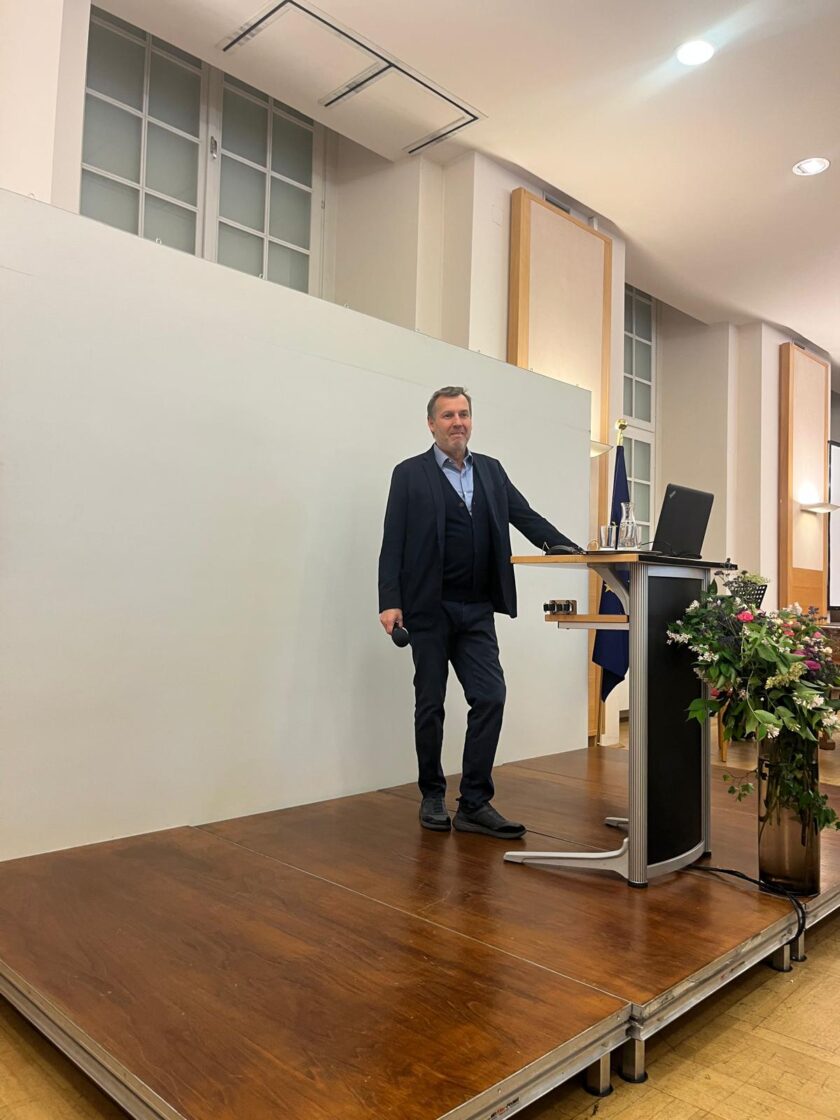
As keynote speaker, Jost Schieren, Dean of the Department of Educational Science, gave a plenary lecture on Rudolf Steiner’s view of human thinking. Under the title “The Reality of Thinking: Rudolf Steiner’s Concept of Intelligence and Its Relevance for Education,” he introduced some of the basic motifs of Steiner’s epistemology and concept of reality, which places the human capacity for freedom at the forefront.
Paula Bleckmann, Professor of Media Education, contributed to three presentations. In two contributions, together with colleagues, she explained various aspects involved in developing a media education concept for improved media literacy in the European research project HERMMES. In another contribution, she addressed the differences between the computing power and associative capacity of machines on the one hand and human intelligence and understanding on the other.
Stefanie Greubel, Vice-Rector of Alanus University and head of the Childhood Education degree programme, presented, together with former Alanus professor Janne Fengler (University of Luxembourg) and Jost Schieren, results from their jointly conducted quantitative study on sustainability attitudes and sustainable behaviour among pupils of the so-called Gen Z with and without a Waldorf background.
Further contributions were given by Thomas Schmaus on the topic of concreativity, by Philipp Gelitz on implicit sensory learning, by Martyn Rawson on judgment and AI, by Julia Kernbach on media education in teacher training, by Belle Leung on Waldorf education and resilience, by Benjamin Streit on attitudes related to media education, by Marcelo da Veiga on questions of cognition in anthroposophy, and by Wilfried Sommer on the role of the body in education.
Numerous students from Alanus University also took part in the conference from the degree programmes in Childhood Education, Waldorf Education, and Practice Research, thus gaining direct insight into current discourse within their department.
Further information at https://www.inaste.net/.
Subscribe to our newsletter!
Receive selected events and news from Alanus University directly in your inbox every month.