When a Village Helps Shape Things
17/10/2025 - Alanus art project “intertwined and interwoven” by Prof. Dr. Ulrika Eller-Rüter’s class in Roșia, Romania
Alanus art project “intertwined and interwoven” by Prof. Dr. Ulrika Eller-Rüter’s class in Roșia, Romania
In the Romanian village of Roșia in Transylvania, art has become a shared language. Prof. Dr. Ulrika Eller-Rüter of Alanus University of Arts and Social Sciences in Alfter/Bonn conceived, initiated, and implemented the art project “intertwined and interwoven” together with students from her class. During a study trip in September 2025, Victoria Betzing, Julia Engler, Mia Jansen, Seline Reber, and Elena Wolff transformed House No. 197 into a vibrant place of encounter.
The population of Roșia has been divided for centuries, something that is reflected even in the topographical structure of the different residential areas. The upper village is inhabited predominantly by older Romanians, while the so-called lower village is home to Roma who were forced to settle under Ceaușescu and who, as a population group, have experienced discrimination for centuries. They mostly live in extended families with many children and low incomes in one-room houses and must cope with everyday life in poverty.
Working together with textiles
With the art project “intertwined and interwoven,” Ulrika Eller-Rüter and her students invited children, young people, mothers, and grandmothers from both parts of the village to work together with textiles in House No. 197 and create communal weavings. While the Roma women, full of a spirit of experimentation, used piles of fabric remnants to create textile pictures, objects, and collages, the Romanian widows knitted, embroidered, crocheted, and made lace in the traditional manner of handicraft. From the many individual and diverse fabric objects, the team of women artists from Alanus University ultimately composed three large wall hangings.
“Even if cultural boundaries, centuries-old prejudices, and the racism of the Romanian population toward the Roma cannot be overcome all at once by such a project, a connection has in fact been created materially as a fabric in which everyone participated and wove shared ‘threads,’” Ulrika Eller-Rüter explains. One of the textile works became a central component of the exhibition at Studio 36 in Sibiu, complemented by the drawings, paintings, and prints that the students from Alfter had brought with them.
Focus on female perspectives
“The art project also acquired a feminist note, even though this was not specifically intended, because almost only women took part,” says Eller-Rüter. “And what happened? The so-called women’s stuff, working with textiles and typical needlework, was elevated into compositions through experiments with the material and in the three tapestries. The lace tablecloth, the fragment of a garment, and the brightly colored, pop-style fabric suddenly became pictures. Moreover, through the weaving, those involved truly crossed the boundaries between the upper and lower village, old and young, poor and well-off.”
During the course of the project, the façade of House No. 197 also received a new look. Together with individual villagers, the students created colorful images from Romania’s plant and animal world under the direction of Julia Engler. The house can now be seen from afar and stands as a symbol of creativity and joie de vivre. And the project continues beyond the trip itself, as the villagers will keep using the house as a platform for communication and creativity.
Funding through the PROMOS program
The study trip to Romania received financial support from the International Office of Alanus University within the framework of the PROMOS program. PROMOS is a program of the German Academic Exchange Service (DAAD), funded by the Federal Ministry of Education and Research (BMBF), that enables students to gain international learning experiences. “We were delighted by the intercultural focus of the trip, which opened up new perspectives for the participating students,” says Leoni Bremer from the International Office. “Projects like this sustainably strengthen international networking and artistic diversity at Alanus University.”
Many years of project work in Roșia
As early as 2008 to 2020, Ulrika Eller-Rüter had already implemented an EU-funded art project in Roșia as part of the COMENIUS program. Together with the sociologist and then Alanus professor Michael Brater, she developed a concept entitled “What Can Art Do? Art Projects Support Disadvantaged Pupils” (KUSCH), which prevailed over 450 other applications and received funding of 200,000 euros. This participatory project resulted in extensive wall designs that can still be seen today at the Hans Spalinger Waldorf School in Roșia. They remain well preserved and bear witness to the lasting impact of arts-based educational work.
Project lead: Prof. Dr. Ulrika Eller-Rüter
Participating artists: Victoria Betzing, Julia Engler, Mia Jansen, Seline Reber, Elena Wolff
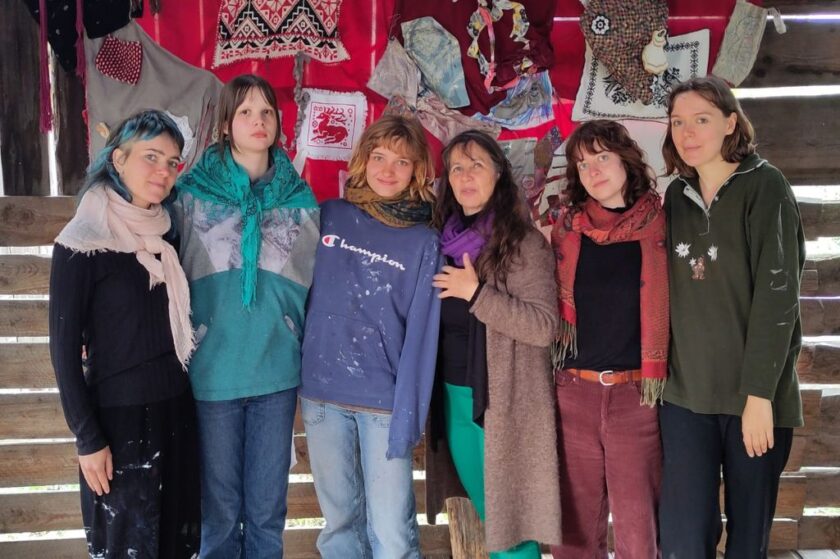
Group photo from left to right: Seline Reber, Victoria Betzing, Julia Engler, Ulrika Eller-Rüter, Elena Wolff, Mia Jansen
Photos: Ulrika Eller-Rüter
Subscribe to our newsletter!
Receive selected events and news from Alanus University directly in your inbox every month.
→ sign up now
 Ulrika Eller-Rüter